


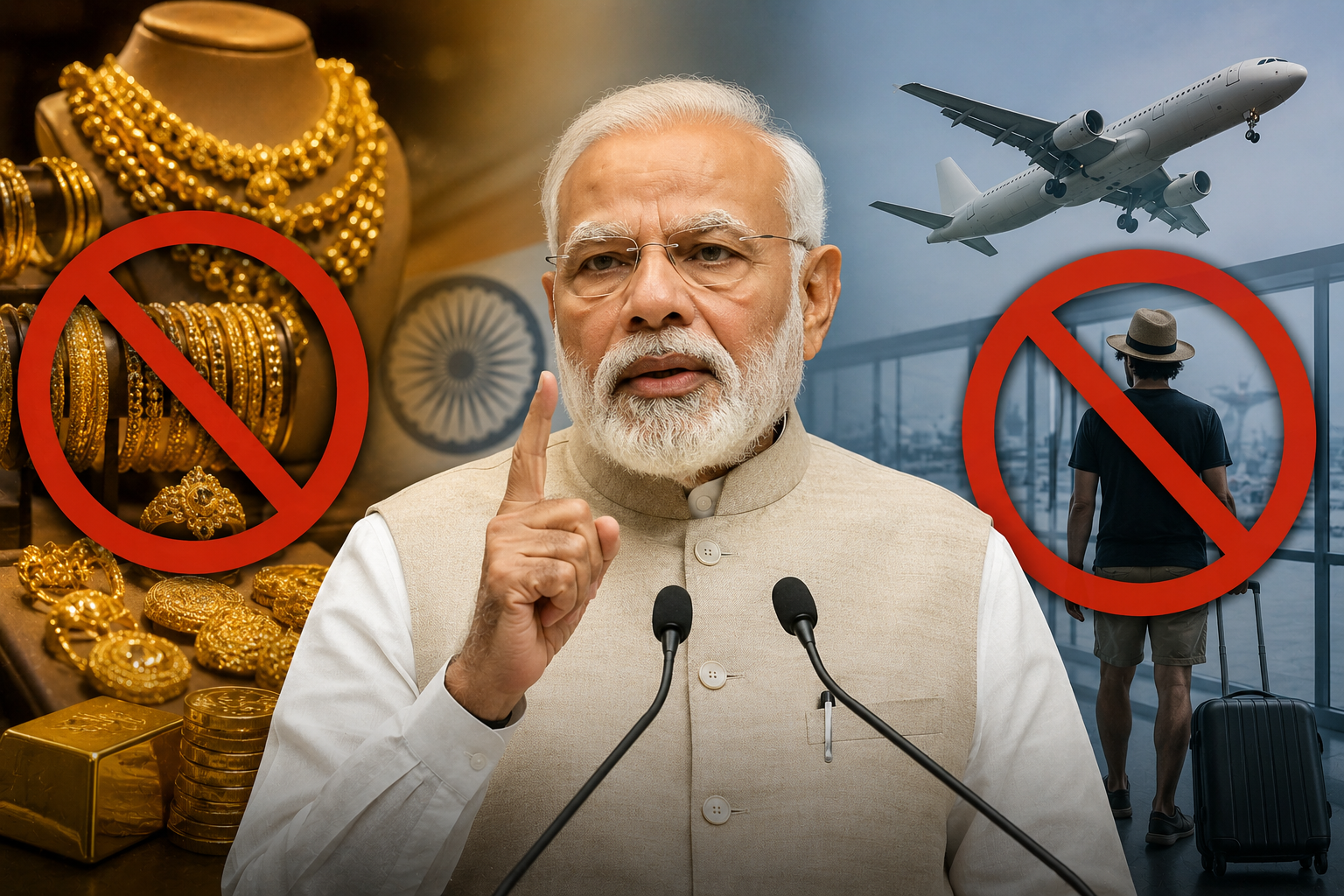
Over the last few days, short clips of Prime Minister Narendra Modi saying “don’t buy gold for a year, postpone foreign travel” have gone viral on Indian social media. Many people heard it as a moral lecture, a savings tip, or even an attack on middle‑class aspirations. But behind the soundbite lies a serious macro story about foreign exchange (forex), the rupee and India’s import bill in the middle of a war‑driven energy shock.
India today is spending heavily in dollars not just on oil and fertilisers, which are hard to cut, but also on discretionary imports like gold and leisure foreign travel, which are easier to postpone without threatening growth or food security. PM Modi’s appeal is essentially a call for “economic patriotism”—a request that households temporarily dial down some dollar‑intensive habits so that the country can conserve its buffers while global risks are high.
This article unpacks the real reasons behind the appeal, how gold and foreign travel affect India’s economy, and what it means for households and investors.
What exactly did PM Modi say?
Speaking at a public meeting in Hyderabad in early May, PM Modi urged Indians to:
- Reduce non‑essential foreign travel and destination weddings.
- Postpone buying gold for at least a year, especially for festivals and weddings.
- Cut fuel use by using public transport, car‑pooling and reviving work‑from‑home and virtual meetings.
He framed this as a seven‑point advisory during a time of war‑driven uncertainty in West Asia, explicitly linking it to conserving foreign exchange, lowering the import bill and keeping the economy resilient.
Key lines from the appeal, as reported:
- “We have to save foreign exchange by any means,” he said, asking people to postpone gold purchases and foreign vacations for one year.
- He called this a form of “patriotism in everyday life”—not just sacrifice at the border, but conscious choices in consumption.
Crucially, this is not about India running out of dollars—RBI data show forex reserves of around $691 billion at end‑March 2026, enough for nearly 11 months of imports. Instead, it is about reducing pressure on those reserves and on the rupee at a time when several big bills are due at once.
Why gold and foreign travel were singled out
India has several large, structural dollar drains:
- Crude oil and LNG imports.
- Fertiliser imports (especially urea).
- Gold imports.
- Outbound tourism and foreign card spending.
Of these, the government has limited short‑term flexibility on oil and fertilisers:
- India imports around 85–89% of its crude oil needs, and recent West Asia tensions have sent prices from about $70 per barrel a year ago to well over $110.
- India is also the largest urea importer in the world, bringing in about 10 million tonnes last year, which cannot be cut sharply without risking farm output and rural incomes.
That leaves gold and foreign travel as areas where consumer behaviour can be nudged without threatening basic economic functioning.
The scale of gold and travel spending
Recent data show:
- India’s gold imports hit an all‑time high of $71.98 billion in 2025‑26, up from $58 billion in 2024‑25 and $45.54 billion in 2023‑24, even though physical volumes actually fell slightly—prices drove the bill higher.
- Gold now accounts for over 9% of India’s total imports, with Switzerland, UAE and South Africa as key suppliers.
- Outbound travel is also booming: around 30.9 million Indians travelled abroad in 2024, rising to 3.27 crore in 2025, with Indians spending roughly ₹2.72 lakh crore (about $32–33 billion) on international travel in 2023‑24.
Al Jazeera notes that, in 2023–24, Indians spent $31.7 billion abroad according to one travel‑insurance provider, and that figure is still rising. Put together, oil, gold, fertilisers and outbound tourism drained well over $240 billion from India in a single year.
In this context, asking households to pause purely discretionary gold purchases and delay foreign holidays for one year is a targeted way to shave billions off dollar outflows.
How gold imports hurt the rupee and current account
India loves gold, but from a macro perspective, the timing of this love affair matters.
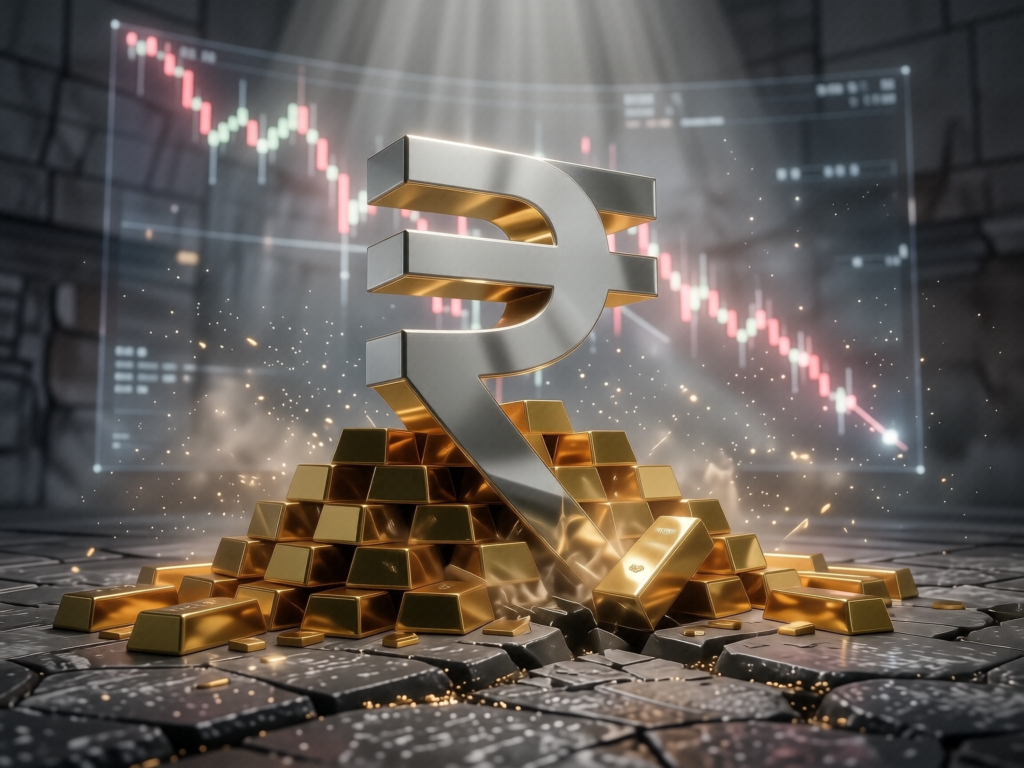
Gold’s growing drag on the current account
Analysts estimate that in Q2 FY26:
- India’s current account deficit (CAD) widened to about $12.3 billion, or 1.3% of GDP, up from 0.3% in the prior quarter.
- A key driver was a merchandise deficit spike led by gold, with imports of the metal surging nearly 150% quarter‑on‑quarter to around $19 billion in just one quarter.
Over the full year 2025–26:
- Gold imports rose 24% to $71.98 billion, despite volumes dipping—because dollar prices soared.
- Economists point out that this has pushed the overall trade deficit to about $333.2 billion, with gold alone forming a significant slice of that gap.
A wider CAD is not automatically a crisis, but financing it requires either foreign capital inflows or use of reserves. When global risk appetite is shaky and bond yields are high, relying too heavily on inflows becomes risky.
The vicious cycle: gold, dollars and the rupee
The Indian Express explains the feedback loop PM Modi is trying to break:
- India produces very little gold domestically; almost all of it is imported using dollars.
- When households and jewellers import more gold, dollar demand rises, putting downward pressure on the rupee.
- A weaker rupee makes both gold and oil even more expensive in rupees, which can encourage more gold buying as a “protection”, especially during uncertainty.
- This can become a self‑reinforcing spiral: earlier gold imports help weaken the rupee, which then makes future gold purchases costlier in rupees.
RBI has been adding gold to its own reserves as a diversification move—purchasing about 168 tonnes over the last year and taking official holdings to around 880 tonnes, or about 16% of total forex reserves, up from 10% a year earlier. That is a policy choice about how to store reserves, not about household consumption.
By contrast, consumer gold imports directly increase the CAD, without improving the country’s ability to defend its currency in the way RBI’s reserve accumulation does.
Outbound tourism: A growing, discretionary dollar leak

Foreign travel is the other big lever PM Modi called out.
- According to Al Jazeera and Indian tourism data, about 30.9 million Indians travelled abroad in 2024, rising to 3.27 crore in 2025.
- Indians spent roughly ₹2.72 lakh crore on international travel in 2023‑24, through tickets, hotels, shopping and overseas card spends.
- Acko, a travel‑insurance company, estimated outbound spending at $31.7 billion in 2023–24 alone.
Unlike oil and fertilisers, foreign holidays and destination weddings are purely discretionary; postponing them does not hurt long‑term growth, and some of that spending can be redirected to domestic tourism and consumption.
From a forex perspective:
- Every foreign vacation is, in effect, an export of Indian purchasing power—rupee savings are converted to dollars and spent abroad.
- In a year when oil and fertiliser bills are already high due to the US–Iran war and Strait of Hormuz disruptions, this additional leakage magnifies the pressure on the rupee and reserves.
That is why the PM’s appeal specifically urged middle‑class families to defer overseas trips and weddings for a year and “vote with their feet” inside India instead.
But aren’t India’s forex reserves strong?
Yes—and that’s precisely why the government wants to keep them that way.
- RBI’s latest reserves report pegs forex reserves at about $691.11 billion at end‑March 2026, enough to cover nearly 11 months of imports—one of the strongest positions among major emerging markets.
- Even so, recent quarters have seen BoP‑driven drawdowns when CAD widened and capital inflows slowed, with one quarter alone seeing a $10.9 billion reduction in reserves on a BoP basis.
International institutions like the IMF project that India’s CAD could reach around $84 billion by 2026, highlighting the risk of spending more foreign currency than we earn through exports and remittances over time.
PM Modi’s message is essentially: “Don’t wait for stress to show up before tightening belts; act now while buffers are strong.”
How businesses and markets are reacting
India Inc’s response
Large corporates have broadly endorsed the spirit of the appeal:
- At a CII summit, Bharti Enterprises chairman Sunil Bharti Mittal said industry should “get away from this obsession of importing gold,” lower energy costs, move faster toward renewables, and “vote with our feet within our country” by investing and spending more domestically.
- Many companies are reviewing policies on work‑from‑home, virtual meetings and travel budgets to cut fuel use and overseas spends, in line with the PM’s call.
At the same time:
- Jewellery stocks fell after the appeal, reflecting fears of weaker demand and potential duty hikes, though officials have said there is no immediate plan to raise import duty on gold and silver.
- The travel and tourism industry expressed support for the message but emphasised the need to redirect demand toward domestic tourism, rather than shutting down travel altogether.
Policy signals investors are watching
Analysts note that such a public advisory often precedes or accompanies policy moves, such as:
- Adjustments to gold import duties or curbs on certain gold‑linked products.
- Tighter LRS (Liberalised Remittance Scheme) limits or stricter checks on large outward remittances for travel.
- Revivals of gold‑mobilisation schemes or incentives to bring idle household gold into the financial system.
- Attractive terms for NRI dollar deposits or foreign‑currency bonds, to draw in stable forex.
ET Now and other outlets have already flagged that measured duty tweaks on gold and steps to manage LRS outflows are “back on the table” in policy circles.
What this means for everyday Indians
From a household perspective, the appeal can feel like yet another sacrifice, especially for families that have already delayed plans during Covid. But there are a few practical ways to view it:
1. Gold: Separate long‑term goals from impulse buys
- If you must buy gold for a near‑term wedding or essential cultural event, you may still do so—but understand that you are buying into an asset that is already very expensive in rupees, partly because of earlier demand and rupee weakness.
- For purely investment purposes, consider whether you already have significant gold exposure via jewellery, coins or ETFs; a temporary pause or reduction in fresh buying may help both your finances and the macro situation.
2. Travel: Re‑balance toward domestic experiences
- If a trip was more about “getting away” than a specific overseas destination, you could consciously switch to domestic tourism for a year, supporting local jobs while keeping dollars at home.
- Big‑ticket foreign weddings and group holidays are precisely the type of spends the PM is asking to defer—not small, essential trips for study, medical reasons or unavoidable business.
3. Fuel and daily consumption
Modi’s seven‑point advisory also mentioned fuel, edible oil and fertiliser use, linking economic prudence to health and environmental benefits:
- Use metros, trains, public transport and car‑pooling where possible.
- Consider reviving work‑from‑home or hybrid arrangements when feasible.
- Moderate excessive edible‑oil use in diets—good for both wallets and health.
None of this is compulsory; it’s a request, framed as a temporary, collective response to a global crisis.
Implications for investors and personal portfolios
For investors, PM Modi’s appeal and the surrounding macro context raise a few important points:
1. Jewellery, travel and consumer stocks
- Jewellery retailers could face a period of softer sentiment and, at the margin, lower volumes if households take the appeal seriously, especially at the premium end.
- Travel and hospitality firms focused on outbound tourism may see some demand moderation, even as domestic tourism players potentially benefit from substitution.
This doesn’t necessarily mean these businesses are broken; it does suggest a need to recalibrate near‑term growth expectations and watch policy signals on duties and LRS.
2. Rupee‑sensitive assets
If the appeal succeeds even partially:
- Pressure on the CAD and rupee could ease at the margin, which is positive for rupee‑denominated bonds and long‑term equity valuations.
- A smoother adjustment reduces the likelihood of abrupt policy moves or emergency tightening later.
It’s another reminder that macro stability and currency risk are crucial when building India‑heavy portfolios.
3. Gold as an investment
Modi’s message is not that gold is a bad asset forever; central banks such as RBI are themselves increasing their gold holdings. Rather, it is about the timing and source of demand:
- Central bank gold purchases are part of reserve management.
- Household gold imports at elevated prices, funded by dollars, have a different impact on CAD and the rupee.
For investors:
- Over the very long term, maintaining some gold exposure as a hedge against global shocks can still make sense.
- In the short term, high rupee prices and macro considerations may justify caution on fresh physical buying, especially for speculative purposes.
The bigger picture: Citizen responsibility vs policy action
Critics have rightly asked: if citizens are being asked to sacrifice, what is the government doing on its side?
The broader policy backdrop includes:
- Import‑duty changes and anti‑circumvention steps on gold, aimed at closing loopholes through FTAs and curbing bar imports via Dubai.
- A push to grow exports and domestic manufacturing, especially via PLI schemes and “Make in India” initiatives, so that the country earns more dollars in the long run.
- Efforts to diversify energy sources, ramp up renewables, EVs and alternative fuels like ethanol to cut oil dependence over time.
Ultimately, macro resilience is a joint project: policy must tackle structural drivers, while citizens and businesses adjust discretionary behaviour at the margin, especially during shocks. The gold‑and‑travel appeal is one visible piece of that puzzle.
Disclaimer
This article is intended solely for general information and educational purposes and does not constitute investment, tax, legal or other professional advice. The economic data, import figures, policy statements and quotes referenced here are based on publicly available sources at the time of writing, including media reports, official statistics and central‑bank publications on India’s gold imports, foreign travel spends, current account dynamics and forex reserves, as well as coverage of recent speeches and appeals by the Prime Minister. Actual policies, economic conditions and market responses may change over time. References to specific companies, sectors, individuals or instruments are illustrative and should not be interpreted as recommendations, endorsements or guarantees of performance. Before making any financial, consumption or investment decisions, readers should carefully consider their personal circumstances and, where appropriate, seek advice from qualified professionals or SEBI‑registered intermediaries.
