


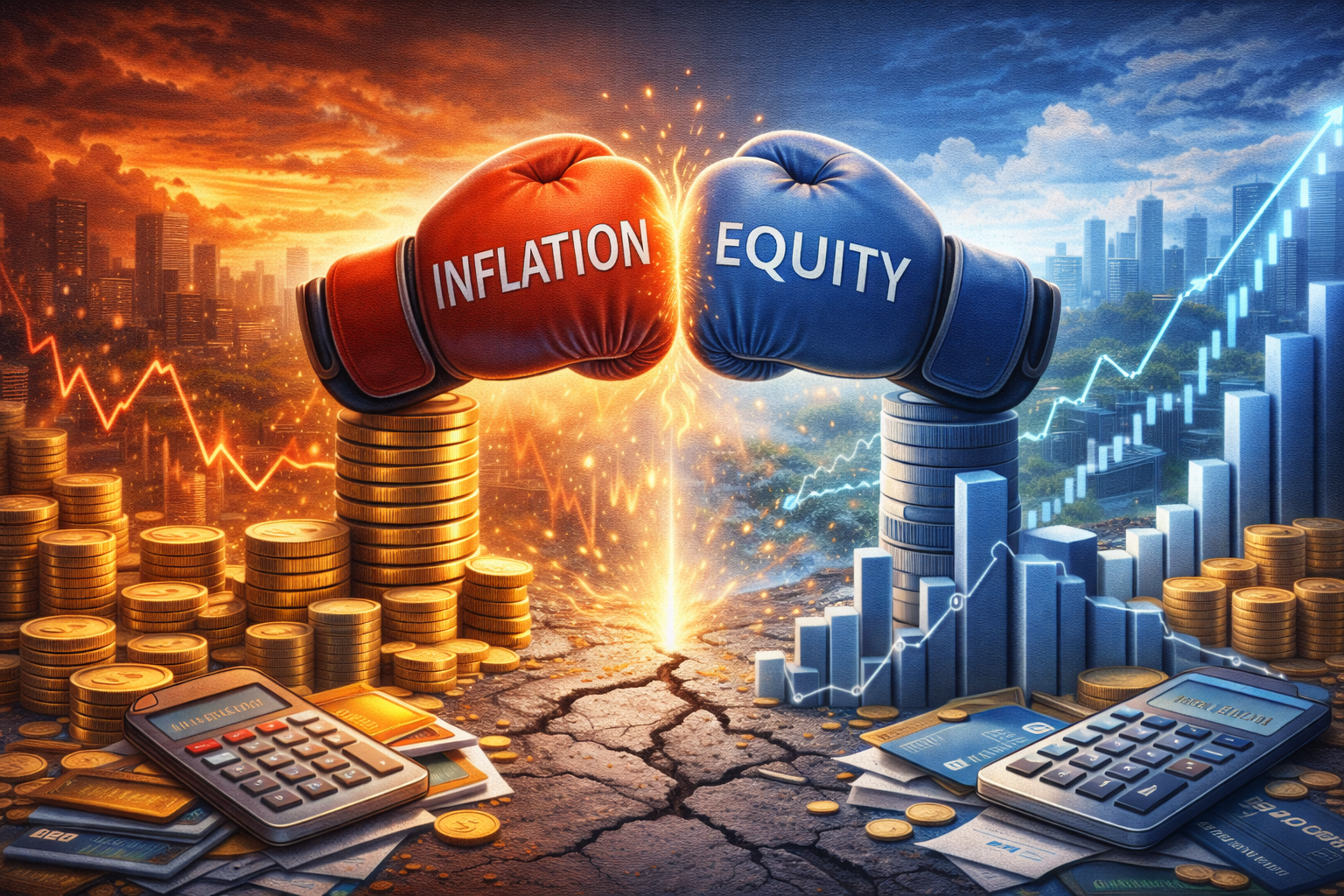
Inflation vs Your Portfolio: The Real Scorecard
Inflation is like slow rust on your money. It does not shock you in a single day, but quietly eats into what your savings can buy over years and decades. A goal that feels very reachable today—a home down payment, a child’s education, an early retirement—can drift further away if your investments grow slower than prices.
In India, this is not a theoretical problem. Consumer price inflation has often hovered in the 5–7 percent band over the last few years. At the same time, many traditional savings products still offer returns that are only slightly above inflation before taxes—and sometimes below it after tax. That means you can feel like you are earning, while your real purchasing power is actually shrinking.
This is where equities come in. Equity mutual funds and stocks are often pitched as “inflation beaters” for the long term. But does the data back this claim? And how should an ordinary investor think about the tug-of-war between inflation and equities?
This article breaks the topic down in simple language, using Indian data, so you can understand what really drives long-term wealth creation.
Nominal vs Real Returns: The Number That Really Matters
Why headline returns can be misleading
One of the biggest mistakes investors make is focusing only on nominal returns—the raw percentage increase in an investment, before considering inflation.
Consider this example:
- You invest in an equity fund that delivers a 12 percent return over a year.
- During the same period, inflation is 7 percent.
On paper, 12 percent looks impressive. But your real return—the return after adjusting for inflation—is only about 5 percent.
In practical terms, if a product that costs ₹100 today becomes ₹107 next year due to inflation, and your ₹100 investment grows to ₹112, your actual increase in purchasing power is just ₹5.
Put differently, the real rate of return is roughly:
Real return ≈ Nominal return − Inflation
This simple formula is widely used in personal finance literature and educational material on real returns.
Why real returns matter for life goals
If your investments earn 6 percent when inflation is 5 percent, your real return is just 1 percent. That might preserve your wealth, but it will not grow it meaningfully after tax. On the other hand, an investment that earns 12–14 percent when inflation is 5–6 percent creates a real return of 6–8 percent, which can substantially grow your purchasing power over time.
Real returns are the lens through which you should evaluate whether your portfolio is truly working for you.
Inflation in India: The Silent Wealth Killer
Recent inflation trends
India’s inflation picture in the mid‑2020s shows why investors cannot ignore price rises.
Moneycontrol and other financial outlets, drawing on official CPI data, highlight the following approximate annual inflation rates:
- 2020: around 3.7 percent.
- 2021: about 5.1 percent.
- 2022: roughly 6.7 percent.
- 2023: close to 5.6 percent.
- 2024: around 5.0 percent.
By January 2026, inflation had cooled, with the first reading under the revised CPI series showing year‑on‑year inflation of about 2.75 percent. At first glance, this seems like welcome relief.
However, as analysts point out, the bigger story is that over time, India’s inflation often clusters in the 5–7 percent range, and even “moderate” numbers compound quietly. At 6 percent inflation, prices roughly double in about 12 years.
How compounding inflation erodes savings
Inflation compounds just like returns do—only in the opposite direction. For example:
- If inflation averages 6 percent, something that costs ₹1,00,000 today could cost nearly ₹1,80,000 after 10 years.
- If your savings grow at 6 percent before tax while inflation is also 6 percent, you are just running to stand still.
This is why merely “preserving capital” is not enough. The real objective is to preserve and grow purchasing power.
How Inflation Interacts with the Stock Market
Central banks, interest rates, and valuations
The relationship between inflation and the stock market is complicated and not always linear. Broadly:
- When inflation rises above comfort levels, central banks tend to raise interest rates to cool demand and stabilise prices.
- Higher interest rates make borrowing more expensive for companies, potentially slowing earnings growth.
- Higher rates also increase the discount rates used for valuing future cash flows, often putting pressure on equity valuations.
This dynamic is seen worldwide and informs how investors think about asset allocation during different parts of the economic cycle.
Why markets react to macro data
Investors closely watch economic indicators such as retail sales, industrial production, housing data (in markets where it is relevant), and labour-market trends, as well as central bank policy meetings like those of the US Federal Reserve’s FOMC.
When inflation or growth numbers come in higher or lower than expected, markets react by repricing risk, which can lead to short-term volatility. For example:
- Higher‑than‑expected inflation often raises fears of more rate hikes.
- Lower‑than‑expected inflation can trigger hopes of rate cuts.
But while these short-term moves can be noisy and sometimes unsettling, long-term investors are better off focusing on how equities behave over full cycles and decades, not weeks or months.
Have Equities Really Beaten Inflation in India?
Evidence from FundsIndia Research
FundsIndia Research, using Nifty 50 Total Return Index (TRI) data and inflation figures, has conducted a detailed study on how Indian equities have performed relative to inflation from 2000 to the mid‑2020s.
Key takeaways from these analyses include:
- Over long periods, equities have historically outperformed inflation by roughly 7–9 percentage points on an annualised basis.
- The study shows that Indian equities have multiplied around 14–16 times over roughly 20 years, translating to nominal returns in the mid‑teens per annum, while inflation has run much lower.
- Year‑by‑year comparisons of Nifty 50 TRI returns versus inflation show a mix of outperformance and underperformance in the short term, but the longer the holding period, the more consistently equities beat inflation.
A recent explainer puts it clearly: historically, equities have outperformed inflation by 7–9 percent in India over long holding periods, although short spells of underperformance are not uncommon.
What happens in crises like 2008?
The same FundsIndia work and subsequent articles highlight how crisis periods look in real-return terms:
- In the early 2000s (around 2000–2003), equities delivered strong real returns as markets recovered from earlier corrections.
- During the 2008 global financial crisis, equities suffered sharp drawdowns and underperformed inflation in the short run.
- However, even for those who invested just before the crisis, returns turned positive over subsequent years as markets recovered.
By the time you extend the horizon to 10 years or more, almost every starting point since 2000 has delivered inflation‑beating real returns.
This does not mean equities are “safe” in the short term. It means that, historically, patient investors willing to sit through volatility have been rewarded with positive real wealth creation.
Academic evidence on real equity returns
Academic work examining long‑term nominal and inflation‑adjusted returns for Indian asset classes echoes this pattern. For example, one study finds that long‑term real returns for Indian equities have averaged around 6 percent per year, versus roughly 1 percent for fixed deposits. This aligns broadly with the gap seen between equity returns and inflation in market-based research.
Equities vs Inflation: A Simple Illustration
To understand how equities can outpace inflation, imagine two scenarios over 20 years:
- Conservative path: Savings grow at 6 percent per annum while inflation averages 5.5 percent.
- Equity‑led path: A diversified equity portfolio grows at 13 percent per annum while inflation averages 5.5 percent.
Using approximate numbers:
- In the conservative path, ₹1,00,000 might grow to around ₹3.2 lakh in 20 years, but the real purchasing power after inflation would be only modestly higher.
- In the equity‑led path, ₹1,00,000 could grow to around ₹11–12 lakh, and even after accounting for inflation, the real wealth created would be several times the starting value.
Real-world returns will differ, taxes will apply, and no outcome is guaranteed—but the gap between single‑digit and double‑digit returns, when compared against persistent inflation, is what drives long-term wealth creation.
Why Time Horizon Matters More Than Timing
Short-term noise vs long-term trend
The FundsIndia studies and similar analyses show an important pattern:
- Over 1–3 years, the chances that equities underperform inflation are meaningful.
- Over 5–7 years, the odds of positive real returns improve but volatility can still cause surprises.
- Over 10 years and beyond, historical data shows equities have almost always beaten inflation in India.
Put visually, if you colour‑code periods where equities beat inflation as green and underperforming periods as red, the short‑term grid shows a patchwork of green and red. As you extend the holding period, the grid turns increasingly green.
This is why experts say equities reward patience, not short-term prediction skills. Trying to jump in and out of markets to “outsmart” inflation rarely works. Staying invested through cycles is what has historically delivered real returns.
Beyond Equities: The Role of Gold and Silver
Why gold and silver still matter
Equities are powerful inflation fighters over long time frames, but they can be extremely volatile over shorter ones. That is where assets like gold and silver come into play.
Studies of Indian asset returns show that while gold’s long-term real returns may be lower than equities, gold often shines during periods of market stress, elevated inflation, or geopolitical uncertainty. Silver, while more volatile than gold, has historically behaved in a similar way as a precious metal with some industrial demand.
By combining equity exposure with allocations to gold (and, to a lesser extent, silver), investors can:
- Reduce overall portfolio volatility.
- Potentially limit drawdowns during crisis periods.
- Improve the consistency of real returns across cycles.
Portfolio thinking: growth plus stability
A simplified way to think about it:
- Equities: Primary engine for long-term, inflation‑beating growth.
- Gold and silver: Shock absorbers that can hold value or appreciate when risk assets are under pressure.
- Debt and cash: Provide stability and liquidity but often struggle to beat inflation after tax over long periods.
Research using simulated long-term portfolios suggests that diversified mixes of equities, debt, and gold can deliver more stable inflation‑adjusted outcomes than any single asset class on its own.
Practical Takeaways for Indian Investors
1. Always think in real terms
When you see a return figure—be it from a bank deposit, debt fund, or equity fund—mentally subtract inflation.
- If a product promises 7 percent and inflation is 6 percent, you are only getting around 1 percent real return before tax.
- If an equity fund targets 12–14 percent over the long term while inflation trends around 5–6 percent, you are in the zone of 6–8 percent real returns if things go well.
This mindset shift alone can improve how you evaluate options.
2. Match your equity allocation with your time horizon
- For goals less than 3 years away, heavy equity exposure is risky because short-term underperformance versus inflation is common.
- For goals 5–10 years away, a meaningful equity allocation becomes more reasonable, but you should be ready for volatility.
- For goals 10+ years away, equities are often essential if you want to truly grow purchasing power.
3. Use SIPs and asset allocation to manage volatility
Systematic Investment Plans (SIPs) in diversified equity funds help average out purchase prices across market cycles, reducing timing risk. Meanwhile, a disciplined asset allocation—say, a blend of equity, debt, and gold suited to your risk profile—can keep your journey smoother even when markets are choppy.
Rebalancing periodically (for example, once a year) ensures you take profits from outperforming assets and top up those that are temporarily out of favour.
4. Do not ignore inflation when judging “safety”
Many investors associate safety with products like long-tenure bank deposits or low‑yielding instruments.
However, if these products earn less than or only marginally above inflation after tax, they may feel safe but are risky in real terms because they compromise your future purchasing power.
Real safety comes from a portfolio that can withstand inflation, volatility, and life events—not from hiding entirely in low‑return assets.
Who Wins in the Long Run: Inflation or Equities?
Over short periods, inflation frequently wins, especially in years when markets correct or move sideways. In those windows, even a modest inflation rate can make positive nominal returns feel less impressive once adjusted for purchasing power.
Over long periods, however, history strongly favours equities as the most reliable way for Indian investors to beat inflation and create real wealth, provided they:
- Stay invested through market cycles.
- Use diversified portfolios and disciplined asset allocation.
- Look at returns after inflation and tax, not just headline numbers.
Gold and silver play an important supporting role, especially during episodes of high inflation or market stress. Together, an equity‑heavy but diversified portfolio can help you protect and grow your purchasing power.
In simple terms, equities are your long‑distance runner against inflation, while gold and silver are the steady teammates who help the whole relay team finish strong.
Disclaimer
This article is for informational and educational purposes only and does not constitute financial, investment, tax, or legal advice. Historical returns, inflation figures, and asset‑class behaviour are based on past data and research, which may not repeat in the future. Investment outcomes are uncertain and can vary widely depending on market conditions, time horizon, product choice, and individual circumstances. Readers should consult qualified financial professionals and consider their own risk tolerance, goals, and tax situation before making investment decisions. References to specific indices, products, or research providers are illustrative and do not represent recommendations or endorsements.
