


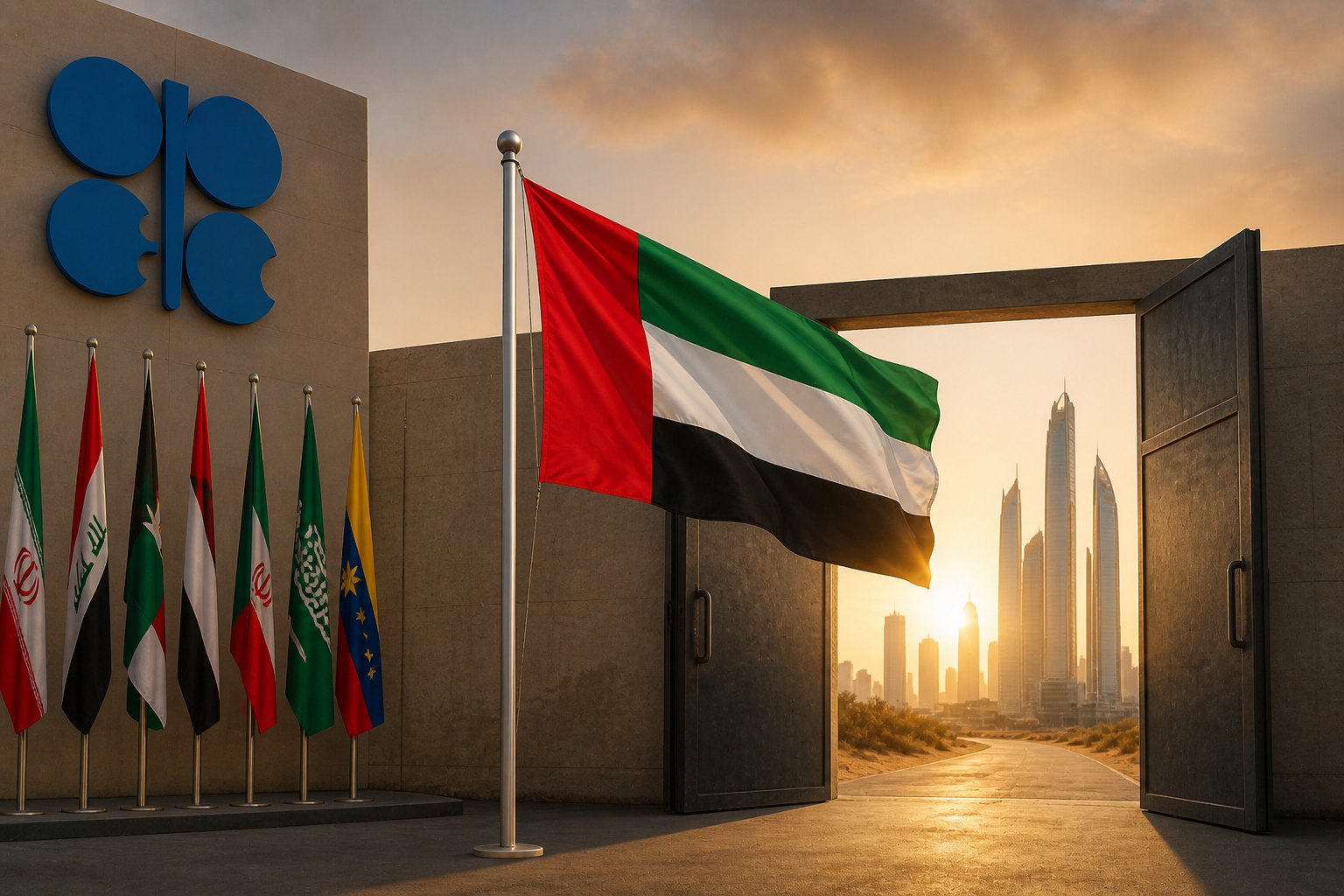
The energy security of a major oil‑importing country like India is no longer just about tankers arriving on time; it now depends heavily on shifting alliances inside producer clubs like OPEC. For almost six decades, the United Arab Emirates (UAE) was a loyal member of the cartel, often acting in step with Saudi Arabia on production cuts and price management. Its decision to walk away from OPEC from 1 May 2026 is therefore more than a procedural change – it signals a deeper re‑ordering of power in the global oil market.
For India, which imports the bulk of its crude and counts the UAE among its top suppliers, this move could gradually change how much it pays at the petrol pump and how vulnerable the economy remains to supply shocks. The impact will not be overnight, but understanding the “why” behind the UAE’s exit helps make sense of what might come next for oil prices and inflation over the rest of this decade.
What’s happening?
In late April 2026, the UAE formally announced that it will terminate its membership in OPEC and the wider OPEC+ alliance with effect from 1 May 2026, ending a relationship that began in 1967 when Abu Dhabi first joined the group. Official statements from the energy ministry and state news agency described the step as a national‑interest decision following a comprehensive review of the country’s production policy and current and future capacity.
Until now, the UAE was one of OPEC’s heavyweights – the third‑largest producer in the group and responsible for roughly 3% of global crude supply, with output of about 3.4 million barrels per day before the Iran war disrupted flows through the Strait of Hormuz. Crucially, it also has some of the largest spare production capacity in the world, thanks to years of investment in ADNOC’s fields and pipelines, taking sustainable capacity close to 4.8–5.0 million barrels per day with a formal target of 5 million barrels per day by 2027.
By quitting OPEC, the UAE is signalling that it no longer wants its output decisions tightly bound by cartel‑wide quotas that were crafted when its capacity – and the broader geopolitical environment – looked very different.
Why did the UAE leave OPEC?
The UAE’s exit is driven by a mix of economic, strategic and political factors rather than a single trigger.
1. Production quotas vs. capacity ambitions
For years, tensions simmered between Abu Dhabi and Riyadh over how much oil the UAE was allowed to pump under OPEC+ agreements.
Key points:
- ADNOC has invested heavily to lift crude production capacity to about 4.8–4.9 million barrels per day, with a public goal of 5 million barrels per day by 2027.
- Yet under OPEC+ quota frameworks, the UAE was effectively limited to around 3.0–3.4 million barrels per day before the Iran conflict – almost 30% below its capacity, meaning expensive new capacity sat under‑used.
- UAE officials and analysts have pointed out that this capacity expansion was funded by tens of billions of dollars in investment, and keeping it idle undermines the country’s growth and diversification plans.
Saudi Arabia, by contrast, has often favoured deeper production cuts and lower group output to support higher prices, especially since 2022, even if that meant some members like the UAE could not fully exploit their upgraded capacity. From Abu Dhabi’s perspective, leaving OPEC opens the door to monetising its full capacity on its own timetable rather than according to cartel compromises.
2. Geopolitical shocks and the Strait of Hormuz

The Iran war and near‑closure of the Strait of Hormuz – through which about 20% of the world’s crude and LNG normally flows – have radically altered the risk landscape for Gulf exporters.
Reports suggest:
- The UAE’s production fell to around 1.9 million barrels per day in March 2026, down roughly 44% from pre‑war levels, as Hormuz tanker routes were disrupted.
- Abu Dhabi partially offset this by routing crude through its pipeline to Fujairah on the Gulf of Oman, which can carry about 1.8 million barrels per day and bypass Hormuz altogether.
Being tied to OPEC+ cuts at a time when war is already constraining its exports made it harder for the UAE to flexibly respond to both physical disruptions and price spikes. Exiting the cartel gives it more room to adjust output unilaterally to protect revenue and market share when choke points are threatened.
3. Political divergence and regional strategy
Although the UAE and Saudi Arabia remain close partners, frictions have grown over issues ranging from Yemen and Iran to economic competition and industrial policy.
Commentary from energy think‑tanks and media highlights that:
- Abu Dhabi has been increasingly assertive in pursuing its own long‑term economic vision, including aggressive investment in petrochemicals, renewables and logistics hubs.
- It has occasionally resisted OPEC deals that it felt undervalued its investment – for example, refusing in 2021 to support a long extension of production cuts unless its reference quota was raised.
Leaving OPEC does not mean the UAE will abandon coordination with neighbours entirely, but it underscores a desire to prioritise national production flexibility over group discipline.
What does this mean for global oil supply?
UAE’s departure is a blow to OPEC’s cohesion, because it removes one of the few members with meaningful spare capacity besides Saudi Arabia.
Short‑term picture: Already tight and noisy
Right now, the immediate driver of oil prices is less the UAE’s exit and more the Iran war and Hormuz disruptions, which have already cut OPEC output sharply and pushed prices into the triple digits.
Recent data and market commentary show:
- Brent crude has been trading near 110 dollars per barrel, with recent prints around 109–118 dollars amid fears of prolonged supply disruptions and war escalation.
- WTI, the US benchmark, has spent late April around 97–100 dollars per barrel, briefly jumping above 100 dollars on geopolitical headlines.
Against this backdrop, the UAE’s announcement is more of a signal of future supply behaviour than an immediate volume shock – it has not suddenly flooded the market, and war‑related logistics constraints remain a bigger near‑term factor.
Medium to long term: More barrels, more volatility
Where the UAE’s exit becomes important is over the next 2–5 years:
- If Abu Dhabi gradually ramps actual output from roughly 3.0–3.4 million barrels per day toward its 5 million barrels per day capacity target by 2027, that is an additional 1.5–2 million barrels per day of potential supply entering global markets versus OPEC‑constrained levels.
- Analysts note that this would make the UAE one of the few non‑US sources of significant new conventional supply in a world where many producers are struggling to grow output.
The impact on prices will depend on what others do:
- If demand growth slows and other OPEC members do not cut enough to offset UAE’s extra barrels, the added supply could cap or gently push down prices, especially once war‑related premiums fade.
- If conflicts, sanctions and under‑investment keep global supply tight, the UAE’s new production might simply replace lost barrels elsewhere, stabilising prices rather than crashing them.
Either way, markets may become more volatile, because OPEC loses some of its traditional ability to fine‑tune output collectively, and traders will have to guess how a now‑independent UAE will respond to price swings.
How does this affect OPEC’s influence?
OPEC has long relied on a combination of Saudi Arabia’s swing capacity and smaller members’ discipline to steer prices within a desired range.
UAE’s exit hurts on several fronts:
- It reduces OPEC’s share of global supply, as one of its largest producers becomes a free agent.
- It weakens the perception of unity, which can matter for market psychology and the credibility of future cuts.
- It sets a precedent: other members with capacity ambitions or political frictions may feel more confident pushing back against quotas or even considering similar moves, though none have signalled this yet.
At the same time, OPEC+ still includes Saudi Arabia, Iraq and several large producers, and Russia remains a major partner in broader coordination despite not being an OPEC member. The cartel will not disappear, but its ability to act as a single, tight “supply manager” is clearly eroding, especially in a world where US shale and non‑OPEC suppliers already took market share in the 2010s.
India’s oil dependence: Where does the UAE fit in?
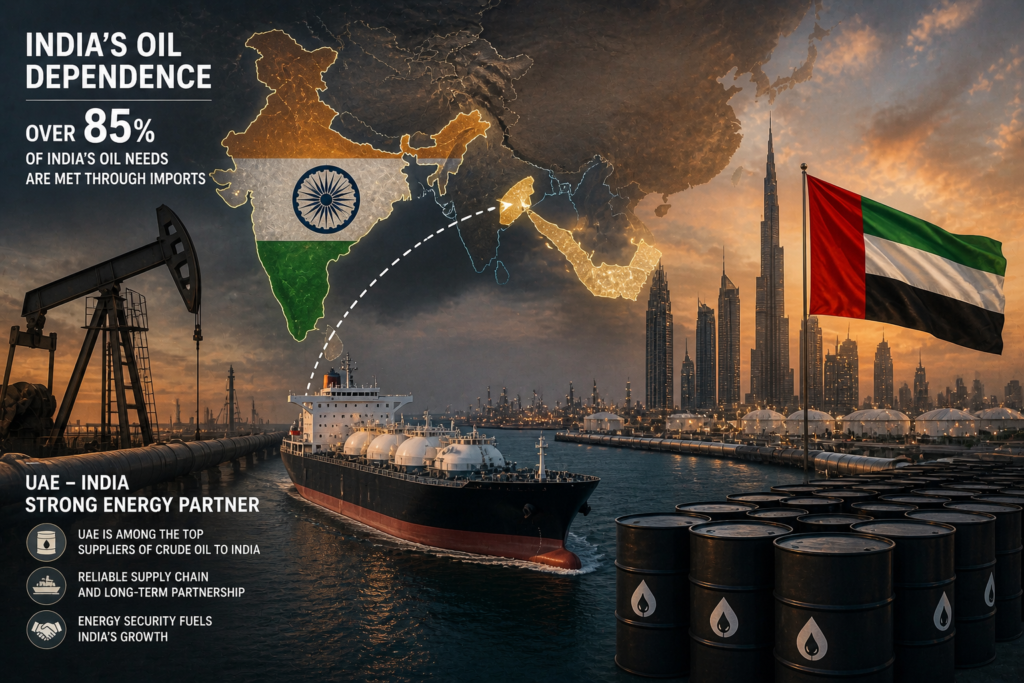
India is the world’s third‑largest oil importer and relies heavily on overseas crude to meet its fast‑growing energy demand. Over the past few years, its supplier mix has shifted, especially with Russian barrels entering the picture post‑Ukraine, but OPEC and the Gulf still matter enormously.
Recent data indicate:
- In FY 2024–25, OPEC’s share in India’s crude imports fell to about 48.5%, a record low, as cheaper Russian oil grabbed roughly 36% of the market.
- Despite this shift, the UAE remains a top‑four supplier, alongside Saudi Arabia, Iraq and Russia.
- As of 2025, the UAE accounts for roughly 9–11% of India’s crude imports, equivalent to around 0.45–0.50 million barrels per day, with bilateral crude trade value expected to exceed 15 billion dollars in 2025.
So while India has diversified beyond OPEC to some degree, Gulf suppliers and especially the UAE remain strategically important, both for physical supply and for long‑term investment partnerships in refining and storage.
What could UAE’s move mean for India’s oil prices?
The implications for India can be thought of across two time horizons: near term and medium to long term.
Near term: War premium and imported inflation
Right now, the level of Brent and WTI is being driven more by war risk and shipping disruptions than by UAE’s future production path.
- Brent crude has hovered near or above 110 dollars per barrel in late April 2026, with spikes above 120 dollars when fears of escalation in the US–Iran war intensify.
- WTI has recently traded in the high 90s to low 100s, reflecting similar concerns and tightness.
For India, elevated prices translate into:
- A higher oil import bill, pressuring the current account and the rupee.
- Higher pump prices and input costs, feeding into inflation across transport, manufacturing and agriculture.
UAE’s exit from OPEC does not immediately change this; if anything, markets are still digesting the war and Hormuz choke‑point risk more than cartel politics. In the short term, the main task for Indian policymakers is to manage the macro impact of high prices via excise duty decisions, strategic petroleum reserve (SPR) use, and hedging where appropriate.
Medium to long term: Potentially more supply, more bargaining power
Once war risk subsides and shipping normalises, the UAE’s ability to increase production independently could be good news for large importers like India.
Possible positives:
- If the UAE ramps from roughly 3.0–3.4 million barrels per day to nearer 5 million barrels per day by 2027, and much of that incremental output is exported, it could add meaningful supply to the global pool.
- More UAE barrels on the market, outside OPEC cuts, can soften OPEC’s grip on prices, creating more competition among Gulf producers for market share in Asia.
- India might gain better bargaining power in term contracts with the UAE and others, especially if it can leverage long‑term strategic partnerships, investments and refinery deals.
However, there are also risks:
- If other OPEC members respond by cutting more aggressively to defend prices, the net supply effect may be limited, and volatility could rise as supply decisions become less predictable.
- If geopolitical tensions persist – for example, around Iran or in other producer regions – supply outages elsewhere could offset new UAE volumes, keeping prices structurally high.
In short, over time the UAE’s move tilts the odds toward more flexible supply and slightly more buyer leverage, but does not guarantee cheap oil – especially in a turbulent geopolitical environment.
Strategic implications for India’s energy policy
Beyond the price of today’s barrel, UAE’s OPEC exit carries broader signals for India’s long‑term energy strategy.
1. Importance of diversified suppliers
Recent trade data already show India deliberately broadening its supplier base, increasing imports from the US, UAE, Egypt, Nigeria and Libya while reducing dependence on Russia, Saudi Arabia and Iraq in FY 2025–26.
UAE’s new flexibility strengthens the case for India to:
- Deepen bilateral crude and LNG contracts with a wider pool of suppliers.
- Invest in joint ventures in refining, storage and petrochemicals both at home and in partner countries.
- Use its scale as a large, fast‑growing market to secure more favourable term deals rather than relying heavily on spot purchases during tight periods.
2. Need for stronger buffers and risk management
Episodes like the Hormuz disruption and 2022–26 price spikes underline the importance of:
- Maintaining and gradually expanding strategic petroleum reserves (SPR) so that India can handle short‑term supply shocks without overreacting in markets.
- Encouraging oil marketing companies and refiners to use hedging and diversification tools to reduce exposure to single benchmarks or routes.
Even if UAE’s future extra barrels help ease prices, the path there will likely include sharp swings, making buffers and risk tools crucial.
3. Faster push on transition and efficiency
Persistently high and volatile oil prices are also a reminder that the best long‑term hedge is to reduce oil intensity in the economy:
- Scaling up electric mobility, public transport, and alternative fuels can gradually lower the share of crude in India’s energy mix.
- Improving fuel efficiency in industry and logistics reduces the rupee cost of each unit of GDP growth.
UAE’s strategy – investing in both capacity and diversification – ironically mirrors what importers like India must do on the demand side: secure today’s barrels while aggressively building tomorrow’s alternatives.
What should Indian investors and consumers watch?
For individual investors and consumers, the headline “UAE leaves OPEC” can feel distant, but it trickles down via fuel prices, inflation and market sentiment.
Things to keep an eye on:
- Brent and WTI trends: If Brent stays around or above 110 dollars and WTI near or above 100 dollars for long, higher fuel costs will keep pressure on inflation and interest rates in India.
- India’s import mix: Shifts in where India buys its oil – more from UAE vs. Russia vs. US – can influence discounts, freight costs and refinery margins.
- Policy responses: Moves on excise duties, fuel price caps/subsidies, or new long‑term supply deals with UAE and others can soften or amplify the impact at the pump and in markets.
For long‑term investors, a key takeaway is that energy geopolitics will remain a major macro driver, affecting sectors from airlines and autos to consumer staples and infrastructure. Diversified portfolios and a clear asset‑allocation plan are better responses than trying to trade every oil headline.
Wrapping up: A signal of a changing oil order
The UAE’s decision to walk away from OPEC after nearly 60 years is a symbolic and practical turning point in the global oil order. It reflects a world where some producers want more freedom to monetise their investments and where traditional cartels find it harder to maintain strict discipline amid wars, sanctions and new suppliers.
For India, the immediate reality is still dominated by high prices and war‑related risk, which keep the oil import bill and inflation under pressure. Over time, though, an independent, high‑capacity UAE could contribute to a more competitive supplier landscape, offering New Delhi both opportunities and challenges as it juggles energy security, diplomacy and its own green transition.
In this environment, the core message for policymakers, businesses and households is similar: plan for volatility, diversify your dependencies, and avoid assuming that any single alliance – whether OPEC, OPEC+ or a particular supplier – will look the same five years from now as it did for the last fifty.
Disclaimer
This article is intended solely for general information and educational purposes and does not constitute investment, tax, legal or other professional advice. The events, data points and scenarios described, including the UAE’s exit from OPEC, current oil price levels and India’s import patterns, are based on publicly available sources believed to be reliable at the time of writing, but may change without notice. References to specific countries, companies, benchmark prices or policies are illustrative and should not be interpreted as recommendations or guarantees of any outcome. Oil prices are inherently volatile and influenced by numerous factors, including geopolitical developments, supply disruptions, demand trends and currency movements. Before making any financial, investment or policy decision based on energy‑market developments, readers should carefully assess their own objectives, constraints and risk appetite and, where appropriate, seek advice from qualified professionals or SEBI‑registered intermediaries.
