



India’s E-Retail Moment: From Promise to Scale
India’s digital economy is no longer just a story of potential; it is firmly in its scaling phase. E‑retail—everything from fashion and electronics to grocery and beauty sold online—has moved from the margins of the consumption story to the centre.
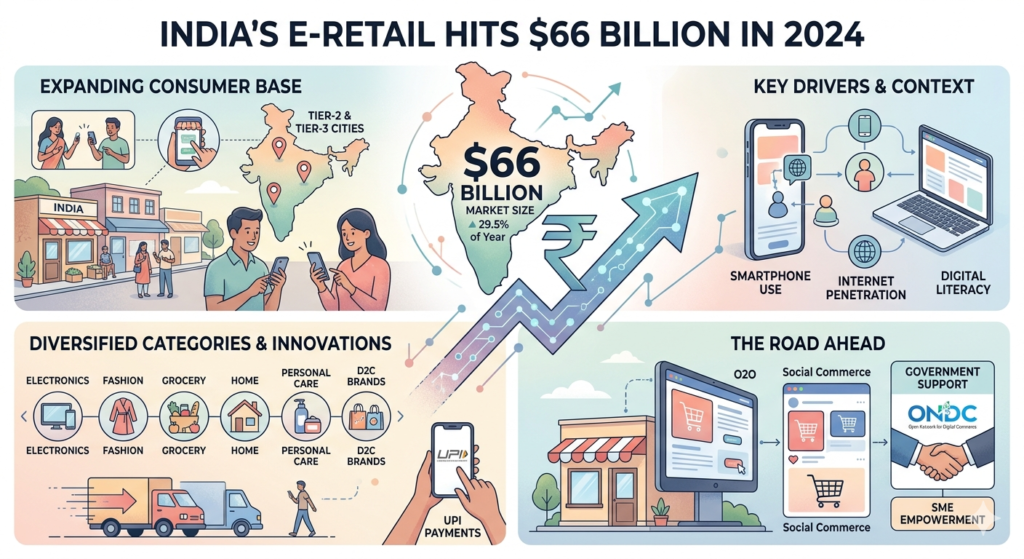
According to the latest How India Shops Online 2026 report by Bain & Company and Flipkart, India’s e‑retail market reached an estimated $65–66 billion in gross merchandise value (GMV) in 2025. The same report projects that e‑retail is likely to grow at more than 20 percent annually and scale to $170–180 billion by 2030, capturing nearly one in ten retail dollars spent in India.
Growth is not just coming from metro shoppers buying more; it is being driven by new users in tier‑2 and smaller cities, rapid adoption of quick commerce, and structural improvements in macro conditions and policy. For investors, this combination of scale, growth and under‑penetration is exactly what a long‑term structural theme looks like.
What’s Happening: The Numbers Behind the Boom
GMV at $65–66 billion and accelerating
Bain–Flipkart’s latest report and multiple summaries across business media highlight a powerful set of data points:
- E‑retail GMV in 2025: Approximately $65–66 billion, up 19–21 percent year‑on‑year.
- Acceleration in H2 2025: Growth picked up to 22–24 percent in the second half of 2025 as consumption strengthened.
- Q1 2026 momentum: Early estimates suggest e‑retail growth of 23–25 percent in the first quarter of 2026, indicating that the recovery is sustaining rather than fading.
- Five‑year trajectory: Over the past five years, India’s e‑retail GMV has more than doubled, with annual active shoppers rising to 290–300 million and the seller ecosystem roughly tripling, heavily led by tier‑2+ towns.
On the macro side, private consumption growth has risen from around 8 percent during 2022–24 to roughly 10.5 percent in 2025, supported by GST rate cuts, income‑tax relief, easing inflation, and lower lending rates. E‑retail is mirroring this broader recovery, acting as a high‑beta play on India’s consumption cycle.
Massive headroom: 1.6% of GDP vs China’s 13–14%
Despite this expansion, e‑retail in India remains structurally under‑penetrated:
- E‑retail GMV was about 1.6 percent of India’s GDP in 2025.
- The comparable figure is 13–14 percent in China and 4–4.5 percent in Indonesia.
Similarly, only about 30 percent of India’s internet users currently shop online, compared with more than 90 percent in China and over 70 percent in the US, according to Bain and public commentary on the report.
This gap is not a weakness—it is the opportunity. As incomes rise, digital infrastructure improves and trust in online commerce deepens, a large pool of non‑transacting internet users can gradually transition into online shoppers.
Quick Commerce: From Experiment to Engine of Growth
A $10–11 billion market already
One of the most striking sub‑stories within Indian e‑retail is the explosion of quick commerce—10–30 minute delivery of groceries and essentials.
Multiple sources summarising the Bain–Flipkart report note that:
- Quick commerce GMV reached approximately $10–11 billion in 2025.
- It now accounts for 16–17 percent of total e‑retail GMV, making India one of the global leaders in this model, ahead of even China in relative penetration.
- The segment has doubled annually over the past two years, on the back of dense urban networks, strong unit economics in certain categories, and rapidly shifting consumer expectations.
The Bain report and media coverage project that quick commerce could reach $65–70 billion in GMV by 2030, contributing 45–50 percent of incremental e‑retail growth over the period, while traditional e‑retail (standard delivery) continues to anchor 60–65 percent of total GMV by the end of the decade.
Micro‑fulfilment, small baskets, high frequency
Quick commerce operates very differently from traditional marketplaces:
- Session lengths are short: People typically browse and check out within a few minutes.
- Basket sizes are small, often focused on daily essentials, top‑up grocery, personal care, snacks and beverages.
- Order frequency is high, making quick commerce less about one‑off shopping sprees and more about being embedded into everyday habits.
To support this, platforms have rolled out thousands of micro‑fulfilment centres (dark stores) across more than 200 cities, with a heavy concentration in the top 8–10 urban centres where density and ticket sizes support rapid‑delivery economics. E‑grocery penetration has increased roughly fivefold to around 1.5 percent of overall grocery, and in metro cities it has reached 6–7 percent, according to Bain.
Crucially, 85–90 percent of quick commerce GMV is still anchored in essential categories, which tend to be more resilient than discretionary spending during economic slowdowns.
Consumer Behaviour: Gen Z and Bharat Are in the Driver’s Seat
Gen Z: 40–45% of shoppers, 50% of new orders
The Bain–Flipkart study and its summaries highlight Gen Z as one of the biggest drivers of e‑retail growth:
- Gen Z now accounts for roughly 40–45 percent of India’s e‑retail shoppers.
- They contribute close to half of new orders, especially in categories like lifestyle, beauty, electronics and impulse purchases.
- In metro cities, Gen Z spending power is reported to be growing roughly 2.5 times faster than other age cohorts.
This cohort is:
- Media‑first and influencer‑driven: Discovery often starts on social media and short‑video platforms rather than search alone.
- Comfortable with instant credit: From BNPL options to embedded credit lines, their friction threshold for using credit online is low.
- Highly experimental: They are more willing to try new brands, formats and platforms.
These traits sustain high engagement and order frequency, particularly in trend‑sensitive categories.
Tier‑2 and beyond: Half of new orders, low penetration
The second growth engine is India’s smaller cities and towns:
- Tier‑2+ cities and towns now account for around half of incremental e‑retail orders, and a meaningful share of new shopper additions.
- However, shopping penetration among internet users in these locations is still only about 25–30 percent, meaning a majority of users are yet to transact online.
In total, India has around 850 million chat and social‑media users, but two‑thirds still do not make online purchases, underscoring the vast untapped potential as trust, affordability and digital literacy continue to improve.
Conversational Commerce and AI: From Search to “Describe and Get”
The rise of conversational interfaces
A key emerging theme highlighted by Bain and several commentaries is the shift from search‑and‑browse to conversational and AI‑assisted discovery.
- India is among the largest markets globally for generative AI tools, with industry commentary suggesting that the country is now one of the top user bases for conversational AI platforms.
- As more consumers get comfortable describing what they want in natural language (“I need a birthday gift for a 10‑year‑old boy under ₹1,000”), search and product recommendation can become far more personalised.
This has direct implications for e‑retail:
- Higher conversion rates as shoppers find relevant products faster.
- Deeper engagement through interactive, chat‑like experiences.
- New monetisation formats around sponsored recommendations, personalised bundles and AI‑curated storefronts.
Social and video commerce
Social media and video‑led commerce are also integrating closely with mainstream e‑retail. Influencer‑led product discovery, live commerce sessions and in‑app purchasing paths are blurring the lines between content and commerce.
For Gen Z and younger Millennials, this shift is natural—they are already discovering brands via creators and short videos. For platforms, the challenge and opportunity is to translate that attention into efficient, repeatable transactions.
What Does All This Mean for Investors?
Structural tailwinds and under‑penetration
When investors look for long‑term themes, they usually seek three things: scale, growth and under‑penetration. India’s e‑retail story currently offers all three:
- Scale: Already a $65–66 billion GMV market with nearly 300 million shoppers.
- Growth: Projected to grow at 20 percent+ annually and reach $170–180 billion by 2030.
- Under‑penetration: Only 1.6 percent of GDP and about 10 percent of total retail spend by 2030, with large headroom compared to China and Indonesia.
This combination makes e‑retail a credible long‑term structural opportunity within India’s broader consumption and digital themes.
Who might benefit?
The opportunity is not restricted to marketplace platforms alone. Potential long‑term beneficiaries include:
- E‑retail and marketplace platforms: Large generalist platforms and specialised vertical players (fashion, beauty, electronics, grocery).
- Quick commerce operators: Especially those that can scale profitably beyond metros and build strong private‑label portfolios.
- Logistics and fulfilment: Warehousing, micro‑fulfilment, last‑mile delivery and supply‑chain technology providers.
- Digital payments and fintech: UPI apps, wallets, BNPL providers and embedded credit platforms that sit on top of e‑retail transactions.
- Enablers and SaaS providers: Tools for inventory, pricing, recommendation, fraud detection and AI‑driven customer engagement.
Investors can approach the theme through listed equities, mutual funds/ETFs with exposure to consumption and digital ecosystems, and over time, possibly through unlisted/alternative investments as the ecosystem deepens.
Risks and challenges
No growth story is without risk. Key challenges in India’s e‑retail and quick commerce journey include:
- Profitability pressure: High customer‑acquisition costs, heavy discounting and intense competition can compress margins.
- Unit economics in non‑metro quick commerce: While metros have density and ticket sizes, replicating quick commerce economics in tier‑2 and tier‑3 cities can be challenging.
- Regulatory and policy changes: Data, competition, taxation and labour regulations can all influence business models.
- Execution risk: Scaling from a few cities to a truly national footprint requires flawless execution in logistics, technology and customer experience.
For investors, this means the theme is attractive, but stock selection and entry price will matter as much as the macro growth story.
What’s Next? Looking Ahead to 2030

By 2030, multiple sources based on the Bain–Flipkart projections suggest that:
- India’s e‑retail GMV could reach $170–180 billion, sustaining 20 percent+ annual growth.
- One in every ten retail dollars (and nearly one in four non‑grocery retail dollars) may be spent online.
- Quick commerce could scale to $65–70 billion, contributing almost half of incremental e‑retail growth, while traditional e‑retail continues to account for 60–65 percent of GMV.
- The overall retail market itself could approach $1.6 trillion, meaning e‑retail will be a large slice of a much bigger pie rather than a replacement for offline retail.
- India is poised to capture one in every eight incremental global consumption dollars over the next five years, underlining its importance as a global demand engine.
As GDP per capita moves towards and beyond the $4,000 mark by 2030, discretionary spending is likely to rise, categories like lifestyle, beauty and general merchandise are expected to deepen, and online penetration in grocery could climb meaningfully from today’s low base.
At the same time, conversational commerce and AI‑driven shopping journeys will likely become mainstream, lowering friction and creating more personalised experiences.
How Investors Can Approach the Theme
For long‑term investors, India’s e‑retail and quick commerce ecosystem can serve as a core growth pillar within a diversified portfolio, provided some basic principles are followed:
- Think in ecosystems, not just individual stocks
Consider exposure across platforms, logistics, payments and enablers rather than concentrating solely on one marquee name. - Prioritise quality and unit economics
Focus on players with clear paths to profitability, strong balance sheets and disciplined customer‑acquisition strategies. - Be realistic on valuations
High‑growth themes often attract rich valuations. Waiting for reasonable entry points and using staggered investments can help manage risk. - Have a long‑term horizon
Short‑term volatility—whether from macro events, regulatory noise or competition—is inevitable. The structural story plays out over 5–10 years, not a few quarters. - Diversify across themes
Even compelling growth stories should not dominate a portfolio. E‑retail can be an important building block alongside other themes such as manufacturing, financials, healthcare and energy transition.
If approached thoughtfully, India’s e‑retail boom can become a meaningful contributor to long‑term wealth creation rather than just a headline about GMV milestones.
Disclaimer
This article is for informational and educational purposes only and does not constitute financial, investment, tax, or legal advice. The statistics, projections and market views cited here are based on publicly available reports and media coverage as of April 2026 and may change with new data or developments. Investing in equities and thematic sectors such as e‑retail and quick commerce involves risk, including possible loss of capital. Readers should conduct their own research, consider their risk tolerance and investment horizon, and consult qualified financial professionals before making any investment decisions. References to specific companies, reports or platforms are illustrative and do not represent recommendations or endorsements.
