


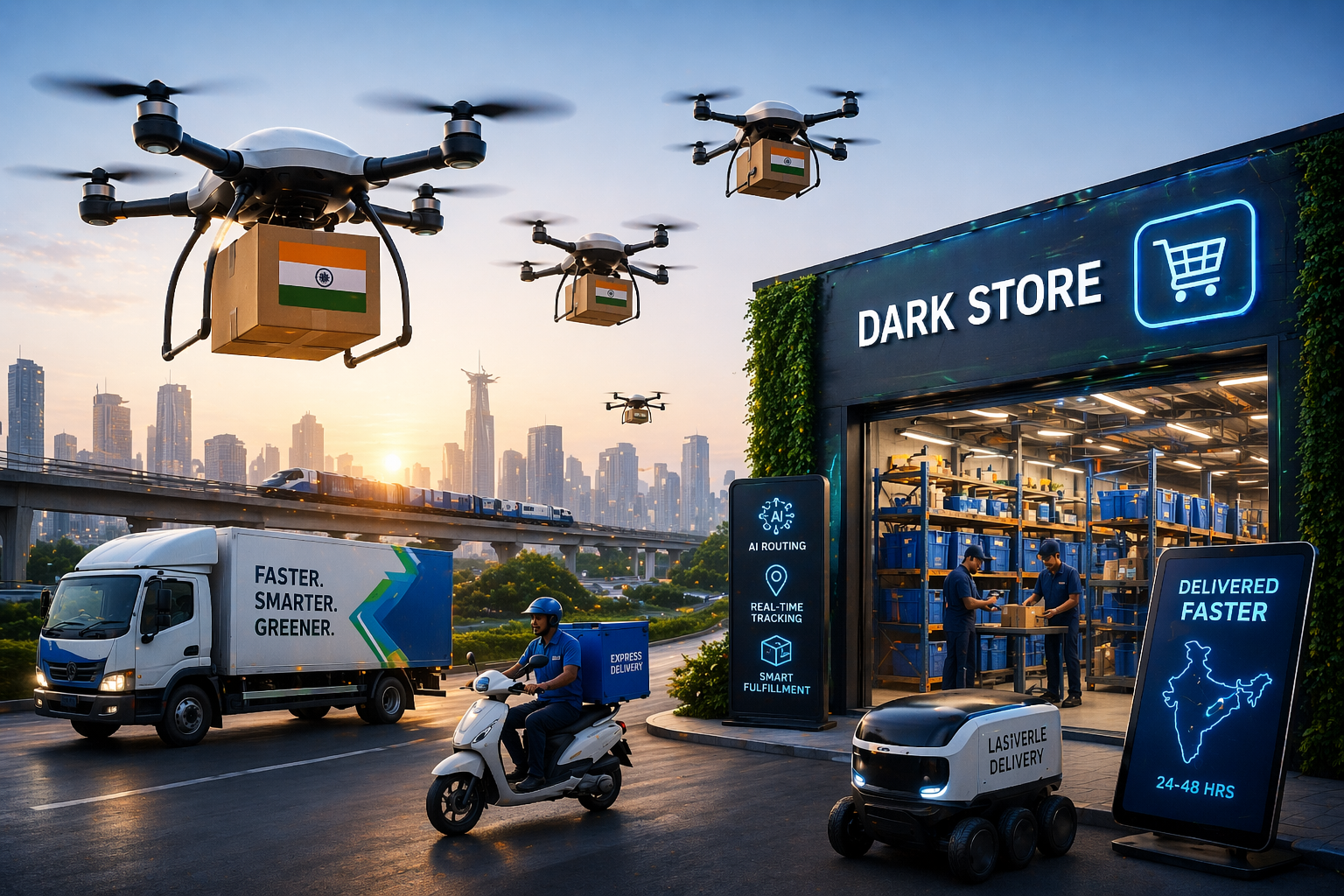
India’s New-Age Logistics Story: Beyond Trucks and Warehouses
India’s logistics sector is undergoing a structural shift. What was once seen as a fragmented, truck‑driven industry is rapidly turning into a technology‑enabled, data‑rich backbone of the digital economy. This transformation is being driven by three powerful forces:
- Digital commerce: E‑commerce and quick commerce have raised the bar on delivery speed, reliability and visibility.
- Policy push: The National Logistics Policy (NLP) 2022 and PM Gati Shakti are focusing on lowering logistics costs and integrating multi‑modal infrastructure.
- Innovation: Drones, dark stores, cold chain networks, AI‑based routing and electric vehicles are redefining how goods move across the country.
For investors, this is not just an operational upgrade—it is the emergence of a multi‑layered ecosystem spanning transportation, warehousing, technology and sustainability.
What’s Happening: A $228 Billion Market on the Move
Market size and growth
Recent research from IMARC Group and other market trackers estimates that:
- India’s logistics market was valued at around $228.4 billion in 2024.
- It is projected to reach approximately $428.7 billion by 2033, implying a CAGR of about 6.5 percent between 2025 and 2033.
Historically, India’s logistics costs have been high—roughly 13–14 percent of GDP, compared with a global average near 8 percent, due to inefficiencies, fragmented networks and limited multimodal integration. Reducing this cost to below 10 percent of GDP is a central goal of the National Logistics Policy.
Demand-side catalysts
Multiple structural trends are fuelling demand for better logistics:
- E‑commerce and quick commerce demand fast, reliable last‑mile delivery and dense urban networks.
- Manufacturing expansion under schemes such as PLI is increasing freight volumes.
- Cold chain needs are rising in food, pharma and chemicals.
- Regulatory simplification through GST has reduced interstate bottlenecks and encouraged network redesign.
Put together, these trends justify sustained capex in transport, warehousing, automation and technology—creating a multi‑year runway for logistics providers and enablers.
The Rise of Drone Delivery: Logistics Takes to the Skies
From pilots to scale
Drone delivery is evolving from proof‑of‑concept pilots to scaled operations in specific corridors.
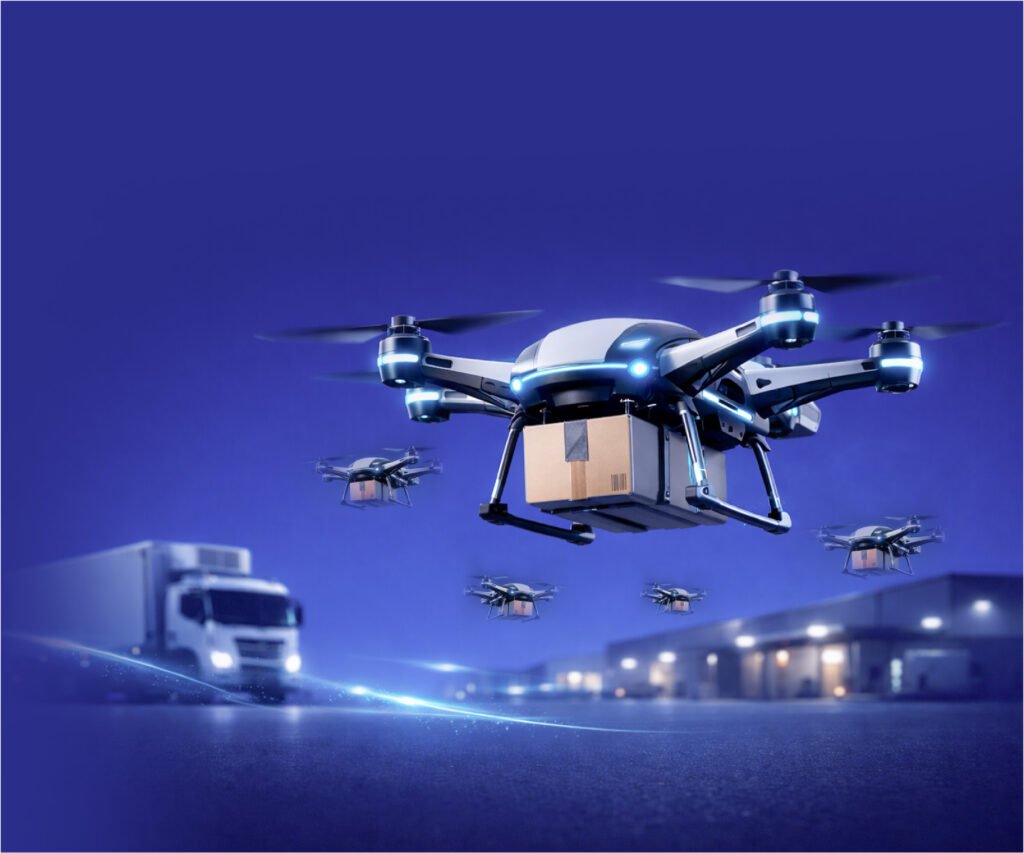
While estimates for the overall drone logistics market vary, industry reports suggest that India’s broader drone market was worth around $900–950 million in 2024 and could cross $3.2 billion by 2030, with the delivery drone segment growing at a CAGR of more than 50 percent, outpacing global peers.
Skye Air Mobility is often cited as one of the leading players in this space:
- It has executed millions of drone deliveries, crossing milestones such as 20 lakh (2 million) deliveries in 2025 and operating thousands of shipments per day across NCR and select metros.
- Its flagship drone platform can carry payloads of around 10 kg, operating at urban speeds that allow deliveries in under 10 minutes on certain routes.
- Each drone‑led delivery can meaningfully cut carbon emissions compared with road‑based last‑mile options, with internal estimates and media commentary suggesting that scaled fleets can save significant tonnes of CO₂ annually.
Beyond Skye Air, global and Indian players such as Zipline, and logistics partners working with major e‑commerce and healthcare companies, have been involved in BVLOS (Beyond Visual Line of Sight) trials to enable more flexible, longer‑range operations.
Policy tailwinds
The regulatory environment has become more supportive:
- The Drone Rules 2021 simplified permissions and moved from a permissions‑heavy “no‑fly‑unless‑approved” framework to a more facilitative digital regime.
- The Production Linked Incentive (PLI) scheme for drones and drone components, along with a GST reduction to 5 percent on drones and parts, has made manufacturing and deployment more attractive.
- Initiatives such as Drone Shakti and the DigitalSky platform aim to standardise approvals and create digital infrastructure for unmanned traffic management.
As these frameworks mature, drones are likely to become a mainstream option in segments such as medical supplies, high‑value B2B spares, rural deliveries and hyperlocal runs in congested urban zones.
Cold Chain Networks: Cutting Waste, Unlocking Value
Market size and growth outlook
Cold chain is a critical, but often overlooked, pillar of India’s logistics system. It underpins everything from fruits and vegetables to vaccines and specialty chemicals.
IMARC and other research providers estimate that:
- The India cold chain logistics market was valued at around $11.5–12.6 billion in 2024–25.
- It is projected to grow to $27–33 billion by the early‑to‑mid 2030s, implying a CAGR in the 8–17 percent range, depending on sub‑segments and methodology.
This growth is being driven by:
- Rising demand for fresh and frozen foods.
- Increased vaccine and pharma distribution needs.
- E‑commerce grocery and quick commerce pushing for more urban cold rooms and reefer fleets.
Technology, policy and the fight against post‑harvest loss
Post‑harvest losses for fruits and vegetables in India have historically been high, often estimated in the high single to mid‑teens as a percentage of output. Cold chain upgrades are helping reduce this through:
- IoT sensors and data analytics for real‑time temperature and humidity monitoring.
- Automation in warehouses (ASRS, conveyors) to improve handling efficiency.
- Multi‑temperature warehousing that can store different categories in a single facility.
Government schemes such as the Pradhan Mantri Kisan Sampada Yojana (PMKSY) and the National Cold Chain Grid are providing subsidies and policy support for cold storage, pack houses and reefer transport, particularly in rural and semi‑urban belts.
In pharmaceuticals, dedicated cold chains are being strengthened for vaccines, biologics and temperature‑sensitive drugs—a niche that offers higher value‑added margins.
Hyperlocal Delivery, Dark Stores and Quick Commerce
Quick commerce GMV and growth
Hyperlocal logistics and quick commerce are perhaps the most visible faces of India’s logistics revolution for urban consumers.
Industry trackers note that quick commerce GMV in India has surged from well under $1 billion in 2022 to an estimated $6–7 billion in 2024, and is expected to cross $10 billion in 2025, implying annual growth in the high double digits.
Some estimates peg the addressable quick commerce market at around $24 billion by 2028, with the segment growing at CAGRs exceeding 50 percent during the 2021–25 period.
Dark stores, routing and EV fleets
Leading quick commerce platforms have built dense networks of dark stores (micro‑fulfilment centres) and integrated them with AI‑driven routing and electric last‑mile fleets:
- Blinkit: market share estimated at roughly 40–45 percent, with a network of over 1,500 dark stores across major cities.
- Swiggy Instamart: around 25 percent share, with 1,000+ dark stores and aggressive sub‑20‑minute delivery promises.
- Zepto: about 20–22 percent share, reportedly executing over 1.5–1.7 million daily orders at the end of 2024 and continuing to scale.
These operations are underpinned by:
- AI‑based routing and slotting to optimise picking, packing and delivery routes.
- Electric two‑wheelers and three‑wheelers reducing fuel costs and emissions.
- Granular demand forecasting to minimise stockouts and wastage.
The result: urban consumers can receive groceries, snacks, personal care and essentials in 10–20 minutes, setting new benchmarks for service levels and forcing traditional retailers and logistics players to adapt.
Sustainability, EVs and Green Logistics
EV adoption in last‑mile delivery
Large platforms and retailers are steadily electrifying their fleets:
- Flipkart has publicly committed to 100 percent electric last‑mile delivery by 2030 and is reported to be operating tens of thousands of EVs in its network already.
- Amazon India has announced plans to deploy 10,000 electric delivery vehicles by 2025, supporting its global Climate Pledge targets.
Combined with government incentives for EVs under schemes like FAME, this push is lowering operating costs over time and reducing the carbon footprint of last‑mile logistics.
Green warehouses and multimodal logistics parks
Sustainability is also reshaping upstream logistics:
- Multimodal logistics parks (MMLPs) under PM Gati Shakti aim to integrate road, rail and waterways, improving efficiency and shifting freight away from pure road dependence.
- Renewable energy‑powered warehouses, rooftop solar installations and energy‑efficient design are becoming more common, particularly among large 3PLs and e‑commerce players.
These investments can offer relatively stable, annuity‑like cash flows for investors in logistics REITs, infrastructure funds and long‑lease warehousing platforms.
What Does It Mean for Investors?
Policy and capex create a multi-year opportunity
Between the National Logistics Policy, PM Gati Shakti, GST and sectoral schemes like PLI and PMKSY, India’s logistics ecosystem is receiving coordinated policy support.
For investors, this translates into opportunities across multiple layers:
- Core logistics and 3PL providers: Benefiting from formalisation, contract logistics growth and integrated solutions.
- Specialised logistics: Cold chain, pharma logistics, express delivery and cross‑border trade.
- Tech‑enabled players: SaaS platforms for routing, warehouse management, freight matching and visibility.
- Drone and automation companies: Hardware and software providers enabling autonomous and semi‑autonomous operations.
- Quick commerce and e‑retail: Platforms leveraging dark stores and dense delivery networks.
The sector already directly employs millions of people and is likely to add more jobs as skill development initiatives expand training for drivers, warehouse staff and control‑tower operators.
Example: capital flows into quick commerce
Funding trends underscore investor interest:
- Quick commerce platforms have raised large funding rounds in recent years, with companies like Zepto reportedly securing hundreds of millions of dollars and reaching multi‑billion‑dollar valuations as they scale across metros.
- Large incumbents such as Flipkart, Amazon, BigBasket and major grocery chains are investing aggressively in dark stores, EV fleets and proprietary logistics tech.
While headline valuations can be volatile, the underlying capex in warehouses, vehicles and technology is building durable infrastructure that will benefit the broader ecosystem.
Key risks to keep in mind
Investors should also be mindful of risks:
- Profitability pressure in quick commerce and drone logistics due to high capex and customer‑acquisition costs.
- Regulatory uncertainty, particularly around airspace management, data, labour and environmental norms.
- Execution risk in scaling complex networks across India’s diverse geography.
- Cyclicality linked to macro slowdowns, fuel prices and interest rates.
A diversified approach—spreading exposure across sub‑segments and focusing on players with strong balance sheets and operational discipline—can help manage these risks.
What’s Next? The Road (and Sky) Ahead
Looking forward, several themes are likely to define India’s logistics evolution over the next decade:
- Cost efficiency: The National Logistics Policy is targeting a reduction in logistics costs from roughly 13–14 percent of GDP to single digits, which would significantly enhance India’s export competitiveness.
- Multimodal integration: PM Gati Shakti and dedicated freight corridors will deepen rail and coastal shipping’s role in freight, easing pressure on roads.
- Automation and AI: Warehouses and fleets will see more robotics, computer vision, predictive maintenance and AI‑based decision systems.
- Drone traffic management: Unmanned Traffic Management (UTM) systems and open logistics networks will enable safe scaling of drones alongside manned aviation.
- Rural logistics and inclusivity: Better rural connectivity, local warehousing and postal‑logistics partnerships will bring e‑commerce and quick commerce deeper into Bharat.
If these pieces come together, India can build a logistics network that is faster, more cost‑efficient and more sustainable, providing a long‑term foundation for its manufacturing, consumption and export ambitions.
For investors willing to take a long‑term view, India’s logistics revolution is more than a buzzword—it is a decade‑long build‑out of critical infrastructure at the intersection of physical assets and digital intelligence.
Disclaimer
This article is for informational and educational purposes only and does not constitute financial, investment, tax, or legal advice. The statistics, projections and market views cited are based on publicly available reports and media coverage as of early 2026 and may change with new data or regulatory developments. Investing in logistics, infrastructure, technology or thematic sectors such as drones and quick commerce involves risk, including possible loss of capital. Readers should conduct their own research, assess their risk tolerance and investment horizon, and consult qualified financial professionals before making any investment decisions. References to specific companies, reports or schemes are illustrative and do not represent recommendations or endorsements.
