


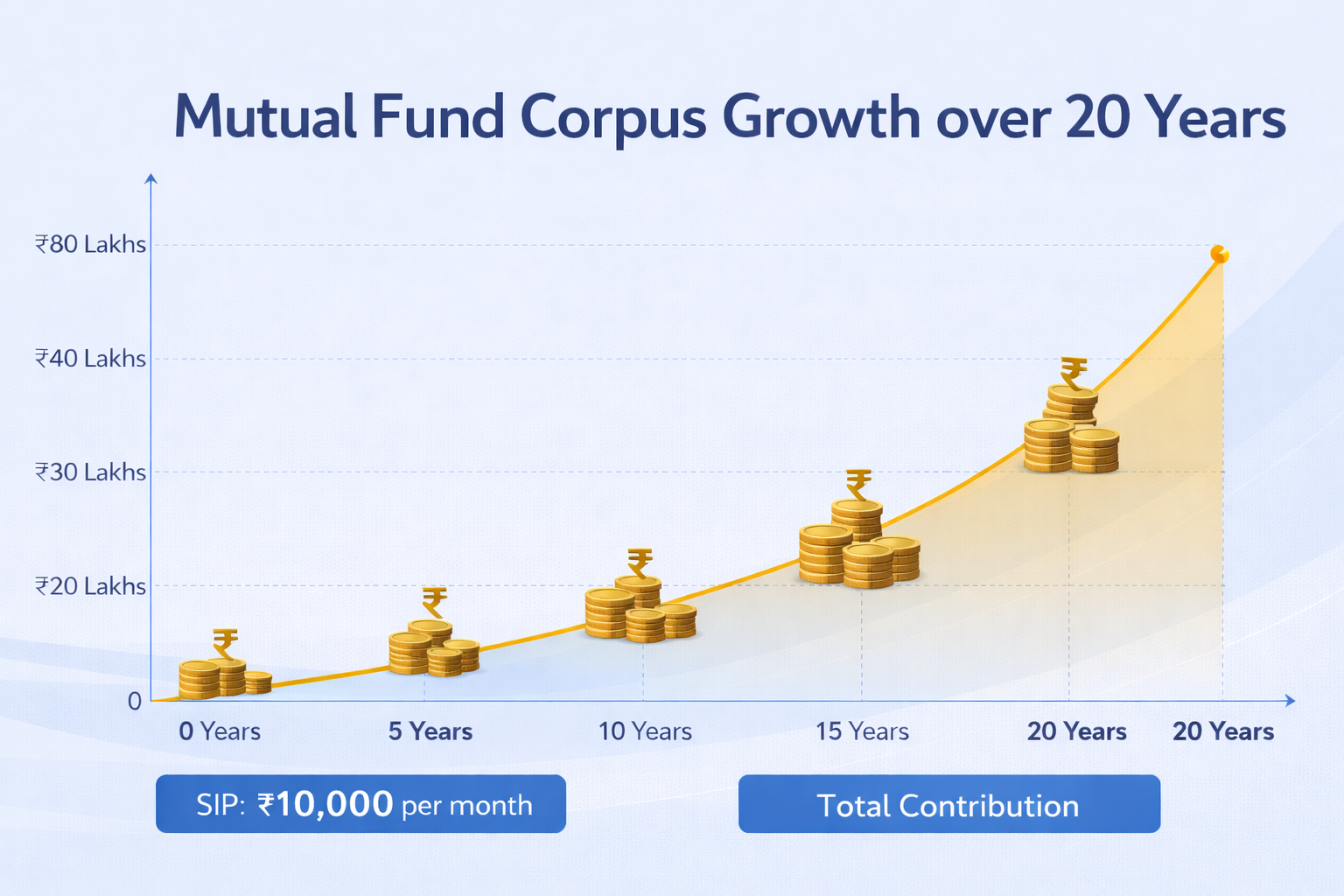
🧮 Jump straight to the tool? Use our free SIP Calculator to calculate your corpus instantly — no sign-up needed.
If you have ever wondered “How much will my ₹5,000 monthly SIP be worth in 20 years?” — you are asking exactly the right question. The answer, at a 12% annual return, is ₹49.96 lakh. That is nearly ₹50 lakh from a total investment of just ₹12 lakh.
This is the power of SIP — Systematic Investment Plan — and a good SIP calculator puts that power right in your hands.
In this guide, you will learn:
- What a SIP calculator is and how it works
- The formula used to calculate SIP returns
- How to use the Finovest SIP calculator step-by-step
- Real-world SIP examples with numbers
- Common mistakes investors make when reading SIP results
- FAQs answered plainly
What Is a SIP Calculator?
A SIP calculator is a simple online tool that tells you the estimated future value (corpus) of your mutual fund investments made through a Systematic Investment Plan.
You put in three inputs:
- Monthly SIP amount — how much you invest every month
- Expected annual return rate — what percentage return you expect per year
- Investment duration — how many years you plan to stay invested
And it instantly shows you:
- Total corpus at the end
- Total amount you invested
- Total wealth gained (the returns on top)
- Absolute return percentage
No spreadsheets, no complex math. Just actionable numbers.
The Formula Behind a SIP Calculator
Every SIP calculator uses one standard formula — the Future Value of an Annuity formula:
FV = P × [((1 + r)ⁿ − 1) / r] × (1 + r)Where:
- FV = Future Value (your final corpus)
- P = Monthly SIP amount
- r = Monthly interest rate = Annual rate ÷ 12
- n = Total number of months = Years × 12
Example: ₹5,000/month for 10 years at 12% p.a.
- P = ₹5,000
- r = 12% ÷ 12 = 1% = 0.01
- n = 10 × 12 = 120 months
FV = 5000 × [((1.01)¹²⁰ − 1) / 0.01] × 1.01
FV = 5000 × [2.3004 − 1) / 0.01] × 1.01
FV = 5000 × 130.04 × 1.01
FV = ₹11,61,695
Total invested: ₹5,000 × 120 = ₹6,00,000
Wealth gained: ₹11,61,695 − ₹6,00,000 = ₹5,61,695
Returns: 93.6% on your investment
That is your money nearly doubling in 10 years with a ₹5,000/month commitment.
How to Use the Finovest SIP Calculator
Our SIP Calculator is designed to give you results in under 10 seconds. Here is exactly how to use it:
Step 1 — Enter Your Monthly SIP Amount
Type in the amount you want to invest every month. Use the quick-select chips for ₹1K, ₹3K, ₹5K, ₹10K, ₹25K or ₹50K — or enter any custom amount.
Step 2 — Set Your Expected Return Rate
Drag the slider or pick a preset:
- 8% — Conservative (debt funds, hybrid funds)
- 12% — Moderate (large-cap / diversified equity mutual funds)
- 15% — Aggressive (mid-cap / small-cap funds, higher risk)
Step 3 — Choose Investment Duration
Drag the years slider from 1 to 40 years. Use presets like 5, 10, 15, 20 or 30 years.
Read Your Results
The calculator instantly shows you:
- Estimated Corpus — your total wealth at the end
- Amount Invested — actual money you put in
- Wealth Gained — how much the market added
- Absolute Returns — gains as a % of invested amount
- Gains Multiplier — how many times your money multiplied
- A donut chart breaking invested vs gains visually
- A year-by-year table showing exactly how your money grows each year
You can also share results on WhatsApp or Email with one tap.
Real SIP Examples: See the Numbers
Example 1 — The ₹5,000/month Beginner
| Duration | Invested | Corpus | Gain |
|---|---|---|---|
| 5 years | ₹3 L | ₹4.12 L | ₹1.12 L |
| 10 years | ₹6 L | ₹11.61 L | ₹5.61 L |
| 20 years | ₹12 L | ₹49.96 L | ₹37.96 L |
| 30 years | ₹18 L | ₹1.76 Cr | ₹1.58 Cr |
Assumed return: 12% p.a.
A ₹5,000 monthly SIP held for 30 years crosses ₹1.76 crore — from just ₹18 lakh invested. This is the power of compounding at work.
Example 2 — The ₹10,000/month Investor
| Duration | Invested | Corpus | Gain |
|---|---|---|---|
| 10 years | ₹12 L | ₹23.23 L | ₹11.23 L |
| 15 years | ₹18 L | ₹50.45 L | ₹32.45 L |
| 20 years | ₹24 L | ₹99.91 L | ₹75.91 L |
Assumed return: 12% p.a.
A ₹10,000/month SIP crosses ₹1 crore in just over 20 years.
Example 3 — What if you start late?
| Start Age | Monthly SIP | Duration | Corpus at 60 |
|---|---|---|---|
| 25 years | ₹5,000 | 35 years | ₹3.24 Cr |
| 30 years | ₹5,000 | 30 years | ₹1.76 Cr |
| 35 years | ₹5,000 | 25 years | ₹94.88 L |
| 40 years | ₹5,000 | 20 years | ₹49.96 L |
Assumed return: 12% p.a.
Starting at 25 vs 40 — same ₹5,000/month — gives you 6.5× more wealth at retirement. This single table is the strongest argument for starting your SIP today.
What Return Rate Should You Use?
This is the most common question about SIP calculators — and the most misunderstood.
The return rate you enter is an assumed average annual return, not a guaranteed figure. Here is a practical guide:
| Fund Category | Conservative Estimate | Historical Range |
|---|---|---|
| Large-Cap Equity | 10–11% | 9–14% (10-yr CAGR) |
| Flexi-Cap / Diversified | 11–12% | 10–15% |
| Mid-Cap Equity | 12–14% | 11–18% |
| Small-Cap Equity | 13–15% | 12–22% |
| Hybrid / Balanced | 9–11% | 8–13% |
| Debt Funds | 6–8% | 5–9% |
| Liquid / Money Market | 6–7% | 5–7% |
Practical advice: For long-term planning (10+ years), use 12% for diversified equity and 8% for debt. These are conservative but realistic based on Indian market history.
⚠️ Important: Mutual fund returns are market-linked and not guaranteed. Past performance does not assure future returns. Use the calculator for planning and comparison, not as a guarantee.
SIP vs Lumpsum: Which Is Better?
| Factor | SIP | Lumpsum |
|---|---|---|
| Capital needed upfront | Low (monthly) | High (one shot) |
| Market timing risk | Low (rupee cost averaging) | High |
| Discipline required | Built-in | Self-managed |
| Best for | Salaried investors | Windfall / bonus money |
| Returns in bull market | Slightly lower | Higher |
| Returns in volatile market | Better | Lower |
Bottom line: SIP is better for most salaried individuals because it removes the need to “time the market.” Both strategies can coexist — use SIP for your monthly income and lumpsum for bonuses or tax refunds.
5 Mistakes Investors Make When Using a SIP Calculator
1. Treating the result as a guarantee
The corpus figure is an estimate based on assumed returns. Markets fluctuate. Use it for goal planning, not as a fixed target.
2. Ignoring inflation
A corpus of ₹50 lakh in 20 years will not have the same purchasing power as ₹50 lakh today. Pair your SIP calculator with our Inflation Goal Calculator to see the real picture.
3. Using too optimistic a return rate
Many investors plug in 18–20% returns based on recent small-cap performance. Over a 20-year horizon, 12% for diversified equity is a more prudent planning assumption.
4. Stopping SIP during market downturns
Market dips are when SIP actually buys more units at lower prices — this is rupee cost averaging working in your favour. Stopping during dips defeats the purpose.
5. Not increasing SIP amount over time
Your income grows over time. Your SIP should too. Even increasing your SIP by 10% every year (called a Step-Up SIP) can dramatically increase your final corpus. Try our Step-Up SIP Calculator to see the difference.
Frequently Asked Questions
Q: Is the SIP calculator free to use?
Yes. The Finovest SIP Calculator is completely free, requires no login and has no usage limits.
Q: Does the calculator account for taxes on SIP returns?
No — the results shown are pre-tax. Equity mutual fund gains held over 1 year are subject to LTCG tax at 12.5% above ₹1.25 lakh per year (as per Budget 2024). For precise post-tax calculations, consult a tax advisor.
Q: Is SIP only for mutual funds?
SIP as a concept means investing a fixed amount at regular intervals. While it is most commonly used for mutual funds, you can also do SIP in stocks (through SIP-based platforms), gold ETFs, and NPS.
Q: How is SIP return different from FD return?
FD gives a guaranteed fixed return (currently 6.5–7.5%). SIP in equity mutual funds gives variable, market-linked returns that have historically been higher over long periods — but with short-term volatility. SIP is not suitable for money you need within 1–2 years.
Q: What is the minimum SIP amount?
Most mutual funds in India allow SIPs starting at ₹100/month. Some funds have a ₹500 minimum. The commonly recommended starting point is ₹500–₹1,000/month if you are a first-time investor.
Q: Can I pause or stop my SIP?
Yes. Most mutual funds allow you to pause a SIP for 1–3 months or stop it permanently without penalty. However, stopping a SIP locks in whatever units you have — you can still stay invested and withdraw later.
The Bottom Line
A SIP calculator is not just a number-cruncher — it is a goal visualisation tool. It converts the abstract idea of “I want to invest” into a concrete picture: if I invest ₹X every month for Y years, I will have ₹Z.
That clarity is what makes SIPs so powerful for Indian investors. You do not need to pick stocks, time the market or have a large sum to start. You just need consistency and time.
The best time to start a SIP was yesterday. The second best time is today.
Use the Finovest SIP Calculator to run your own numbers. Then explore our Inflation Goal Calculator to ensure your corpus will be enough in real terms when you need it.
Disclaimer: This article is for educational purposes only and does not constitute financial advice. Mutual fund investments are subject to market risk. Please read all scheme-related documents carefully before investing. Consult a SEBI-registered investment advisor for personalised advice.
Related Tools on Finovest:
- Inflation Goal Calculator
- EMI Calculator
- FD / RD Maturity Calculator (coming soon)
- Retirement Corpus Calculator (coming soon)
- Step-Up SIP Calculator (coming soon)
