


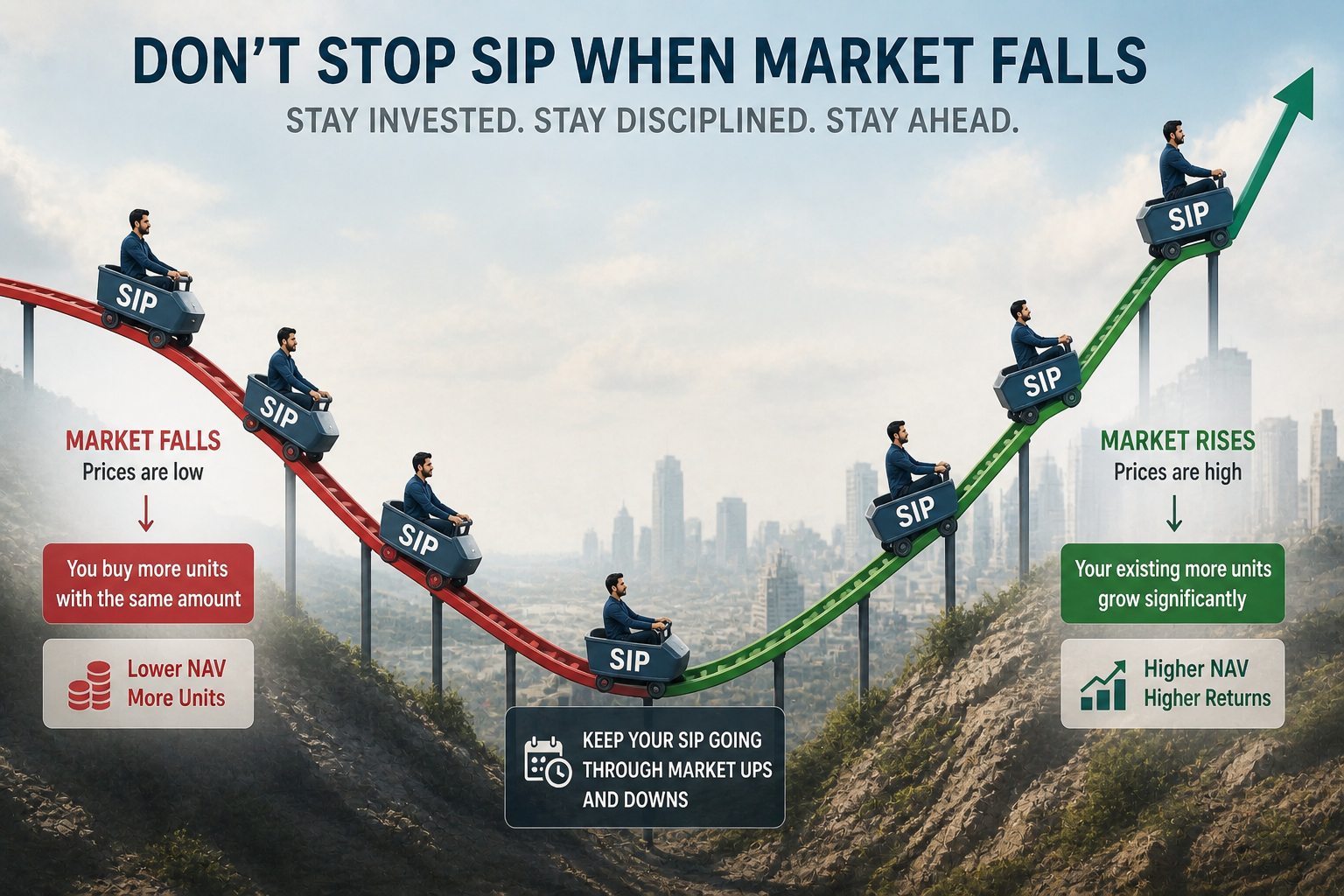
Introduction: When volatility hits, discipline is tested
Stock market fluctuations do not just move numbers on a screen; they test an investor’s patience, discipline and faith in their plan. When markets fall sharply, it is natural to feel uneasy opening your app and seeing red. For many people, the first instinct is to hit “pause” on their SIPs, reasoning that it is safer to wait for things to stabilise.
Yet this instinct often works against long‑term wealth creation. The very periods that feel the scariest are usually the ones where SIPs quietly do their best work: buying more units at lower prices and setting you up for stronger recovery when markets bounce back. This article explains, why stopping your SIP during market falls is usually a mistake, what rupee cost averaging really does for you, and how to handle volatility without derailing your plan.
What’s really happening when markets fall?
When markets fall, two things happen simultaneously:
- The value of your existing investments goes down.
- The price of new units you can buy through SIPs goes down as well.
Most investors focus only on the first part – seeing their portfolio temporarily drop – and ignore the second, more powerful part: every SIP instalment now buys more units at lower NAVs.
The concept behind this is called rupee cost averaging. Instead of trying to guess the right time to invest, you commit a fixed amount regularly. When NAVs are high, you buy fewer units; when NAVs are low, you buy more. Over time, this tends to reduce your average cost per unit compared to investing everything at a single point in time.
Educational resources from Indian mutual fund houses and advisors repeatedly show that SIPs become even more powerful in volatile or falling markets because they automatically “buy the dip” without you having to make fresh decisions every month.
Rupee cost averaging: Why lower NAVs are your friend
Imagine you invest ₹10,000 every month in an equity fund via SIP. If the NAV is ₹100, you buy 100 units. If the NAV temporarily falls to ₹80, the same ₹10,000 buys 125 units. You feel bad seeing the earlier units show a notional loss, but your latest instalment quietly picked up a bargain.
Over time, this pattern leads to a lower average cost per unit than the simple average of NAVs, because you bought more units when they were cheaper.
Several Indian examples illustrate this:
- A rupee cost averaging explainer from Groww shows how investing the same ₹10,000 over different months at different NAVs leads to an average purchase price lower than the average NAV.
- FinEdge and other advisors demonstrate cases where SIPs through volatile periods accumulate more units and end up ahead of lump sum investments made at a single point.
The key idea: if your time horizon is long, falling NAVs are not just “losses” – they are temporary markdowns on future growth. Your SIP is designed to take advantage of these markdowns.
Why stopping SIP during crashes usually backfires
From the outside, pausing a SIP during a crash looks sensible – “why buy when everything is falling?” But when you see how SIPs work, you realise that this often means skipping the very months that would have helped you most.
Behavioural trap: Stopping at the bottom, restarting at the top
Common pattern:
- Markets fall, portfolio looks bad, fear rises.
- Investor pauses SIP “for a few months” to wait for clarity.
- Markets recover; confidence returns only after prices have already risen.
- Investor restarts SIP at higher NAVs.
Tools and case studies that simulate SIP performance around crashes show how costly this behaviour can be.
- A 2026 analysis of Indian SIP investors found that about 18 percent paused their SIPs during the March 2020 crash and missed a large part of the subsequent recovery.
- A calculator case study comparing three investors around the 2008 crash showed that the one who continued SIP throughout ended up with a significantly higher corpus than the one who paused for just six months; the investor who stopped and withdrew in panic locked in permanent losses.
These examples highlight an important point: the biggest risk is not market volatility itself, but behavioural volatility – changing your plan at exactly the wrong time.
Hypothetical illustration of the “pause cost”
To make the idea concrete, consider a simplified, illustrative scenario:
- You run a ₹10,000 SIP in an equity fund at ₹100 NAV (buying 100 units per month).
- In a temporary downturn, NAV falls to ₹80 for three months.
- If you continue, those three instalments buy 125 units each – 375 units total.
- If you pause, you miss accumulating those 375 units.
Years later, if the NAV recovers to, say, ₹150, those 375 units alone would be worth ₹56,250. By pausing, you have simply skipped buying units when they were on “sale”. The numbers will differ in real life, but the direction of impact is the same.
Calculators that model real crash periods (2008, 2020, 2022) consistently find that even 3–6 months of paused SIPs can create noticeable gaps in long‑term corpus values. The so‑called “safe” decision of pausing often translates into a very real opportunity cost.
SIP performance in major crashes: 2008 and 2020
Looking at history helps you separate emotion from evidence.
2008 Global Financial Crisis
During the 2008 crisis, the Nifty 50 fell roughly 50–60 percent from its peak, with many investors seeing their portfolios halve on screen. It was an extremely unpleasant experience – but for SIP investors who continued, it also meant buying units at prices that, in hindsight, were deeply discounted.
Analyses of long‑term SIPs starting before 2008 show that investors who kept investing during and after the crash ended up with significantly higher corpus values after 8–10 years than those who stopped contributions for a year or two.
2020 COVID‑19 crash
In early 2020, the Nifty 50 plunged nearly 39 percent within weeks due to COVID‑19 and lockdowns. Yet the recovery was surprisingly swift: the index hit new highs within months.
Data and case studies show that:
- SIP investors who continued through March–April 2020 accumulated units at very low NAVs.
- Those units multiplied in value as markets rebounded later in 2020 and 2021.
- Investors who paused or stopped missed some of the fastest recovery gains, even if they re‑entered later.
The lesson from both episodes is consistent: markets crash, but they also recover. SIPs only work if you allow them to keep buying through both phases.
Volatility doesn’t break SIPs, it powers them
Many investors treat volatility as a “problem” that needs to be avoided. In reality, volatility is the raw material SIPs use to create value.
Research on rupee cost averaging emphasises that investing a fixed amount regularly across market cycles helps:
- Lower average cost per unit over time.
- Reduce the impact of poor market timing.
- Promote discipline and commitment regardless of short‑term noise.
Articles from mutual fund houses and advisors repeatedly note that long‑term SIP returns are not very sensitive to whether you started exactly at a market peak or a bottom. What matters far more is how long you stayed invested and whether you kept contributing during downturns.
Even beyond equities, analyses of long‑term SIPs in assets like gold show that 10‑year SIPs have historically delivered positive returns across most periods, despite sharp interim swings. Again, the winning behaviour is consistency, not perfect timing.
Behaviour vs strategy: The real weak link
On paper, SIPs are a robust strategy. In real life, the weak link is often investor behaviour.
Common behavioural mistakes during market falls:
- Checking portfolios too frequently: Daily or hourly updates magnify short‑term moves and trigger emotional reactions.
- Anchoring to peak values: Comparing current values only to the highest point ever reached, instead of original cost or long‑term goals.
- Chasing safety at the wrong time: Redeeming or pausing SIPs after a big fall, effectively converting temporary notional losses into permanent ones.
- Restarting only after markets feel “safe”: Waiting for green screens and good news, which usually means prices are already higher.
Behavioural finance pieces on SIPs stress that trying to time market bottoms consistently is practically impossible for most investors. Rupee cost averaging is a practical workaround: it acknowledges that you will never pick the perfect day, so you pick many days instead.
When does it make sense to pause or stop SIPs?
All of this does not mean you should blindly continue SIPs in every situation. There are valid reasons to pause or stop:
- Income disruption: Job loss, salary cuts, or business downturns that make it hard to meet basic expenses.
- Genuine financial emergency: Medical crises, family emergencies, or essential obligations that require liquidity.
- Change in goals or asset allocation: If your investment objective has been met or your time horizon has shortened significantly (for example, you are 1–2 years from a goal), it may be appropriate to reduce equity SIPs and move to safer assets.
In these cases, adjusting or pausing SIPs is a rational, holistic decision, not a reaction to market fear. The problem is when the only reason to pause is “markets are falling and I am scared.” In most long‑term scenarios, that is exactly when your SIP should keep going.
Practical ways to stay disciplined during market falls
Knowing that you should continue SIPs is one thing; actually doing it when headlines are screaming is another. A few practical habits can help.
1. Put SIPs on auto‑pilot
Set up mandates so that SIPs run automatically every month. Treat these as non‑negotiable commitments, like EMIs or rent, rather than optional investments. Automation reduces the number of decisions you need to make when emotions are running high.
2. Stop obsessively tracking short‑term values
Checking your portfolio daily during a crash is like weighing yourself after every meal during a diet. It only increases stress. Many advisors suggest:
- Limiting portfolio reviews to a fixed schedule (say, quarterly or half‑yearly) unless there is a major life event.
- Focusing reviews on progress towards goals rather than short‑term performance versus peaks.
3. Reframe crashes as “sale seasons”
When markets fall, think of it like a sale in a store you love: you can buy the same quality items at lower prices. Articles and SIP tools that show the long‑term impact of units bought during crashes can make this mental shift easier.
Some investors even use downturns to increase their SIP amounts slightly, if cash flows permit, to take extra advantage of lower valuations.
4. Use asset allocation and rebalancing
Maintaining a sensible mix of equity, debt, and other assets based on your goals can also help emotionally. When equity falls and debt holds steady, rebalancing by shifting some money into equity can feel less scary because you are following a rule, not a hunch.
Example structures and visuals you can add
For an article on Finovest, simple illustrations can make the concepts more tangible.
- SIP during crash vs SIP paused:
- Two lines showing corpus value over 10–15 years: one where SIP continues through a crash, one where SIP is paused for 6–12 months.
- Highlight the gap at the end and label it as “cost of pausing”.
- Units accumulated with and without pausing:
- Bar chart comparing total units accumulated by a continuous SIP versus a SIP that skipped several months of low NAVs.
- Rupee cost averaging table:
- A simple month‑by‑month table showing SIP amount, NAV, units bought, and cumulative units and cost, demonstrating how average cost per unit falls over time.
These visuals help investors see in one glance what dozens of market updates cannot convey.
What this means for you as an investor
Putting it all together:
- Market falls are uncomfortable but normal; they are part of every long‑term equity journey.
- SIPs are designed to harness this volatility through rupee cost averaging – buying more units when prices are low and fewer when prices are high.
- Historical evidence from crises like 2008 and 2020 shows that investors who continued or even increased SIPs tend to end up with larger corpuses than those who paused or exited.
- The real risk is often not market risk but behavioural risk – changing strategies out of fear, then returning only after the best opportunities have passed.
If your income and emergency fund are intact, the default choice in most downturns should be to keep your SIPs running. If your financial situation allows, thoughtfully increasing SIPs during deep corrections can be even more powerful. The aim is not to be fearless, but to have a plan that keeps working even when you feel afraid.
Wrapping up: Time in the market beats timing the market
Every market cycle, the same drama repeats: sharp falls, scary headlines, then eventual recoveries that look obvious only in hindsight. Trying to perfectly time these cycles is an almost impossible game, even for professionals.
SIPs and rupee cost averaging offer a different path. Instead of trying to jump in and out, you stay in with discipline, let volatility work in your favour, and allow compounding to do its job over years, not weeks. The investors who come out ahead are rarely the ones who guessed the exact bottom; they are the ones who kept showing up month after month, especially when it was hardest.
“Time in the market” really does tend to beat “timing the market” – provided you give your SIPs the one thing they need most: consistency.
Disclaimer
This article is intended solely for general information and educational purposes and does not constitute investment, tax, legal or other professional advice. The examples and scenarios discussed, including hypothetical SIP illustrations and references to historical market crashes, are for explanatory purposes only and do not represent guarantees of any future performance. Actual investment outcomes can vary significantly based on market conditions, product choices, costs and individual behaviour. Past performance of mutual funds, SIPs, equity markets, gold or any other asset class is not indicative of future results. Readers should carefully assess their financial situation, investment objectives, time horizon and risk appetite before making any investment decision, and consider seeking personalised guidance from a qualified, SEBI‑registered investment adviser or other licensed professional. Systematic Investment Plans do not eliminate market risks and do not assure a profit or protect against loss.
