


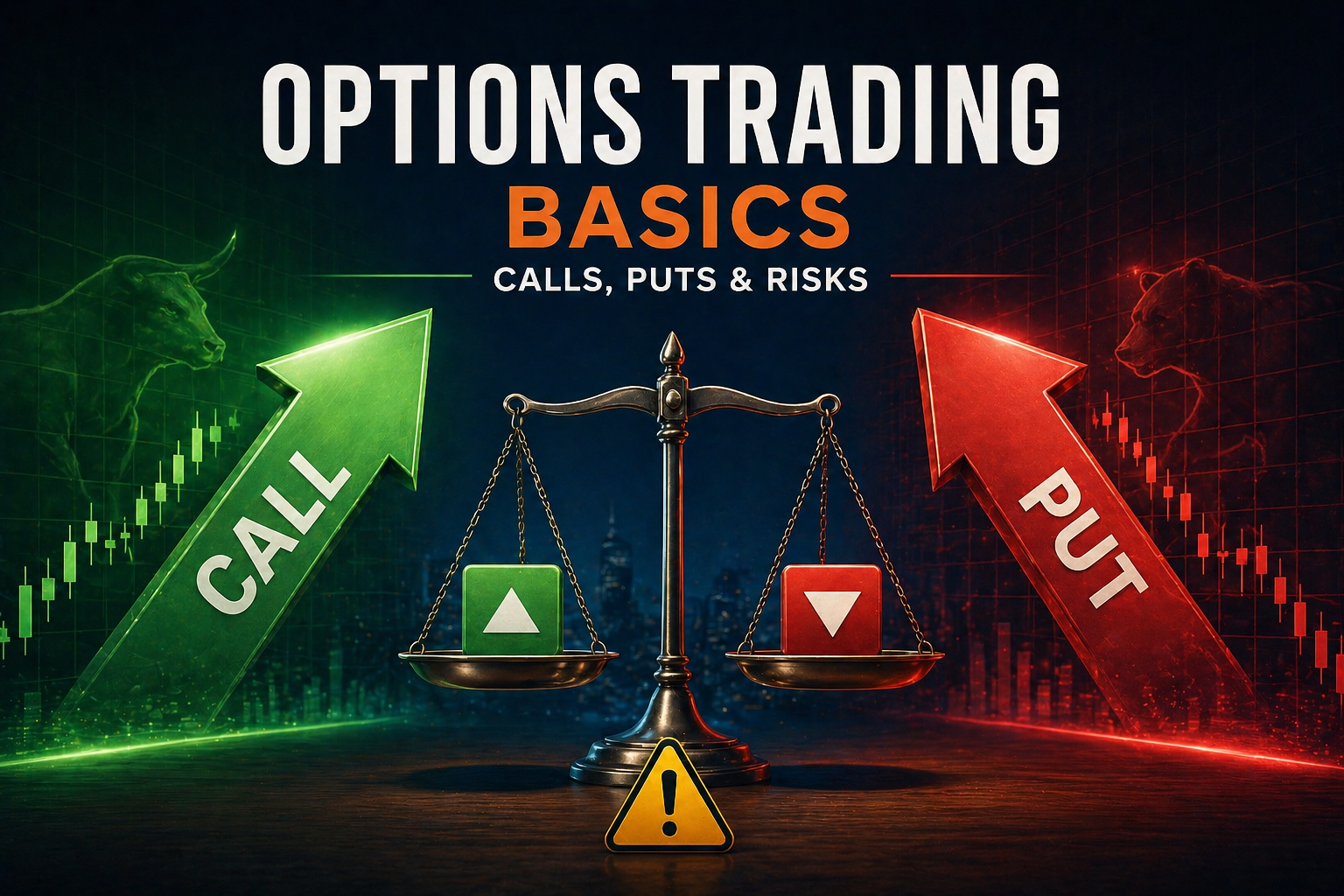
Introduction: Why options suddenly seem to be everywhere
Scroll through any trading app or social media feed and options strategies are everywhere – “lottery ticket” weekly calls, expiry‑day bets, and screenshots of overnight riches. For many new traders, options feel like a fast lane to big profits with small capital.
But regulators see a different side of the story. SEBI’s 2023 circular on risk disclosure for individual traders in equity F&O came after data showed a surge in retail participation alongside significant losses for many small traders. Exchanges and brokers are now required to flash prominent risk warnings and maintain profit‑and‑loss data for F&O clients, precisely because derivatives can amplify mistakes as easily as they amplify skill.
This article is a beginner‑friendly guide to options trading basics – what calls and puts are, how you can realistically use them, and the key risks you must understand before risking real money.
What is an option, in plain language?
An option is a financial contract that gives the buyer the right, but not the obligation, to buy or sell an underlying asset at a pre‑decided price (strike price) on or before a specific date (expiry). In exchange for this right, the buyer pays a premium to the seller (also called the writer).
Key building blocks:
- Underlying: The asset the option is based on – for example, a stock, index (like Nifty), or ETF.
- Strike price: The pre‑agreed price at which the underlying can be bought or sold if the option is exercised.
- Expiry date: The last date on which the option can be used; beyond this, it simply ceases to exist.
- Premium: The price of the option itself, paid upfront by the buyer to the seller.
- Lot size: Exchange‑defined quantity of the underlying per contract; equity options typically represent 100 shares in US markets and fixed lot sizes (such as 25, 50, etc.) in Indian markets.
The buyer has limited risk (the premium paid) but potentially large upside. The seller has limited upside (the premium received) but potentially large or even theoretically unlimited risk, depending on the position.
Calls vs puts: the two basic types
All option strategies are built from two basic instruments: call options and put options.
What is a call option?
A call option gives its buyer the right, but not the obligation, to buy the underlying at the strike price by the expiry date.
- Call buyer: Expects the underlying price to go up.
- Call seller (writer): Takes the opposite side, willing to potentially sell the underlying at the strike price if assigned.
Example (simplified):
- Stock ABC is trading at ₹100.
- You buy a one‑month ABC 105 call for a premium of ₹3.
- Lot size is 100 shares, so you pay ₹300 premium.
- If by expiry ABC is at ₹115, your call is ₹10 in‑the‑money (115 – 105). Gross intrinsic value is ₹1,000; minus ₹300 premium, net profit is ₹700 (before costs).
- If ABC stays below ₹105 at expiry, your call expires worthless and your loss is limited to the ₹300 premium.
This is why beginners often start with buying calls – limited risk, leveraged upside if the move happens in time.
What is a put option?
A put option gives its buyer the right, but not the obligation, to sell the underlying at the strike price by the expiry date.
- Put buyer: Expects the underlying price to fall (or wants protection against a fall).
- Put seller: Takes the opposite side, potentially obliged to buy the underlying at the strike price if assigned.
Example (simplified):
- Stock XYZ is trading at ₹100.
- You buy a one‑month XYZ 95 put for ₹2 (₹200 premium for 100 shares).
- If at expiry XYZ has fallen to ₹80, your put is ₹15 in‑the‑money (95 – 80). Gross intrinsic value is ₹1,500; net profit is ₹1,300 after the ₹200 premium, before costs.
- If XYZ stays above ₹95, your put expires worthless; your loss is the ₹200 premium.
Puts are often used as insurance (protective puts) to limit downside risk on stocks you already own.
Quick comparison: Calls vs puts
| Feature | Call option | Put option |
|---|---|---|
| Right for buyer | To buy the underlying at strike | To sell the underlying at strike |
| Buyer’s view | Bullish (expects price to rise) | Bearish (expects price to fall) or hedging long positions |
| Seller’s obligation | May have to sell the underlying at strike | May have to buy the underlying at strike |
| Profit profile for buyer | Profit if price rises sufficiently above strike + premium | Profit if price falls sufficiently below strike – premium |
| Max loss for buyer | Limited to premium paid | Limited to premium paid |
| Risk for uncovered seller | Theoretically unlimited on short calls | Substantial on short puts if price collapses |
Understanding this basic table is essential before moving to any complex options strategies.
Intrinsic value, time value and why options aren’t cheap “lottery tickets”
The premium you pay or receive for an option is not random. It is made up of two parts:
- Intrinsic value: The amount the option is in‑the‑money right now.
- For a call: max(spot price – strike, 0).
- For a put: max(strike – spot price, 0).
- Time value (extrinsic value): The extra amount you pay for the possibility the option becomes more profitable before expiry.
If Nifty is at 22,000, a 21,500 call has intrinsic value of 500 points; a 23,000 call has zero intrinsic value and only time value.
As expiry approaches, this time value decays, a phenomenon known as theta decay. For long options (options you bought), theta is always negative – every day that passes, the option tends to lose some time value if everything else stays the same. For sellers, the opposite is true – they benefit from time decay, all else equal.
Educational resources and brokers warn that this time decay accelerates as expiry nears, especially for at‑the‑money options, making last‑minute speculative buying particularly risky.
The Greeks: Why price direction alone isn’t enough
Options traders use a set of risk measures called the Option Greeks to understand how sensitive an option’s price is to different factors: price movement, time decay, and volatility.
The most important ones for beginners:
- Delta: How much the option’s price is expected to move if the underlying moves by one unit.
- Theta: How much the option is expected to lose (or gain) per day solely due to time decay.
- Vega: How sensitive the option is to changes in implied volatility.
For this article, theta is the one you must respect. Guides from brokers and educational platforms stress that theta is always negative for long options, meaning that if you are a buyer, time is working against you – the longer the market goes nowhere, the more your option bleeds value.
This is why profitable option buying is not just about being right on direction, but also about being right on timing and volatility.
Basic option strategies every beginner should know
Most beginners do not need complex spreads or exotic strategies. Four foundational strategies cover a large part of practical use‑cases.
1. Buying calls – directional upside with limited risk
- Use when you are bullish but want to limit downside.
- You pay a premium; your maximum loss is that premium.
- Upside is theoretically large, but you need the move to happen before expiry and large enough to cover the premium and costs.
This can be a capital‑efficient way to express a view, but frequent, random call buying (especially deep out‑of‑the‑money, near‑expiry options) behaves more like a lottery than an investment.
2. Buying puts – insurance or bearish bets
- Use protective puts to insure a stock or index portfolio against big downside.
- Alternatively, buy puts when you are bearish but do not want to short the stock directly.
Educational examples from brokers show that protective puts cap downside on a stock position at the cost of the premium, functioning like an insurance policy. This can be useful during uncertain markets, but repeated hedging can become expensive if used constantly.
3. Covered calls – generating income on stocks you own
A covered call involves:
- Holding the underlying stock.
- Selling a call against it, typically out‑of‑the‑money.
You collect premium income, which provides a buffer against small price declines, but if the stock rallies beyond the strike, you may have to sell at that strike price, capping your upside. This is often seen as a more conservative strategy compared to naked call writing because your potential obligation to deliver shares is covered by stock you already own.
4. Cash‑secured puts – getting paid to potentially buy lower
A cash‑secured put involves:
- Selling a put on a stock you would not mind owning.
- Keeping enough cash aside to buy the shares if assigned.
If the stock stays above the strike, you keep the premium as income. If it falls below, you may have to buy at the strike price, which should ideally be a level you are comfortable owning at. This can be a disciplined way to enter positions, but losses can be significant if the stock collapses.
Why SEBI is worried: Real risks retail traders face
SEBI’s 2023 risk‑disclosure circular was prompted by concerns that many individual traders were entering F&O without fully understanding the downside. The circular mandates that brokers show prominent risk disclosures to clients at login and maintain profit–loss data for at least five years.
Key risks highlighted by SEBI and exchanges include:
- High probability of loss for frequent traders: Historical data indicates that a large majority of individual F&O traders lose money after costs, especially those engaging heavily in short‑term speculative trades.
- Leverage amplifying losses: Margin allows you to control large positions with smaller capital, but adverse moves can lead to rapid, large losses and margin calls.
- Complexity and non‑linear pay‑offs: Unlike direct equity, option pay‑offs are non‑linear and influenced by time and volatility, not just direction.
- Liquidity and slippage: Illiquid strikes can have wide bid–ask spreads, leading to poor fills and larger‑than‑expected losses.
Regulators and depositories emphasise that options are not appropriate for all investors and that individuals should carefully assess their risk appetite and understanding before trading.
Risk profile: Option buyers vs option sellers
A common misunderstanding is that buying options is “safer” because the loss is limited to the premium, and selling options is automatically “smarter” because time decay works in your favour. The truth is more nuanced.
Option buyers
- Pros:
- Limited risk – you cannot lose more than the premium.
- Leverage – a small favourable move can produce large percentage gains.
- Cons:
- Negative theta – options lose value every day; you must be right on direction and timing.
- Many cheap, out‑of‑the‑money options expire worthless, especially when bought close to expiry.
Buying options without a clear plan often leads to repeated small losses that add up over time.
Option sellers
- Pros:
- Positive theta – you benefit from time decay if the market stays within your expected range.
- Profitable even if the underlying moves a bit against you, as long as it does not cross your break‑even point.
- Cons:
SEBI’s messaging makes clear that while many strategies can be framed as “income‑generating”, individual traders must recognise that option writing without hedges can expose them to large, sudden losses.
Time decay (theta): The silent killer for option buyers
Time decay deserves special attention because it is invisible in a simple price chart of the underlying.
- Theta measures how much an option’s price is expected to fall purely due to time passing, assuming price and volatility stay the same.
- For long options, theta is negative; for short options, theta is positive.
- Time decay accelerates as expiry approaches, particularly for at‑the‑money options which have the highest time value.
Educational articles and broker guides illustrate this with examples where a long call can lose value even if the stock moves slightly in the right direction, simply because time value erodes faster than intrinsic value grows. For expiry‑day speculators, this means small delays can turn a promising trade into a losing one very quickly.
This is why many experienced traders advise beginners to first understand and respect theta before trading short‑dated options aggressively.
Simple graphs you can use in the article
To make these concepts more tangible in a blogpost, you can include or later design simple charts:
- Pay‑off diagram of a long call and long put:
- X‑axis: underlying price at expiry.
- Y‑axis: profit/loss.
- Shows limited downside (premium) and leveraged upside for calls and puts.
- Time decay curve:
- X‑axis: days to expiry.
- Y‑axis: option time value.
- Curve slopes downward, steepening near expiry, illustrating why last‑minute option buying is risky.
- Buyer vs seller risk profile:
- Side‑by‑side bar chart of max profit, max loss, and probability of small vs large outcomes for an option buyer versus a naked option seller.
These visuals can help new readers “feel” the asymmetry and non‑linear nature of option pay‑offs.
Building a sensible approach to options
If you are curious about options but wary of the horror stories, a few practical principles can help.
1. Treat options as tools, not shortcuts
Options can be used conservatively – to hedge, generate incremental income, or structure entries – or aggressively – for leveraged bets. Beginner‑friendly guides stress starting with simple, defined‑risk strategies before moving to complex or leveraged ones.
Ask yourself before every trade:
- What exact scenario am I betting on (direction, magnitude, time)?
- How much am I willing to lose if I am wrong?
- Does this trade complement or contradict my broader portfolio?
2. Position sizing and risk caps
Risk‑management resources for options emphasise limiting the percentage of capital risked per trade and per strategy.
- Cap the amount you lose on any single trade (for buyers, the premium; for sellers, a pre‑defined stop or hedged structure).
- Avoid concentrating large positions on a single expiry or strike.
- Remember that no single trade should be able to significantly damage your long‑term capital.
3. Prefer defined‑risk structures
Instead of naked selling, consider spreads (like buying one option and simultaneously selling another at a different strike) which limit maximum loss at the cost of capped profit. Many beginner guides recommend spreads as a safer way to learn about options while controlling the downside.
4. Respect SEBI’s intent: these are high‑risk instruments
SEBI’s risk‑disclosure circular and the requirement for brokers to show prominent warnings are strong signals that F&O is not meant for casual or uninformed speculation.
Before scaling up, ask:
- Have I traded options on paper or in a simulator long enough to understand how they behave near expiry and around events?
- Do I understand the margin, assignment and exercise rules of my broker and exchange?
- Am I clear about the tax implications of F&O in my jurisdiction?
If the answer to any of these is “no”, it is worth slowing down.
Key takeaways
- Options are contracts that give buyers the right, but not the obligation, to buy or sell an underlying at a set price before expiry, in exchange for a premium.
- Calls are typically used for bullish views and puts for bearish views or protection, but both have limited risk for buyers and potentially large risk for sellers, especially when positions are unhedged.
- Time decay (theta) causes options to lose value as expiry approaches, which hurts buyers and benefits sellers; this effect accelerates near expiry and is strongest for at‑the‑money options.
- SEBI’s risk‑disclosure circular for individual traders in the equity F&O segment underscores that derivatives trading carries significant risks and is unsuitable for all investors, making education and disciplined risk management essential.
Disclaimer
This article is intended solely for general information and educational purposes and does not constitute investment, tax, legal or other professional advice. Options and other derivative instruments are complex, high‑risk products and may not be suitable for all investors. Examples provided are simplified and hypothetical, and they do not represent recommendations, solicitations, or guarantees of any outcome. Real‑world trading involves transaction costs, margin requirements, tax rules, and other factors not fully reflected here. Before trading options or any other derivatives, readers should carefully assess their financial situation, objectives, risk appetite, and level of experience, and consider seeking advice from a qualified, SEBI‑registered investment adviser, broker, or other licensed professional. Regulatory frameworks and market practices are subject to change, and readers should refer to the latest SEBI and exchange circulars, risk disclosures, and broker‑specific terms before engaging in F&O trading.
