


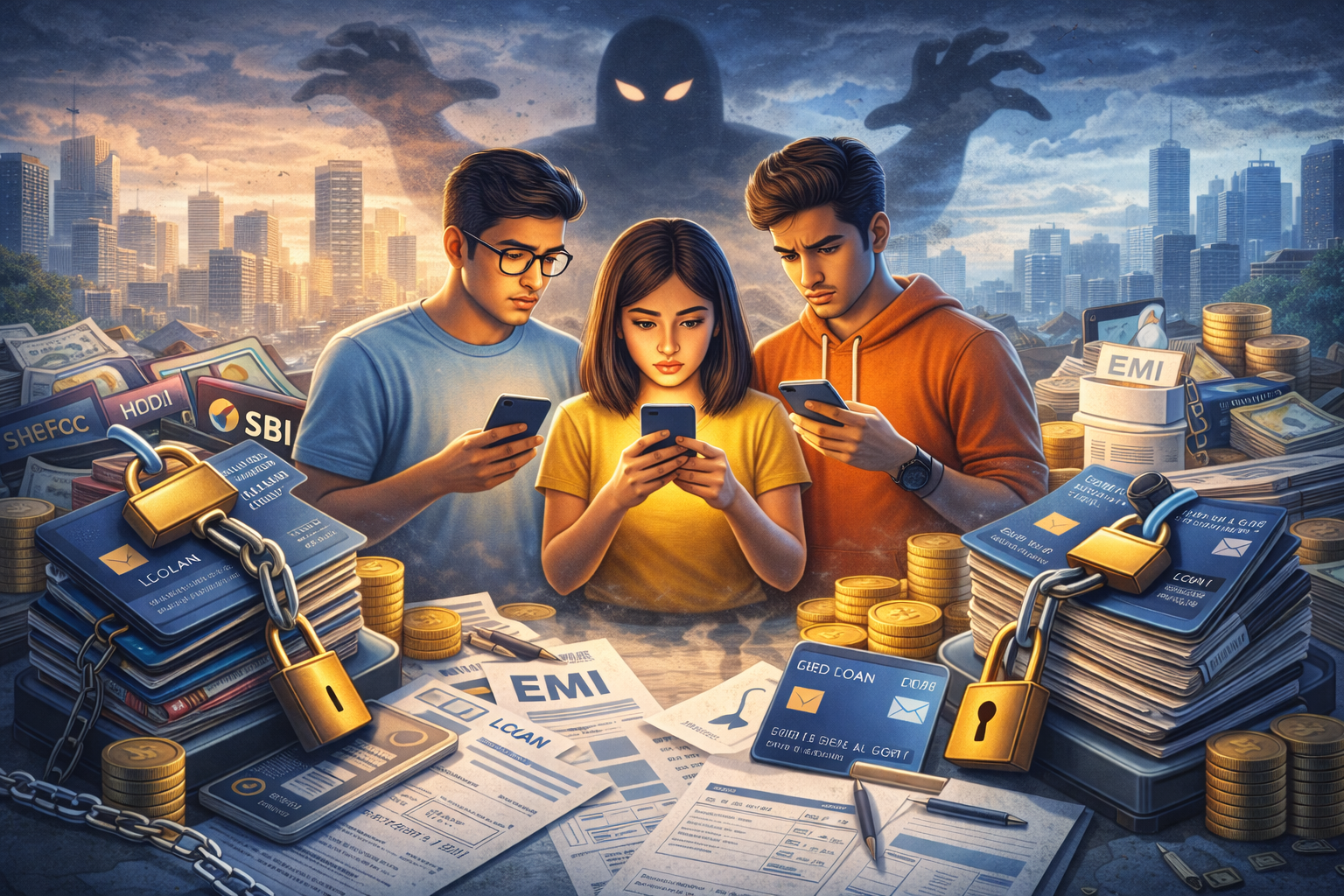
Introduction: A Young India, A Credit-Hungry India
Walk into any café, scroll through any social media feed, or glance at your UPI notifications, and one trend stands out: young Indians are using credit like never before. EMIs for phones and laptops, “pay in 3” buttons on shopping apps, travel booked on credit cards, and micro-loans for lifestyle expenses have quietly become the norm.
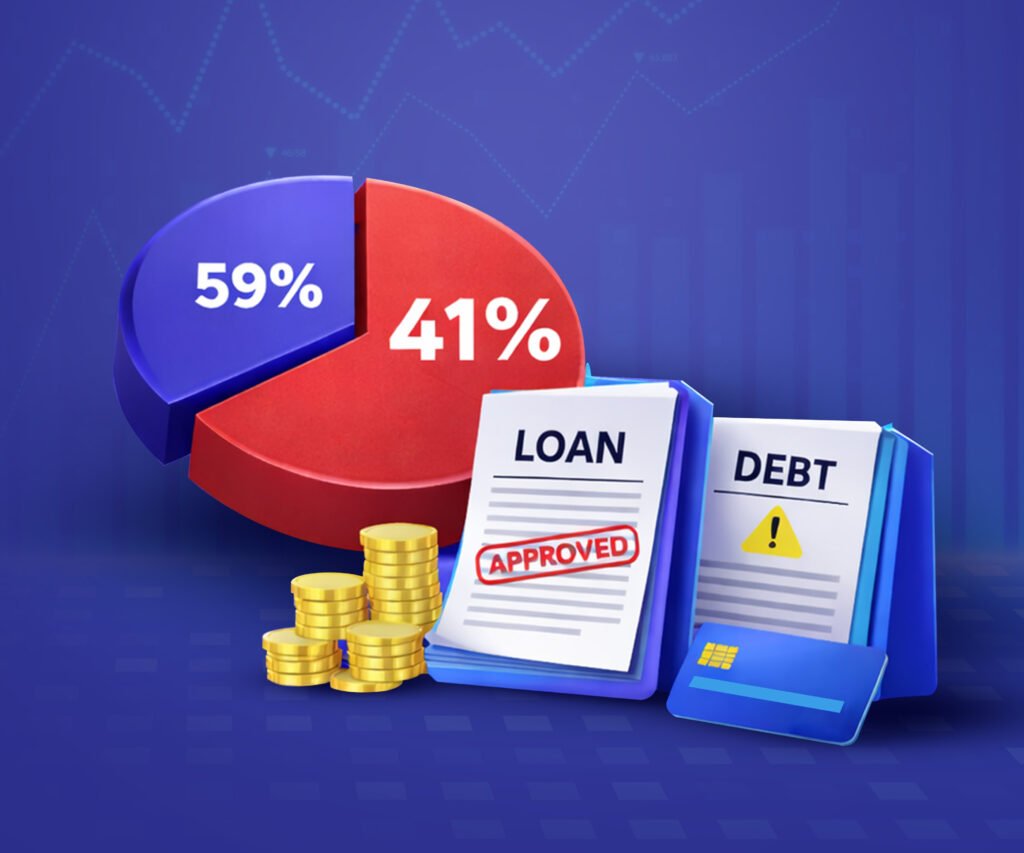
Behind this behavioural shift lies a startling data point. According to TransUnion CIBIL’s latest Credit Market Indicator (CMI) insights, 41 percent of first-time borrowers in India are now from Gen Z, broadly those aged around 18 to 30. At the same time, credit card overdues in the 91–360 days bucket have surged by about 44 percent year-on-year to roughly ₹33,900 crore by March 2025, and outstanding credit card dues are nearing ₹3 lakh crore.
This is the paradox of India’s young credit story: on one hand, inclusion, opportunity, and purchasing power; on the other, the quiet build-up of what experts are calling “silent debt” – small, scattered obligations that are easy to ignore until they become unmanageable.
This article unpacks this trend in plain language: why Gen Z is driving India’s credit market, how hidden debt is forming beneath the surface, and what that means for you – whether you are a young borrower or a parent, employer, or advisor.
Gen Z in the Credit System: What the Numbers Say
41% of first-time borrowers are Gen Z
TransUnion CIBIL’s analysis of India’s credit market shows that Gen Z has become the single largest cohort among new-to-credit consumers. Key highlights include:
- Around 41 percent of first-time borrowers are now from Gen Z, making this generation the most active new entrant into the formal credit system.
- India’s credit-eligible population (aged roughly 18–80 years) is estimated at about 1,036 million, and Gen Z forms around 34 percent of this group, though their overall credit penetration is still relatively low.
- Among consumers who took their first-ever loan in FY22–23, one in three went on to take a second credit product within 12 months, and about 44 percent of them did so with the same lender, indicating rising comfort and trust in the system.
In other words, not only are more young Indians entering the credit system early, many are also “stacking” credit products quickly—moving from a first personal loan or consumer durable loan to cards, BNPL, or additional loans.
Rising participation of women and rural borrowers
The same data reveals a positive inclusion story.
- Women account for roughly 37 percent of first-time loan originations, significantly higher than their 27 percent share among existing borrowers.
- About 32 percent of first-time borrowers come from rural areas, indicating that credit growth is no longer just an urban or metro phenomenon.
This tells us that the formal credit system is widening—more women, more rural households, and more young people are being served by banks and NBFCs. For policymakers and lenders, this is a success story in terms of financial inclusion.
For individual households, however, the story is more nuanced. Access to credit is an opportunity, but it is also a responsibility.
How Gen Z Uses Credit: Lifestyle, Consumption, and Convenience
Credit as a normal part of life
For many Gen Z Indians, credit is not a taboo subject or a “last resort”. It is simply another tool, like UPI or a debit card, woven into everyday life. India Today’s analysis, quoting Sachin Jain of Scripbox, points out that this generation has grown up in a very different economic and social environment compared to those who came of age in the 1990s or early 2000s.
Three big forces shape Gen Z’s approach to borrowing:
- Digital-first consumption: Apps make it easy to split payments into EMIs at checkout, often with “no-cost EMI” or “pay later” options that feel painless in the moment.
- Social media pressure and global lifestyle exposure: Aspirations are no longer limited to local peers; they are benchmarked against global influencers, creators, and brand campaigns.
- Early earning and higher spend potential: Many young professionals start earning earlier, especially in IT, startups, gig work, or creative fields, and feel confident using future income to fund present consumption.
As Jain describes it, this combination of higher earning power and easy access to credit creates a “double bonanza” for Gen Z—more money and more ways to spend it.
What are they borrowing for?
Young borrowers today frequently use credit for:
- Smartphones, laptops, and other gadgets.
- Fashion, beauty, and lifestyle shopping on e-commerce platforms.
- Travel, staycations, and experiences.
- Small-ticket personal loans for weddings, gifts, or big-ticket events.
None of these are inherently “bad” uses of credit. The concern arises when multiple small loans and EMIs get layered on top of each other with little visibility of the total monthly burden.
Silent Debt: What It Is and Why It’s Dangerous
Defining “silent debt”
“Silent debt” refers to small, often overlooked obligations that accumulate across multiple platforms—credit cards, BNPL schemes, instant app loans, and lifestyle EMIs. Individually, each EMI might look manageable. Collectively, they can hollow out a paycheck.
Major sources of silent debt include:
- Credit cards: Revolving balances, rolled-over dues, and EMIs on card spends.
- BNPL (Buy Now, Pay Later) products: “Pay in 3/6” offers on shopping and travel apps.
- Digital micro-loans: Short-term, small-ticket loans from fintech apps, often with high effective interest rates.
- Lifestyle EMIs: Loans for electronics, furniture, gym memberships, and even education add-ons.
Because these are spread across apps and statements, many borrowers do not see the full picture until a payment is missed or a credit report is checked.
The hard numbers behind silent debt
Recent data from CRIF High Mark and other sources show stress building up in the unsecured credit segment:
- Overdues on credit card dues in the 91–360 days bucket surged by about 44 percent year-on-year to around ₹33,886 crore as of March 2025.
- Portfolio at Risk (PAR) in the 91–180 days range reached roughly 8.2 percent by March 2025, up from 6.9 percent a year earlier, indicating more borrowers are falling behind on repayments.
- Outstanding credit card dues climbed to roughly ₹2.9 lakh crore by mid-2025, and the number of active cards crossed 11 crore, up sharply over the last few years.
At the same time, India’s overall credit card spending and transaction volumes continue to hit new highs, driven largely by urban, digitally savvy users. Put simply, more people are using cards more often—and a growing number are struggling to pay back on time.
How hidden debt creeps up on young borrowers
For a typical Gen Z professional, silent debt might look like this:
- One main credit card with a rolling balance.
- A second card used purely for online offers and cashbacks.
- Two “no-cost” EMIs for a phone and a laptop.
- A BNPL plan for a flight plus hotel.
- A small personal loan taken during a job change or relocation.
Each monthly instalment seems manageable. The shock comes when all EMIs, minimum dues, rents, and living expenses are added up—and they eat 60–70 percent of take-home pay. At that point, even a minor emergency can trigger a late payment, which then spirals into fees, interest, and a weakened credit score.
Inclusion Stories: Women and Rural India Step Forward
Despite the risks of hidden debt, there is a strong positive underlying story: more Indians who were historically under-served are now part of the formal credit system.
Women’s growing share in new credit
TransUnion CIBIL’s findings show that women are increasingly visible among first-time borrowers:
- Women constitute around 37 percent of first-time loan originations, compared with just 27 percent among existing borrowers.
- This suggests that new credit growth is more gender-balanced than the legacy portfolio, hinting at greater financial independence and access for women.
For households, this can be empowering: women with access to formal credit can invest in education, business, assets, and emergencies without relying solely on family networks.
Rural borrowers entering the formal system
Similarly, rural India is no longer on the sidelines of the credit market:
- Around 32 percent of first-time borrowers are from rural areas.
- Lenders are actively targeting rural and semi-urban customers using data analytics, alternative data, and digital channels.
Over time, this can strengthen livelihoods and resilience in rural areas—if borrowing is matched with income-generating activities and responsible repayment behaviour.
How Hidden Debt Threatens Long-Term Goals
When convenience today costs freedom tomorrow
Silent debt is not just about missing one payment. Its real danger lies in how it erodes long-term financial flexibility.
As India Today’s coverage and experts like Sachin Jain point out, over-reliance on high-cost, consumption-driven credit can derail key life goals if not managed carefully.
Potential long-term consequences include:
- Delayed or compromised goals such as buying a home, starting a business, or funding higher education.
- Reduced ability to save for retirement or build an emergency fund.
- Increased dependence on new loans to plug gaps created by old loans, leading to a debt spiral.
Early warning signs of trouble
Some practical “red flags” that suggest silent debt is starting to become a problem:
- Paying only the minimum due on credit cards for several months in a row.
- Juggling multiple repayment dates and frequently forgetting or delaying payments.
- Credit utilisation regularly above 30–40 percent of total card limits.
- Taking a new loan to repay an old one or rotating balances across cards.
- Frequent overdrafts, bounced auto-debits, or penalty SMS alerts.
- Noticeable drop in savings, with most monthly income going to EMIs and card payments.
- Using credit for essential expenses like groceries, rent, or utility bills.
When the total debt-to-income (DTI) ratio crosses about 30–35 percent of net take-home pay, financial flexibility starts to shrink. If it moves beyond 40–50 percent, even small shocks—job loss, medical bills, family emergencies—can push a borrower into a prolonged debt trap.
Missed or delayed payments also hurt credit scores, making future borrowing (for example, home loans) more expensive or harder to access.
A Snapshot of India’s Young Credit Market
To bring the key numbers together, here is a quick, high-level snapshot based on recent reports and media coverage:
| Indicator | Latest insights (approximate) | Source |
|---|---|---|
| Share of Gen Z among first-time borrowers | 41% of new-to-credit consumers | TransUnion CIBIL CMI report |
| Women’s share in first-time loan originations | 37% (vs 27% among existing borrowers) | TransUnion CIBIL / media coverage |
| Rural share among first-time borrowers | 32% | TransUnion CIBIL / media coverage |
| Credit-eligible population | ~1,036 million Indians aged 18–80 | TransUnion CIBIL / media coverage |
| Increase in 91–360 day credit card delinquencies | ~44% YoY to about ₹33,886 crore (March 2025) | CRIF High Mark / media reports |
| Outstanding credit card dues | Around ₹2.9 lakh crore (mid-2025) | CRIF / RBI data via media |
| Active credit cards | About 11 crore cards in use | CRIF / RBI data via media |
These figures underline the central theme: India’s credit market is expanding fast and skewing younger, but stress pockets are emerging in unsecured, consumption-driven lending.
Managing Debt the Smart Way: Practical Strategies for Gen Z
Step 1: Map your entire debt picture
The first step in tackling silent debt is simply to see it clearly.
- List every credit product: cards, BNPL, EMIs, personal loans, education loans.
- Note down outstanding amounts, interest rates, and due dates.
- Add up total EMIs plus minimum dues to see what portion of your take-home pay they consume.
If this number is already near or above 30–35 percent of your net income, consider it an amber warning light. Above 40 percent, it is time for proactive course correction.
Step 2: Prioritise high-interest debt
Not all loans are equal. Revolving credit card dues and certain digital micro-loans often carry annualised interest of 30–45 percent or more, compared with 10–18 percent for many personal loans and even lower for secured loans.
- Focus on clearing high-interest debt first, even if that means keeping low-cost EMIs unchanged for a while.
- If possible, consider a consolidation loan (for example, a lower-rate personal loan) to close multiple small high-interest obligations—provided you also change the underlying spending behaviour.
Step 3: Set a realistic monthly budget
A budget is not about cutting all fun from life; it is about knowing what you can enjoy without stress.
- Categorise your monthly spends into essentials (rent, bills, groceries), goals (savings, investments), and lifestyle (eating out, shopping, travel).
- Decide in advance how much you are willing to allocate to EMIs and dues.
- Keep a small but non-zero discretionary allowance so the budget feels sustainable.
Step 4: Build an emergency buffer
An emergency fund is the shock absorber that prevents a temporary crisis from turning into a debt spiral.
- Aim for 3–6 months of essential expenses parked in a liquid, low-risk instrument.
- Start small if needed— even one month’s buffer is better than none.
With a buffer in place, you are less likely to swipe your way through crises and more likely to stay current on existing obligations.
Step 5: Monitor your credit score and reports
With BNPL and app-based loans now increasingly reported to credit bureaus, your “small” loans are very much part of your formal credit history.
- Check your credit score and report at least once or twice a year.
- Look for errors, duplicate entries, or closed loans that still appear as open.
- Track how your score responds to changes in utilisation and repayment behaviour.
A better score means cheaper borrowing later, especially for big milestones like a home loan.
How Lenders and Regulators Are Responding
Tighter norms on unsecured lending
The Reserve Bank of India has been tightening norms on unsecured consumer lending, including higher risk weights for certain unsecured exposures, encouraging banks and NBFCs to be more prudent in their approach. Credit bureaus such as TransUnion CIBIL and CRIF High Mark have also been providing granular data on delinquencies, helping lenders refine their acquisition and risk strategies.
As a result:
- Some lenders have slowed credit card issuance growth and tightened underwriting.
- Risk-based pricing has become more prominent, with stronger customers getting better terms.
- There is greater focus on monitoring early warning signs and portfolio-at-risk metrics.
Financial literacy and responsible borrowing
Many banks, NBFCs, and fintechs are now adding financial education modules, nudges, and in-app warnings to help users understand repayment obligations and interest implications.
TransUnion CIBIL itself emphasises that sustainable credit growth among new-to-credit consumers depends on using advanced analytics and responsible practices to manage risk while expanding access.
Still, no amount of nudging can fully replace individual responsibility. Ultimately, borrowers have to decide how much credit is “enough” for their own circumstances.
Gen Z and Debt: Risk, Resilience, and the Road Ahead
Experts quoted in India Today and other analyses strike a balanced tone: yes, there are genuine risks from silent debt, but there is also confidence in Gen Z’s adaptability.
On the risk side:
- Unsecured, consumption-driven credit is growing faster than many other segments.
- Delinquencies in certain buckets are rising sharply, particularly in credit cards.
- Social media-fuelled lifestyles and easy app-based credit can tempt borrowers into over-commitment.
On the resilience side:
- India’s youth are digitally savvy, information-rich, and often quick to learn from mistakes.
- As careers progress and incomes stabilise, many are likely to rebalance their borrowing, shifting focus towards asset creation and long-term goals.
- With the right nudges, tools, and guidance, this cohort can use credit as a stepping stone rather than a stumbling block.
As Sachin Jain notes, India’s young borrowers are “resilient, learning, experimenting, and evolving,” and their approach to credit is likely to become more thoughtful over time if supported by strong financial literacy and prudent market practices.
Key Takeaways for Young Borrowers
To sum up the practical lessons:
- Credit itself is not the villain: It is a powerful tool that, if used well, can accelerate your goals.
- Silent debt is the real danger: Multiple small EMIs and dues scattered across platforms can quietly erode your financial freedom.
- Track your debt-to-income ratio: Try to keep total EMIs and dues under 30–35 percent of your net income; if it is higher, prioritise course correction.
- Know your numbers: Regularly review outstanding amounts, interest rates, credit scores, and credit reports.
- Think beyond today: Before taking on a new EMI, ask, “Will I still be comfortable paying this if my income dips or expenses rise?”
If Gen Z can pair its ambition and consumption power with disciplined, informed borrowing, the current 41 percent share in new borrowers will not just be a statistic—it will be a foundation for a stronger, more inclusive financial ecosystem for decades to come.
Disclaimer
This article is for informational and educational purposes only and does not constitute financial, investment, tax, or legal advice. The statistics and examples cited are based on reports and media coverage available at the time of writing and may change over time. Individual financial situations vary, and readers should consult qualified professionals and review current data before making borrowing, investment, or debt-management decisions. References to specific products, lenders, or institutions are illustrative and do not represent recommendations or endorsements.
