


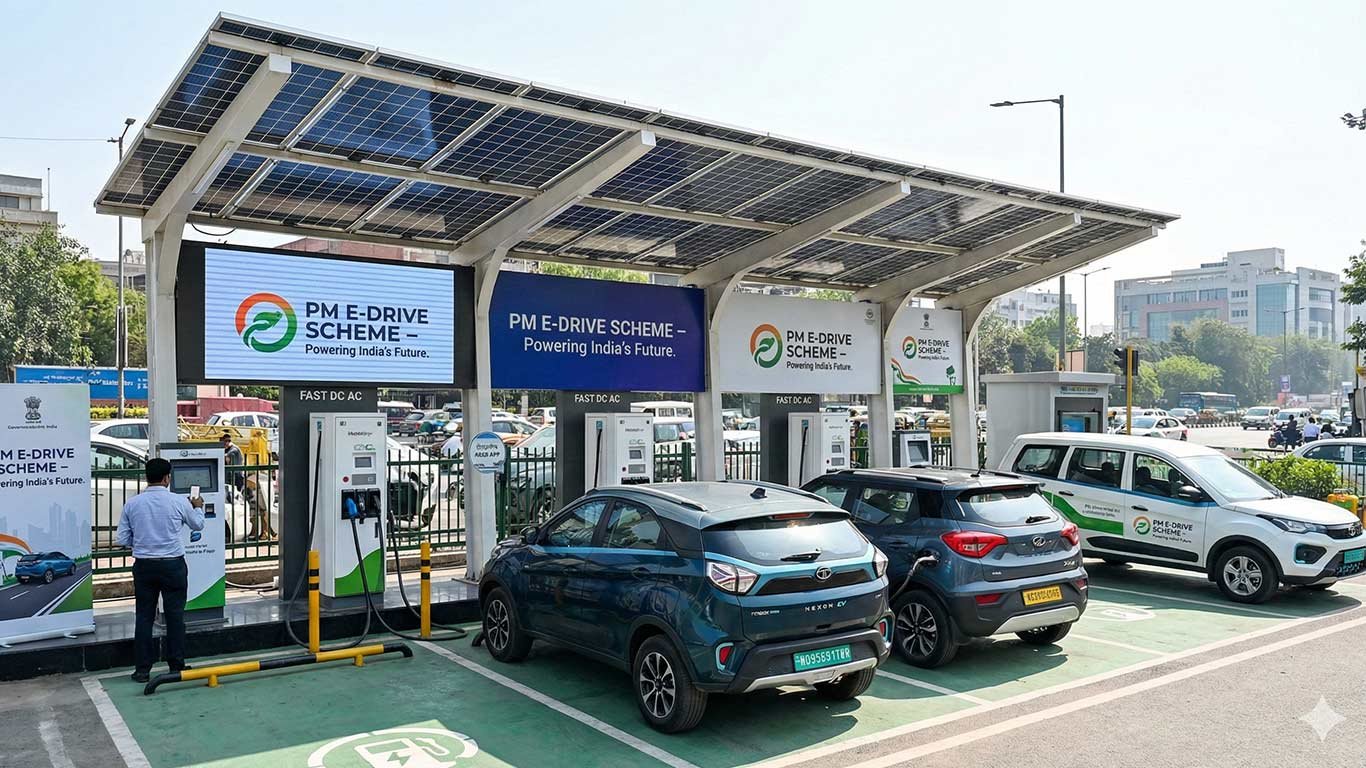
If you are thinking about buying an electric scooter or e-rickshaw in the next year, or tracking EV stocks in your portfolio, you cannot ignore what just changed in the PM e-DRIVE scheme.
The government has quietly reset the timelines and limits for subsidies on electric two wheelers and electric three wheelers. At the same time, the market itself is maturing. In FY26, TVS Motor has overtaken Ola Electric to become the top electric two wheeler player, with Bajaj and Ather close behind.
In other words, policy support is becoming more targeted, and competition is becoming more serious.
Let us break down what has changed, how it affects buyers and what it signals for investors.
1. What Exactly Has Changed In PM e-DRIVE?
The revised PM e-DRIVE guidelines set clear deadlines, price caps and volume caps for subsidies on electric two wheelers and three wheelers.
New subsidy deadlines
- Electric two wheelers (e-scooters, e-bikes)
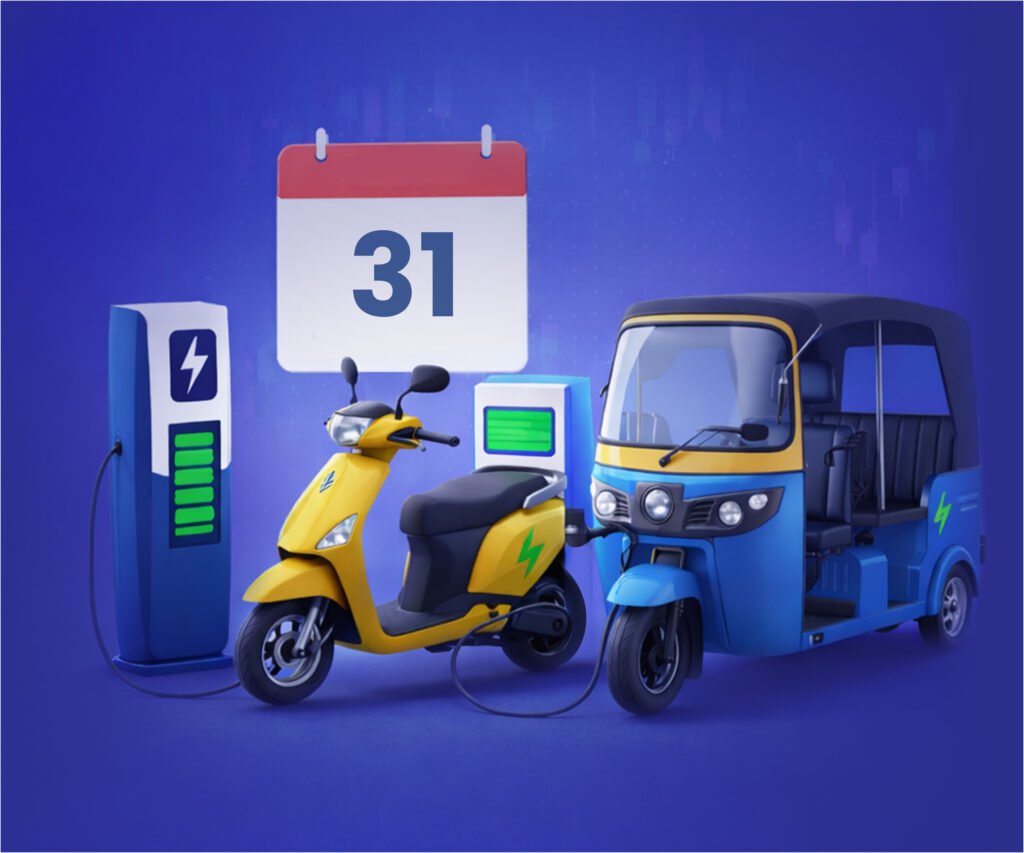
- Eligible for incentives up to 31 July 2026.
- Electric three wheelers (e-rickshaws and e-carts)
- Eligible up to 31 March 2028.
After these dates, no fresh vehicles will get support under this scheme, even if the model itself is approved.
Fund limited scheme
- Total scheme outlay: ₹10,900 crore.
- It is explicitly fund limited. That means:
- If this budget is used up earlier, the scheme can shut before the deadline.
- In practice, subsidies work on a first come, first served basis, similar to how earlier EV schemes like FAME II or EMPS were run.
Price caps and volume caps
To ensure the money goes where it is intended, the government has introduced caps on ex factory price and caps on number of vehicles:
- Maximum ex factory price to qualify
- Electric two wheelers: up to ₹1.5 lakh
- Electric three wheelers: up to ₹2.5 lakh
- Maximum vehicles to be supported
- 24,79,120 electric two wheelers
- 39,034 e-rickshaws and e-carts
Once these caps are reached, new buyers will no longer receive subsidy benefits, even if timelines are still open.
This structure tells you the intent clearly:
Support a defined number of reasonably priced EVs, and avoid open-ended, poorly targeted subsidy leakage.
2. A More Competitive EV Two Wheeler Market
While policy is becoming sharper, the market itself is going through its own shake up.
TVS, Bajaj and Ather move ahead of Ola
According to Vahan based registration data for FY26 and recent business coverage:
- TVS Motor has emerged as the top electric two wheeler player, with around 3,30,145 units sold in FY26.
- Bajaj Auto follows with about 2,76,518 units.
- Ather Energy is close behind with roughly 2,29,565 units.
- Ola Electric, which once dominated monthly charts, recorded about 1,60,558 units and has slipped down the rankings.
The total electric two wheeler market in FY26:
- Around 13.5 lakh units, up from about 11 lakh units the previous year.
- That is a year on year growth of roughly 17.3 percent.
In March 2026 alone, registrations of electric two wheelers were about 1,39,238 units, a spike driven partly by buyers rushing to take advantage of subsidies before rules changed.
So the message is simple:
- EV adoption is still growing at a healthy double digit pace.
- The leadership board is changing, with legacy ICE players using their brand, distribution and execution strength to gain share.
3. How The New Rules Affect EV Buyers
If you are planning to buy an electric scooter or e-rickshaw, here is what the revised PM e-DRIVE scheme means in practical terms.
Clearer but narrower subsidy window
- There is now a visible time window for subsidy eligibility.
- Up to 31 July 2026 for 2 wheelers.
- Up to 31 March 2028 for 3 wheelers.
- But because the scheme is fund limited, it is risky to assume subsidies will definitely last till the last date. High demand can exhaust the corpus earlier.
For buyers:
- If you were anyway planning to buy an EV in the next 12 to 18 months, it may make sense to advance your purchase rather than wait indefinitely.
- Waiting too long can mean:
- The price goes up once subsidies run out.
- Or you miss the support altogether because the fund is exhausted.
Focus on affordable models
Because of the ex factory price cap:
- Subsidies will concentrate on mass market, accessible models, not premium high end scooters and three wheelers.
- High priced EVs above ₹1.5 lakh (2W) and ₹2.5 lakh (3W) will need to make the case on total cost of ownership and performance, rather than subsidy.
This is good for:
- Students, delivery workers, gig economy riders and small businesses who rely on affordable commuting and logistics.
- Willingness of OEMs to design models that balance features with cost.
First come, first served reality
Because of unit caps and fund caps:
- Buyers cannot assume that a model that is eligible today will continue to be subsidised in the last year of the scheme.
- Dealers and OEMs may front load sales and campaigns to capture as much of the subsidised demand as possible, earlier in the window.
For buyers, this means:
- Watching official communication from OEMs and the government portal for real time status, rather than only relying on verbal assurances.
4. Policy Signals: From Pure Push To Shared Push Pull
The way PM e-DRIVE has been updated tells you how the government sees the EV journey now.
- The approach is phased and fund limited, not open ended.
- Earlier schemes like FAME II and EMPS were also designed with specific budgets and unit targets, and the new structure continues that pattern.
- The focus is shifting from just cutting prices through subsidies to building the entire EV ecosystem:
- Localisation of components and batteries
- Charging and swapping infrastructure
- Financing and insurance products
- After sales and service networks
Market data already shows that:
- EV penetration in India was just under 5 percent in FY24, most of it driven by electric two wheelers and three wheelers.
- ICRA expects EVs to account for around 25 percent of domestic two wheeler sales and 15 percent of passenger vehicle sales by 2030, backed by capex of at least ₹25,000 crore in EV components over the next 3 to 4 years.
In other words, the direction is clear. Policy is there to speed things up, but the market is now strong enough that it does not live or die by one scheme alone.
5. What All This Means For Investors
For investors looking at EV related stocks or themes, there are a few clear takeaways.
1. Execution matters more than hype
- The shift in leadership from Ola Electric to TVS, Bajaj and Ather shows that brand trust, service reach and reliable product execution are winning over pure marketing buzz.
- Companies that can scale quickly within policy windows, manage supply chains and provide strong after sales support are better positioned to monetise subsidies while they exist, and to survive after they taper.
2. Fund limited subsidies favour faster movers
Because PM e-DRIVE is both:
- Time bound, and
- Fund limited,
the main beneficiaries will be:
- OEMs who have models already in the market,
- With sufficient capacity, and
- With distribution in most relevant states and towns.
Late entrants who depend heavily on subsidy may struggle to catch up.
3. Long term EV theme remains intact
From an investment perspective:
- ICRA and other agencies see large long term opportunities in EV components and batteries by 2030, with the e two wheeler and passenger vehicle component market alone projected to exceed ₹1.5 lakh crore.
- EV penetration targets of 25 percent of two wheelers and 15 percent of passenger vehicles by 2030 suggest a multi year growth runway, even if annual numbers are lumpy.
So while short term subsidy changes can move individual stocks and monthly volumes, the structural story is still positive.
4. What to focus on
If you are building an EV themed watchlist, pay attention to:
- OEMs with:
- Strong brands and wide service networks
- A thoughtful EV product roadmap, not just one showpiece scooter
- Solid balance sheets and realistic capex plans
- Component makers with:
- Exposure to motors, controllers, power electronics, battery packs, not just low tech parts
- Clear localisation and JV strategies
Avoid basing decisions solely on the latest subsidy headline or one month’s registration ranking.
6. Practical Tips For EV Buyers Right Now
To bring it back to the consumer level, here is how to respond if you are in the market for an EV.
- Decide your time frame honestly
- If your purchase horizon is inside the next 12 to 18 months, track subsidy status closely and aim to buy before funds start running thin.
- If you are flexible beyond 2027, you may see more models, better tech and potentially new policy phases.
- Check model eligibility and price cap
- Confirm that your short listed scooter or three wheeler:
- Meets the ₹1.5 lakh or ₹2.5 lakh ex factory limit, and
- Is officially approved under PM e-DRIVE (or its successor), not just informally promised at the dealer counter.
- Confirm that your short listed scooter or three wheeler:
- Evaluate total cost of ownership, not just sticker price
- Factor in:
- Running cost versus a petrol bike or auto
- Battery warranty and replacement cost
- Service and spares availability in your city
- Factor in:
- Give weight to network and reliability
- The recent market share gains of legacy OEMs suggest that for many customers, peace of mind and service access matter as much as headline range or app features.
7. The Road Ahead
The revision of PM e-DRIVE is not a sign that the government is pulling back from EVs. If anything, it shows a desire to:
- Make subsidies sharper and more accountable.
- Build a self sustaining ecosystem that can stand even when subsidies eventually fade.
With EV penetration still in single digits and strong forecasts for 2030, India’s EV journey is closer to the end of the beginning than the beginning of the end.
For buyers, that means a growing range of choices, better products and gradually improving infrastructure. For investors, it means a theme that will likely have cycles and volatility, but also long term depth, provided you stay selective and avoid chasing every headline.
Disclaimer
This article is for informational and educational purposes only and does not constitute investment, tax, legal or other professional advice. References to schemes such as PM e-DRIVE, FAME II, EMPS and Electric Mobility Promotion initiatives are based on the scenario described in the query combined with publicly available reporting on India’s EV subsidy programs and timelines. Market share and volume data for TVS Motor, Bajaj Auto, Ather Energy and Ola Electric are drawn from recent coverage based on Vahan registration statistics. Long term EV projections and component market estimates are based on ICRA research and related press releases.
Actual policy details, subsidy amounts, deadlines and company performance numbers may differ from the illustrative figures used here and are subject to change without notice. EV investments involve business, regulatory and technology risks, and historical growth rates are not guarantees of future performance. Before making decisions about buying an EV or investing in EV related companies, you should carefully consider your financial situation, needs and risk tolerance, and consult a SEBI registered investment adviser, qualified tax professional or other competent expert.
