


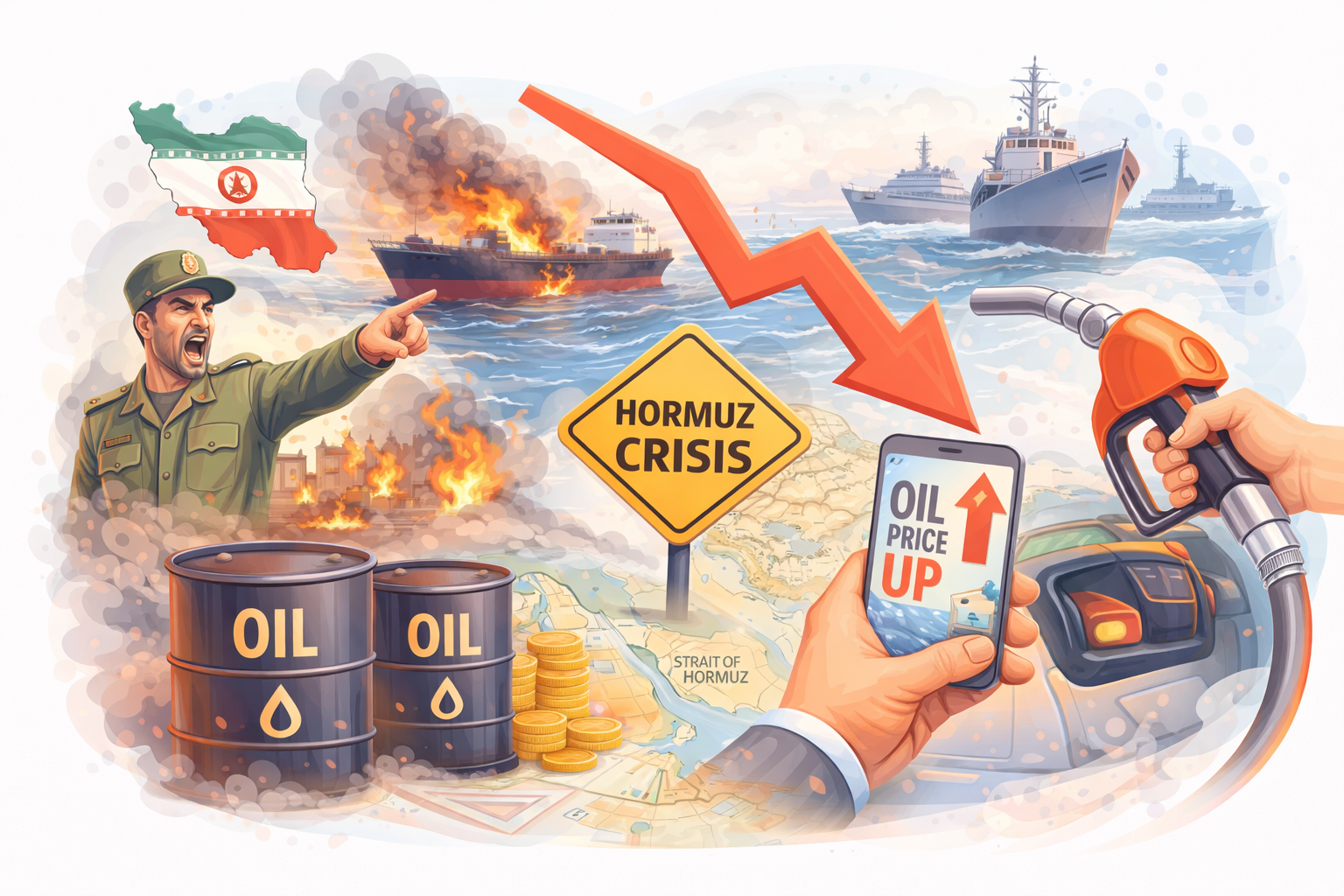
The world is staring at a fresh energy shock as tensions in the Strait of Hormuz escalate from a regional flashpoint into a full-blown global risk event. Iran’s effective closure of this narrow waterway after the recent US–Israel strikes has choked off one of the most important arteries of global oil and gas trade, sending crude prices sharply higher and rattling financial markets.
For Indian investors, this is not just “another” geopolitical headline. It has direct implications for petrol and diesel prices, inflation, the rupee, government finances, and ultimately your portfolio. In this post, we break down what is happening, why the Strait of Hormuz matters so much, the possible economic scenarios, and how a long-term investor in India can respond without panicking.
The Strait of Hormuz: A Tiny Waterway with Outsized Power
The Strait of Hormuz is a narrow chokepoint connecting the Persian Gulf to the Gulf of Oman and the Arabian Sea, bordered by Iran to the north and Oman plus the UAE to the south. It is the only sea passage out of the Persian Gulf and is therefore one of the most strategically important shipping lanes on the planet.
According to data compiled from the US Energy Information Administration (EIA), roughly 20–21 million barrels per day of crude oil and petroleum products flowed through the Strait of Hormuz in 2023, out of about 78 million barrels per day shipped globally by sea. In other words, this one narrow passage handles roughly a quarter of all seaborne oil and petroleum product trade in the world.
The strait is equally critical for natural gas. Between 2023 and 2025, about 20 percent of global liquefied natural gas (LNG) exports transited Hormuz each year, making it a vital route for energy-thirsty economies in Europe and Asia. A LinkedIn analysis based on EIA data estimates LNG shipments through the strait were equivalent to around 10.1 trillion cubic feet per day in 2023, with Qatar as the dominant exporter.
For Asia, this chokepoint is especially important. VisualCapitalist’s breakdown of trade flows through Hormuz shows nearly 89 percent of its crude and condensate shipments are destined for Asian countries, with China, India, Japan, and South Korea topping the list. Put simply, if Hormuz shuts, Asia catches the flu—and India is very much in the firing line.
What’s Happening Now in Hormuz?
Following joint US–Israel strikes on Iranian targets at the end of February 2026, Iran has moved from threats to action in the Strait of Hormuz. Multiple reports indicate:
- Iranian forces and proxies have attacked or attempted to disrupt commercial tankers using drones, missiles and naval mines.
- Iranian Revolutionary Guard commanders have publicly declared the strait “closed”, warning that any vessel attempting to transit the passage would be set “ablaze”.
- Maritime tracking and intelligence firms estimate that shipping traffic has fallen by around 80 percent, with hundreds of ships choosing to wait outside the Gulf rather than risk being caught in the conflict zone.
Officially, there is no universally acknowledged legal closure, but in practical terms, the risk of attacks, mines and miscalculation has reduced tanker movements to a trickle. For all practical purposes, this is a functional blockade.
Against this backdrop, the scenario you described—roughly 3,000 ships usually crossing each month versus only a couple of dozen successfully making the passage since the conflict flared—fits what we are seeing in early data from satellite tracking and shipping analytics: traffic has “nearly come to a standstill”.
Why This Chokepoint Matters So Much
The concentration of both supply and demand around Hormuz is what makes this crisis so dangerous. It is not just another shipping route; it is the main export outlet for some of the world’s largest oil and gas producers.
Major Gulf producers—Saudi Arabia, Iraq, Kuwait, Qatar, the UAE and Iran—ship most of their crude and LNG exports through this narrow passage. Saudi Arabia and the UAE have some alternative infrastructure, but even that only partially offsets the loss of Hormuz.
- Saudi Arabia’s East–West pipeline (Petroline) can move at least 5 million barrels per day from its eastern oil fields to the Red Sea coast, enabling exports without passing through Hormuz.
- The UAE has a pipeline system that can send around 1.5 million barrels per day to the port of Fujairah on the Gulf of Oman, again bypassing the strait.
Even these alternatives were underutilised by about 2.6 million barrels per day in 2023, meaning there is some spare capacity—but not nearly enough to replace a full shutdown of Hormuz, which handles roughly 20 million barrels per day.
That is why markets react so violently. When a quarter of seaborne oil and a fifth of LNG faces disruption, traders immediately start pricing in shortages, higher freight costs, and the possibility that the crisis could drag on for months.
Oil Prices: From Calm to Shock in Weeks
Oil markets entered 2026 in a relatively calm state, with West Texas Intermediate (WTI) crude trading around the low 60s and Brent in the high 70s per barrel as of late February. Your reference to WTI in the 60–67 range and Brent around 79 reflects this pre-crisis environment.
Once news of US–Israel strikes on Iran and the subsequent tanker attacks broke, prices jumped sharply. Reports from late February and early March show:
- WTI crude pushing above 97 dollars per barrel as the full scale of the disruption became clear.
- Brent crude jumping more than 10 percent in a single session to briefly cross 82 dollars before settling near 79 dollars as traders tried to assess whether the closure would be short-lived or prolonged.
These sharp moves are classic “risk repricing” rather than full-blown panic. Markets are still implicitly assuming that diplomacy, US naval escorts, or alternative routes will restore a significant portion of flows in a matter of weeks. The real concern is: what if that assumption is wrong?
The Dallas Fed’s Oil Shock Scenarios
The Federal Reserve Bank of Dallas has run model-based simulations of what a prolonged Hormuz shutdown could mean for global growth and oil prices. Their baseline analysis suggests that if oil transport through Hormuz remains essentially closed through June:
- Global real GDP growth could be reduced by an annualised 2.9 percentage points in the second quarter.
- WTI crude prices would likely stay near or above the current elevated levels (around the high 90s) in the near term, with further spikes possible if the disruption drags on.
More detailed scenario work reported via financial news summarising their research indicates:
- If the strait reopens after one quarter of disruption, prices could retreat in the second half of the year as supply normalises.
- If the closure lasts two quarters, oil prices could climb into the 110–115 dollar range before easing as demand destruction and strategic reserve releases kick in.
- If disruption extends to three quarters, the model shows a path where prices might touch the low 130s per barrel by year-end—levels that start to look uncomfortably like a 1970s-style energy shock in real terms.
Of course, these are scenarios, not predictions. But they underline one simple truth: the longer Hormuz stays effectively blocked, the greater the chance that this turns from a “short shock” into a serious global recession risk.
Global Spillovers: Inflation, Freight and Supply Chains
The impact of a Hormuz blockade does not stop at the petrol pump. It ripples through multiple layers of the global economy.
First, higher crude and LNG prices feed directly into fuel costs for transport, power and industry worldwide. Analysts already see consumers paying more for petrol, diesel, jet fuel and LPG in many countries, while airlines and shipping firms face rising operating expenses.
Second, shipping risk premiums and insurance costs are spiking. Insurers are adding war-risk surcharges on Middle East routes, and freight rates for tankers and container ships in the broader region are rising as vessels reroute or idle. An Indian news summary notes that war-risk surcharges alone can add around 1,500 dollars per container, on top of the underlying freight cost.
Third, a prolonged disruption can squeeze critical commodities beyond oil and gas. Qatar has temporarily suspended some LNG operations in response to the attacks, raising concerns about winter gas supply for Europe and Asia if the crisis drags on. The Fertiliser and chemicals trade, a significant fraction of which uses Hormuz, also faces delays and higher input costs, which ultimately feed into food inflation.
Put together, these factors point to a stagflationary risk: slower global growth, but higher inflation, especially in energy-importing economies.
How Hard Could This Hit India’s Economy?
India imports more than 85 percent of its crude oil requirement, making it structurally vulnerable to spikes in global prices. That vulnerability shows up in multiple economic channels:
Import Bill and Current Account
Recent estimates from rating agencies and market analysts suggest that:
- Every 10 dollar per barrel increase in average crude prices can raise India’s annual oil import bill by roughly 13–16 billion dollars.
- Translated, that’s about 1.3–1.6 billion dollars for every 1 dollar increase in crude, on a sustained basis across the year.
If prices were to average 110–115 dollars per barrel in the coming year instead of a more benign baseline, ICRA’s chief economist estimates India’s net oil imports could swell by 56–64 billion dollars annually. That would significantly widen the current account deficit and place additional pressure on the rupee.
Your rule-of-thumb—an extra 2 billion dollars annually in the import bill for every 1 dollar increase in crude—is slightly more conservative than these estimates but captures the broader point: even modest sustained increases in oil prices can meaningfully strain India’s external balances once freight, insurance and currency effects are factored in.
Inflation and Monetary Policy
Higher crude prices flow into the domestic inflation basket through fuel, cooking gas, transport and eventually food and manufactured products. Analysts warn that a sustained 10 dollar per barrel increase can add notable pressure to headline inflation, especially when combined with higher freight and insurance costs.
If inflation pushes materially above the Reserve Bank of India’s comfort band, the RBI may be forced to keep interest rates higher for longer or delay any planned easing, even if growth shows signs of slowing. That combination—higher rates and higher inflation—is especially uncomfortable for rate-sensitive sectors like real estate, autos and consumer durables.
Fiscal Impact
The central and state governments rely heavily on indirect taxes on fuel. When global prices surge, policymakers often face a tough choice:
- Pass through the full increase to consumers, risking public backlash and higher inflation.
- Absorb part of the increase by cutting excise or duties, which hurts government revenues and can widen the fiscal deficit.
In past episodes, the government has tried to smooth the impact using a mix of excise tweaks and pressure on oil marketing companies’ margins. A prolonged shock this time could once again test that delicate balancing act.
Sector-by-Sector Impact on Indian Markets
For equity investors, the Hormuz crisis is not uniformly negative. It creates clear losers, but also some potential winners, at least in the short to medium term.
Likely Pressure Points
- Aviation and Travel
Jet fuel is one of the largest cost components for airlines. A sustained 20–30 dollar per barrel increase in crude can severely hit margins, forcing fare hikes and dampening demand. International carriers with routes over West Asia also face rerouting and security risks. - Auto and Logistics
Higher petrol and diesel prices can delay discretionary purchases like cars and two-wheelers, while logistics and transport companies see their fuel bills rise, squeezing profitability unless they can rapidly pass on costs. - Oil Marketing Companies (OMCs)
State-owned OMCs often bear the brunt when the government leans on them to keep pump prices stable during sharp crude spikes, compressing their marketing margins. - Rate-Sensitive Sectors
If inflation stays sticky and the RBI delays rate cuts, banks, NBFCs, real estate developers and consumer durables firms may see slower credit growth and weaker demand.
Potential Relative Beneficiaries
- Upstream Oil & Gas Producers
Companies with domestic oil and gas production can benefit from higher realised prices, at least to the extent that price controls or windfall taxes do not fully cap the upside. Their earnings are naturally leveraged to global energy prices. - Refiners with Export Exposure
Some complex refiners can gain if refining margins rise due to global supply dislocations, especially if they have flexibility to ship products to markets with tighter supply. - Renewable Energy and Energy-Efficiency Plays
The more painful each fossil-fuel shock becomes, the stronger the push for renewables, electric mobility, energy storage, and efficiency technologies. Over time, policy support and capital allocation tend to accelerate in these segments after every major oil shock. - Commodity Exporters and Defensive Sectors
Select commodity producers, utilities, healthcare, and consumer staples may act as relative safe havens if growth slows but essential spending remains resilient.
None of this means investors should blindly rotate into “energy winners” or dump all “losers”. The actual impact depends on each company’s business model, balance sheet, pricing power and policy environment. But understanding these sectoral dynamics helps you think more clearly about portfolio risks and opportunities.
Global GDP and Market Valuations: Why 2.9 Percentage Points Matters
A 2.9 percentage point hit to global real GDP growth in one quarter, as simulated by the Dallas Fed under a prolonged Hormuz closure, may sound abstract, but for markets it is a big deal.
Historically, global recessions have often coincided with oil price spikes and policy missteps. An abrupt move from moderate growth to near-stagnation, combined with higher inflation, tends to compress valuation multiples, widen credit spreads and trigger risk-off behaviour in equities.
For Indian markets, that can mean:
- Foreign portfolio investors reducing exposure to emerging markets, including India, to de-risk globally.
- Higher cost of capital for Indian corporates, especially those dependent on offshore borrowing.
- Pressure on cyclical sectors linked to global trade and capex, such as metals, capital goods and IT services (through weaker global discretionary tech spending).
The corrections you are seeing in both global and Indian equity markets today are a reflection of this repricing of macro risk. They do not necessarily mean the start of a deep bear market, but they do signal that investors are demanding a higher risk premium to hold equities in a world of elevated geopolitical uncertainty.
Short Shock vs Long Grind: Possible Paths from Here
The future course of this crisis largely depends on how long the effective closure of Hormuz lasts and how much alternative capacity can realistically be mobilised.
Scenario 1: Quick De-escalation (Reopening in 1–2 Weeks)
In this relatively benign scenario:
- US and allied naval forces secure shipping lanes, Iran reduces attacks under diplomatic pressure, and tanker traffic resumes, albeit with higher insurance and escorts.
- Oil prices could stabilise around current levels or retreat modestly as fears of an extended supply shock fade.
- The global growth hit is limited, and the Dallas Fed’s more severe downside scenarios do not materialise.
Even here, though, some damage is already done: war-risk surcharges, disrupted cargo schedules and temporary price spikes will still leave a mark on inflation and corporate earnings in 2026.
Scenario 2: Partial Blockade with Workarounds (Several Months)
In a more moderate but extended scenario:
- Hormuz remains dangerous but not completely shut, with some tankers willing to pass under naval escort or under Iran-friendly flags.
- Saudi Arabia and the UAE ramp up alternative pipeline capacity to the Red Sea and Fujairah, partially offsetting the loss of volume through Hormuz.
- Oil trades in a higher band—say, 90–110 dollars per barrel—depending on the degree of disruption and the pace of demand adjustment.
This is the kind of environment where global GDP could see the 2.9 percentage point quarterly hit envisioned by the Dallas Fed, with markets oscillating between fear and relief on each headline.
Scenario 3: Prolonged, Severe Disruption (Two–Three Quarters or More)
In the worst case:
- Attacks and mines keep tanker traffic depressed for much of the year, with only limited alternative routes functioning safely.
- Strategic reserves are drawn down aggressively, but cannot fully offset a sustained loss of up to 8–10 million barrels per day of supply.
- Oil prices spike toward the 115–130 dollar range described in the Dallas Fed’s most pessimistic simulations, causing serious demand destruction and raising the risk of a global recession.
For India, such a scenario would likely mean a sharply wider current account deficit, persistent pressure on the rupee, higher inflation, and slower growth—all of which would challenge both policymakers and investors.
What About Strategic Reserves and Policy Responses?
Recognising the severity of the risk, the International Energy Agency (IEA) and key consuming countries have mechanisms to release emergency oil stocks. Historically, coordinated stock releases have been used to cushion markets during supply shocks such as the Libya crisis and the Russia–Ukraine war. While the exact numbers will evolve, talk of releasing hundreds of millions of barrels from strategic reserves is consistent with past interventions in major disruptions.
Such releases can:
- Smooth near-term price spikes by temporarily adding supply.
- Buy time for producers to reroute flows and for demand to adjust.
But they are not a permanent solution. Strategic stocks are finite, and drawing them down too aggressively leaves countries exposed if the crisis escalates further. That is why markets typically view such releases as helpful but not decisive—especially if a chokepoint remains dangerous.
On the diplomatic front, key importers such as India and China have strong incentives to press for de-escalation, given their dependence on Gulf energy. Back-channel talks, naval coordination and perhaps even creative sanctions relief or security guarantees could form part of any eventual settlement.
What This Means for Indian Investors in Practical Terms
So how should you, as an Indian investor, respond to the Hormuz crisis?
1. Separate Noise from Structural Change
Geopolitical headlines can be noisy and emotional. Not every flare-up leads to a regime change in markets. The key questions to ask are:
- Does this event fundamentally alter long-term cash flows for the businesses I own?
- Or is it a cyclical shock that will likely be absorbed over 1–3 years?
For many quality Indian companies with strong balance sheets and pricing power, even a deep but temporary oil shock will not permanently damage their long-term earnings potential. Their valuations may fall in the short run, but the underlying franchise remains intact.
2. Respect Macro Risks Without Trying to Time Every Move
Trying to trade every twist and turn of a geopolitical crisis is a recipe for errors. Most investors do not have the speed, data or emotional discipline to consistently get those calls right.
Instead, consider:
- Reducing excessive exposure to highly leveraged or cyclical names that are directly hit by high fuel costs or global trade slowdown.
- Avoiding aggressive use of leverage or margin at a time when volatility and gap-down risks are elevated.
- Keeping some dry powder (cash or liquid funds) to deploy gradually if markets correct further and valuations become more attractive.
3. Use Volatility to Upgrade Portfolio Quality
Corrections driven by macro shocks often punish weaker and stronger companies alike. For long-term investors, that is an opportunity to:
- Exit structurally weak stories that you were holding “for a bounce” and rotate into higher-quality names at better valuations.
- Accumulate businesses with durable competitive advantages, strong cash flows and prudent capital allocation, especially in sectors less directly exposed to crude prices.
Systematic investment plans (SIPs) into diversified equity funds automatically implement this “buy more when cheaper” behaviour, which is why continuing SIPs through volatility has historically worked well for many Indian investors.
4. Think in Scenarios, Not Single-Point Forecasts
We do not know whether Hormuz will normalise in weeks or remain a flashpoint for months. What you can do is:
- Build a base case (partial disruption, moderate oil prices, slower but not collapsing growth).
- Define an upside case (quick reopening, oil back toward 70–80, risk appetite returning).
- And a downside case (prolonged closure, oil in 110–130 zone, global recession risk).
Then ask: Is my portfolio resilient across these scenarios? Where are the vulnerabilities? Do I have enough diversification across sectors, styles (growth vs value), and asset classes (equity, debt, gold) to weather these paths?
The Long-Term Lesson: Energy Security and Diversification
Every major oil shock leaves a legacy. The 1970s crises accelerated energy efficiency and nuclear power. The 2000s spike reinforced the case for unconventional oil and gas. The Russia–Ukraine war turbocharged Europe’s push into renewables and LNG diversification.
The current Hormuz crisis will likely have similar long-term consequences:
- For India’s policy mix: Expect renewed emphasis on domestic exploration and production, strategic petroleum reserves, long-term LNG contracts, and diversification of import sources away from any single chokepoint.
- For energy transition: High and volatile fossil fuel prices strengthen the economic case for renewables, storage, electric mobility, and grid modernisation over a multi-decade horizon.
- For portfolios: Investors who remain overly concentrated in any one sector, region or asset class are reminded—painfully—of the value of diversification.
None of this means oil is going away soon. Even in the most optimistic energy transition scenarios, hydrocarbon demand remains substantial for decades. But it does mean that portfolios tilted entirely toward fossil-fuel-sensitive sectors, without any exposure to beneficiaries of the transition, are taking on an additional layer of long-term risk.
How Investors Can Approach This Phase
For readers of Finovest, who typically lean toward disciplined, research-backed investing rather than speculation, a few guiding principles can help:
- Revisit your asset allocation: Ensure your equity, debt and alternative mix still matches your time horizon and risk tolerance. If not, use rallies to rebalance rather than dumping assets into panic.
- Prioritise quality and resilience: Focus on companies (or funds) with strong balance sheets, diversified revenue streams and proven ability to handle past crises. These tend to survive shocks and gain share when weaker peers falter.
- Stay process-driven: Have predefined rules for when you will add, trim or exit positions based on valuation and fundamentals, not headlines.
- Keep an eye on macros, but invest bottom-up: Understand the macro backdrop (oil, rupee, rates, global growth), yet make decisions primarily based on business quality and price versus intrinsic value.
And most importantly, recognise that crises are a feature, not a bug, of equity investing. If you have a 10–20 year horizon, you will live through multiple such episodes. Your long-term outcome will be driven less by any single shock and more by whether you consistently avoid big permanent capital losses and remain invested through recoveries.
A Final Word of Caution
The Strait of Hormuz crisis is still unfolding, and the information landscape is changing almost daily. Shipping flows, diplomatic initiatives, military actions and policy responses can all shift the market narrative in short order.
Nothing in this article should be treated as a stock recommendation or personalised investment advice. The right response for you depends on your specific financial situation, goals and risk tolerance. If the current volatility is making you deeply uncomfortable, it may be a sign to revisit your asset allocation with a qualified advisor rather than making impulsive decisions.
What is clear, however, is that this episode has once again exposed the fragility of global energy security—and the importance of building portfolios, and economies, that can withstand such shocks rather than being broken by them.
