

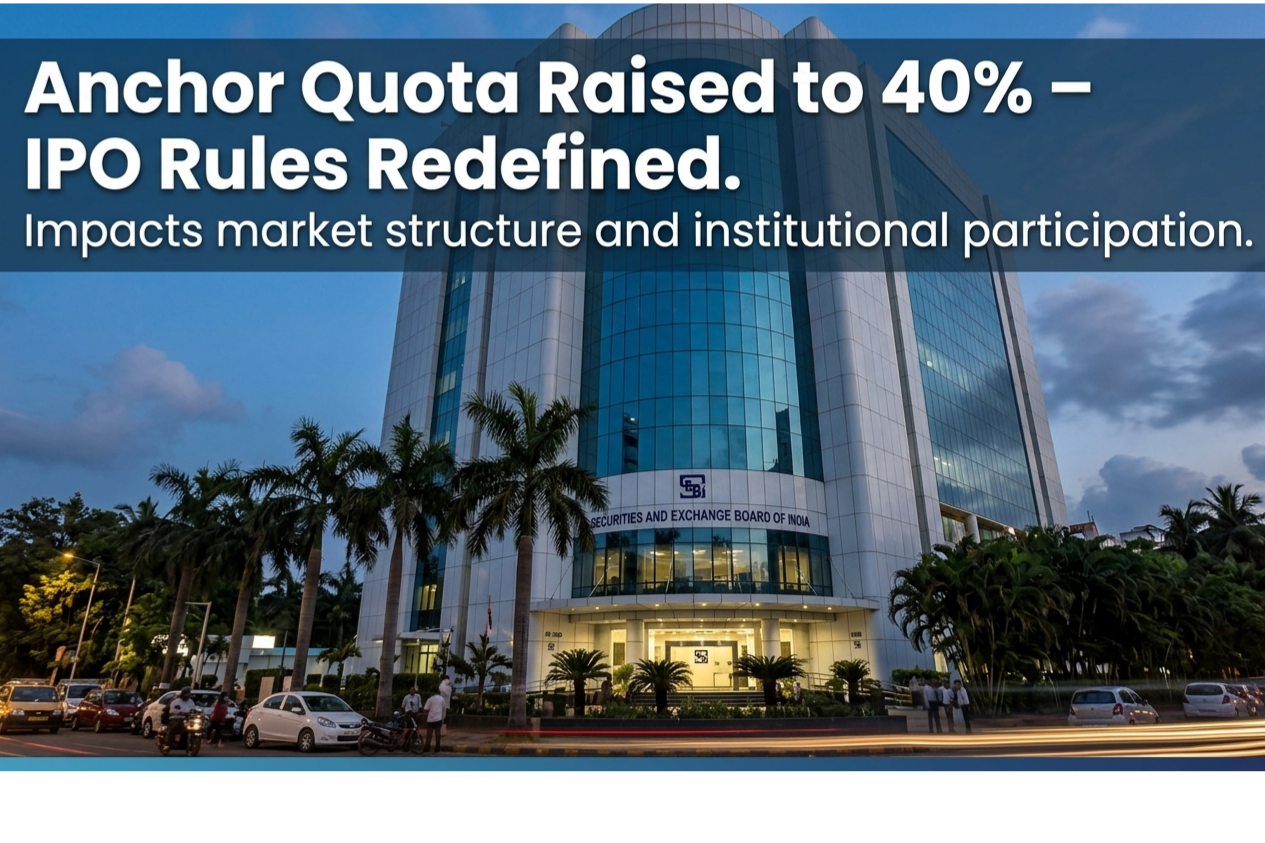
From 33 % to 40 %: Why SEBI’s IPO Anchor Rule Matters
In early November 2025, SEBI made waves. It announced that the anchor investor portion in initial public offerings (IPOs) will be raised from 33 % to 40 %.
This is no small tweak. For the IPO ecosystem in India—issuers, anchor investors, retail investors and merchant bankers alike—it signals a structural shift.
In this article we unpack:
- what exactly the change entails;
- why SEBI did it;
- how different participants will be impacted;
- how this affects retail investors (you) and issuers;
- the potential pitfalls;
- and key takeaways for market watchers and participants.
1. What the New Rule Says
1.1 The core change
Under the revised framework:
- The anchor investor allocation in an IPO has been raised from 33 % to 40 % of the issue size.
- Of this 40 %, a 33 % slice is earmarked for mutual funds, and 7 % for insurance companies and pension funds.
- If the 7 % reserved for insurers and pension funds is unsubscribed, it can be reallocated to mutual funds.
1.2 Additional tweaks
Beyond the headline quota change, SEBI has also refined other aspects:
- The number of allowable anchor investors in an IPO with anchor portion above ₹250 crore has been increased: previously up to 10, now up to 15 per each ₹250 crore block.
- SEBI has merged two prior categories under anchor allotment (Category I and II) into a single unified discretionary allotment category for allocations up to ₹250 crore.
- The changes take effect from 30 November 2025, via amendment to the ICDR (Issue of Capital & Disclosure Requirements) regulations.
1.3 Why it matters
In simple terms: Anchor investors are large institutional buyers who subscribe before the IPO opens to the public. Their commitment is seen as a vote of confidence. By increasing the anchor quota, SEBI is aiming to:
- Secure deeper institutional participation;
- Improve the credibility and stability of IPO pricing;
- Reduce dependence on foreign anchor allocation or speculative retail frenzy;
- Provide better signals to retail investors about the strength of issues.
2. Why SEBI Took This Step
2.1 Domestic institution strengthening
SEBI’s move reflects a broader strategy: deepen domestic institutional investor (DII) involvement in the Indian capital markets. By officially reserving part of the anchor portion for mutual funds, insurers and pension funds, SEBI is nudging greater long-term capital into IPOs.
2.2 Improve IPO quality and post-listing behaviour
One of the concerns in IPOs has been over-valuation at IPO stage, followed by sharp drops post-listing. Retail investors often bear the brunt of such reversals. With stronger anchor backing, the expectation is that underwriting discipline improves and pricing becomes more realistic.
2.3 Addressing size, volatility and absorption of large IPOs
With ever-larger companies coming to the market, and fewer genuinely diversified anchor books, there was risk of IPOs being under-subscribed or unstable. The amendment seeks to ensure that big issues have a robust base of institutional commitment.
2.4 Retaining global competitiveness
India’s IPO market is among the largest in the world. To keep listing standards high, international investors and domestic savers confident, rules need to align with global best practices—diversified anchor cohorts, transparent allocations, strong institutional participation.
3. The Broad Impacts: Who Gains, Who Adapts
3.1 Issuers (Companies going public)
Potential benefits:
- With a larger anchor portion, issuers may find it easier to secure early commitments and reduce listing-day volatility.
- More domestic anchor participation may reduce perceived reliance on foreign investors, giving issuers more certainty and potentially smoother pricing.
Potential challenges: - The requirement to accommodate a larger pool of anchor investors may result in more negotiation, longer book-building time, higher coordination costs.
- With more large institutional anchor investors, issuers may face stronger scrutiny of valuations, business models and growth projections.
3.2 Anchor Investors (Mutual Funds, Insurers, Pension Funds)
Opportunities:
- Mutual funds clearly benefit from an increased reserved share (33 % of total anchor quota).
- Insurers and pension funds now have a formal role (7 %) in anchor allocations, which may open a new allocation avenue for them.
Considerations: - Minimum allotment sizes remain large (minimum ₹5 crore per anchor investor under the new rules) which means anchor participation remains a high-commitment play.
- With more institutions competing for the anchor slice, anchor investors may demand better terms or stronger disclosures from issuers.
3.3 Retail Investors
Positive effects:
- A larger institutional base in anchor books may signal higher quality IPOs, making retail participation less risky.
- Greater diversification of anchor investors may reduce price‐jump volatility at listing, benefiting retail investors who buy in the general tranche.
Cautionary aspects: - While the anchor quota has increased, retail quota and non‐anchor categories remain subject to the same pricing pressures. Retail investors still need to do due diligence.
- A larger anchor portion surprisingly could leave less quantity for non‐anchor categories (including retail) in some cases, depending on issue structure.
3.4 Merchant Bankers, Book-runners and Brokers
- They will need to recalibrate IPO design: allocation sizes, anchor investor lists, timing, marketing.
- Larger anchor books may mean more negotiation, higher coordination costs—but also potentially smoother IPO launches.
- They may benefit from improved reputational outcomes if listings post better due to stronger anchor backing.
4. The Mechanics: What Changes Under the Rule
4.1 Anchor Investor Portion: 40 % of Issue
The anchor portion refers to that part of the issue allocated to institutional investors before public subscription opens. From now on, for a typical IPO:
- 40 % of the portion earmarked as anchor.
- Within the anchor pool: 33 % to mutual funds, 7 % to insurers/pension funds (with reallocation possible).
This contrasts with earlier practice where anchor allocation was capped at 33%.
4.2 Number of Anchor Investors & Minimum Sizes
- For IPOs with anchor allocation up to ₹250 crore: minimum 5 investors, maximum 15.
- For each additional ₹250 crore (or part), up to an additional 15 anchor investors may be added.
- Minimum allotment size per anchor investor: ₹5 crore.
4.3 Unified Discretionary Category
Previously, there were two categories of anchor allocation in discretionary allotment: Category I (up to ₹10 crore) and Category II (₹10–₹250 crore). Under the new rule, these are merged for allocations up to ₹250 crore, simplifying the framework.
4.4 Effective Date & Transitional Rules
The amendments are to be effective from 30 November 2025 (for IPOs opening after that). Issuers, merchant bankers and institutional investors will need to adjust their plans and disclosures accordingly.
5. Strategic Implications for IPO Pipeline & Market Sentiment
5.1 Improved Signals for IPO Quality
When large, credible institutional investors are visibly backing an IPO ahead of its public offer, it creates a stronger signal of credibility. With 40 % reserved for anchor investors—larger than before—the expectation is that the average IPO will have better institutional vetting and perhaps a more stable listing performance.
5.2 Reduction in Over-Hyped Listings & Speculation
One of the issues in recent years has been companies coming out at high valuations, only to fall sharply post-listing (hurting retail investors). A stronger anchor investor base may impose stricter valuation discipline, thereby reducing speculative mismatches.
5.3 Effects on Retail Allocation & Pricing
While retail quotas remain unchanged in many cases, the larger anchor piece means the “public” tranche may face different dynamics:
- If anchor demand is strong, pricing may adjust upward early;
- If anchor demand is weak, issuers may reconsider issue size or pricing strategy.
Retail investors must remain alert to these changes.
5.4 Impact on IPO Launch Timing & Structure
Issuers that want to tap large institutional pools must now factor in the enlarged anchor portion—this may affect how the IPO is marketed, how band pricing is set, how anchor book building is done. Merchant bankers may prefer to delay issues to build stronger anchor books.
5.5 Domestic vs Foreign Anchor Mix
By emphasising domestic institutional anchors (mutual funds, pension funds, insurers), SEBI is signaling a push for self-reliance and long-term capital in Indian markets. This may reduce reliance on foreign anchor investors, which can be beneficial when foreign flows turn volatile.
6. Retail Investor Focus: What You Should Know
6.1 Anchor Investor Presence = A Signal
When you look at an IPO, check: how many anchor investors, how diversified their list, how large their commitment. With the 40 % rule, a more robust anchor list is possible—and that often means better backing.
6.2 Don’t Assume Anchor = Sure Win
Even with strong anchor backing, IPOs can falter if valuations are excessive or fundamentals weak. Anchor participation improves odds—but does not guarantee success.
6.3 Be Aware of Allocation Changes
With more anchor allocation, there might be less size left for other categories (public, retail). This might impact application strategies and allotment probabilities.
6.4 Post-Listing Behavior Could Improve
With larger, stable institutional backing, price stability post-listing may improve—less wild first-day swings. That can reduce the “one-day listing pop” mentality and encourage long-term investment thinking.
6.5 What To Check in the IPO Prospectus
- Anchor investor list (who they are; how many).
- Size of anchor allotment relative to total issue.
- Whether the 7 % reserved for insurers/pension funds is fully utilised or re-allocated.
- Pricing band in context of anchor bids.
- Retail quota, non‐institutional quota and how they compare to prior similar IPOs.
7. Risks & Critical Views: The Other Side of the Coin
7.1 Does More Anchor Allocation Limit Retail Share?
Some critics argue: while strong anchor backing is good, a bigger anchor quota could shrink the public/retail slice in certain IPOs, especially when issue sizes are large. Retail investors might find fewer shares available or lesser flexibility.
7.2 Are Mutual Funds Becoming Over-Committed?
With mutual funds being given a large reserved piece (33 % of anchor quota), there is a risk of concentration or over-commitment to IPOs. If a mutual fund heavily subscribes and many holdings list at a discount, that may impact performance and eventually hurt investors.
7.3 Minimum Allotment Sizes Still High
The minimum ₹5crore per anchor investor remains substantial. Smaller institutional players may still be excluded; thus, the anchor investor club remains somewhat elite.
7.4 Over-Reliance on Institutional Vetting
Just because anchor investors commit doesn’t mean everything is perfect. Mistakes in due diligence, inflated valuations, sector bubbles can still occur. Institutional backing is a signal—but not a substitute for personal research.
7.5 Implementation & Transition Risks
Since the rules take effect on 30 Nov 2025, the pipeline of IPOs before and after may behave differently. Some issuers may rush or delay to accommodate new rules—leading to hybrid/awkward structures in transition.
8. Comparative Perspective: How Does India’s Anchor Allocation Norm Stack Up?
In global IPO markets, anchor allocations vary widely. Let’s compare:
- In the U.S., IPOs typically allocate a smaller pre-subscription “anchor” tranche; institutional subscriptions happen in book building, but there is less formal anchor quota.
- In Hong Kong or Singapore, anchor/subscriptions to corner-stone investors are common, but regulations differ by jurisdiction.
- India’s new 40 % anchor quota is relatively high—meaning India is moving toward heavier institutional anchoring as part of its market design.
This indicates that India is choosing to anchor its IPOs on strong domestic institutional investors, rather than leaving them to possibly volatile retail sentiment or foreign flows.
9. Case Study: Hypothetical IPO Under New Rule
Let’s walk through a hypothetical example to illustrate how things change:
Company-X Ltd plans to issue ₹1,000 crore via IPO. Under earlier rules:
- Anchor investor portion: 33% of 1,000 = ₹330 crore.
Under new rule: - Anchor investor portion: 40% of 1,000 = ₹400 crore.
Within that ₹400 crore: - ₹(400 × 0.33) = ₹132 crore reserved for mutual funds;
- ₹(400 × 0.07) = ₹28 crore reserved for insurers/pension funds;
- If insurers/pension funds don’t apply fully, the remaining portion (out of ₹28 crore) can go to mutual funds.
If the anchor portion is above ₹250 crore, the number of anchor investors allowed increases (up to 15 for each ₹250 crore block).
Implications:
- Company-X must secure ₹400 crore from anchor investors, up from ₹330 crore earlier—so larger institutional commitments.
- More institutional investor names in the prospectus → better signalling.
- For retail/public portion: remaining issue size is ₹600 crore (versus earlier ₹670 crore) – slightly smaller, but backed by stronger anchor base.
- Entities applying for anchor allotment must comply with new category, size and investor number requirements—thus the “anchor club” gets bigger but slightly more regulated.
This simple arithmetic shows how the mix and scale shift under the new rule.
10. What This Means for Future IPOs & Market Structure
10.1 Deeper Institutionalisation of Indian IPOs
With more institutions participating as anchors, the IPO market becomes less retail-driven and more institution-driven. This may increase the average ticket size, increase pre-subscription seriousness, and reduce impulsive IPO listings.
10.2 Potential for Less Volatility on Listing Day
If a large anchor book is in place, the issuance may face less speculative frenzy, fewer steep listing-day pops or drops, which helps market integrity and investor confidence.
10.3 Better Pricing Discipline
With institutional investors committing earlier and in larger size, valuation discipline may improve. Issuers know that anchor investors will walk away if valuations are unreasonable—thus potentially curbing over-pricing.
10.4 Impact on Retail Appetite
Retail investors may prefer IPOs with strong anchor backing (as a filter for quality). The secondary effect might be that IPOs lacking strong anchor line-up may have to reduce valuation or delay listing. Retail investors may develop new heuristics (“If anchor list is weak, beware”).
10.5 Competitive Position of India among IPO Destinations
Improved structures may help India compete with international IPO destinations, attract better companies, and maintain healthy primary market volumes in a global environment where capital is more mobile.
11. Key Takeaways for Participants
For Issuers:
- Build a strong anchor investor list early, emphasise institutional credibility.
- Be transparent about anchor commitments in DRHP.
- Expect greater scrutiny of valuation and business model from anchors.
For Institutional Investors:
- Leverage the reserved quota (mutual funds especially).
- Assess anchor participation not just as allocation but reputational signal.
- Be disciplined—anchor commitments carry more weight and visibility now.
For Retail Investors:
- Use the anchor list as a quality marker in IPOs. More anchor participation = higher confidence.
- But continue independent research—anchor participation isn’t guarantee of success.
- Consider whether the retail portion is slightly smaller and carefully gauge allotment risk and pricing.
For Market Participants & Regulators:
- Monitor how IPO listings evolve under the new framework—issue size, post-listing performance, anchor composition.
- Ensure that smaller issuers and smaller investors are not inadvertently disadvantaged by “elite anchor club” dynamics.
- Maintain transparency in allocation—anchor portion must not become opaque special deal room.
12. Critical Perspective & Things to Watch
While the reform is well-intentioned, there are issues worth monitoring:
- Will the 7 % reserved for insurers/pension funds be fully utilised, or simply reallocated to mutual funds? Over time, the nominal reservation may become symbolic if unsubscribed regularly.
- Will the increased anchor quota reduce the share of retail investors in some large IPOs? Retail quota may remain constant, but the total flow may shift.
- Minimum allotment sizes mean smaller institutions may still be excluded from anchor participation. Is this a widening of participation or just redistribution among the same large players?
- The rush to line up anchor commitments could lead to weaker due diligence if issuers focus on crowding in names rather than substance.
- The effectiveness of reforms will show only over a sustained period—monitor say 12–24 months of IPOs to judge whether post-listing behaviour has improved.
13. Conclusion: A Structural Shift, But With Guardrails
SEBI’s raise of the IPO anchor quota to 40 % marks a meaningful structural shift in how primary capital markets in India will operate. By embedding stronger domestic institutional participation, the regulator signals a move toward more robust, credible IPOs—a welcome change in a market where speculative listings, volatile post-listing performance and retail investor disappointment have been recurring concerns.
However, as with all reforms, the devil lies in the implementation details. Issuers, anchor investors and retail participants all face new dynamics—and perhaps new challenges. Retail investors must recognise that while the anchor list is an important signpost, it is not a guarantee. Issuers must understand that institutional depth now matters more than ever.
In the end, the success of this rule will be judged not by percentages on paper but by outcomes: better IPO quality, fair pricing, stronger secondary market performance, and sustained investor confidence.
Keep an eye on IPOs in the coming months: the ones with strong, diversified anchor books may well be the ones that deliver—not just on Day 1, but over the long haul.
