

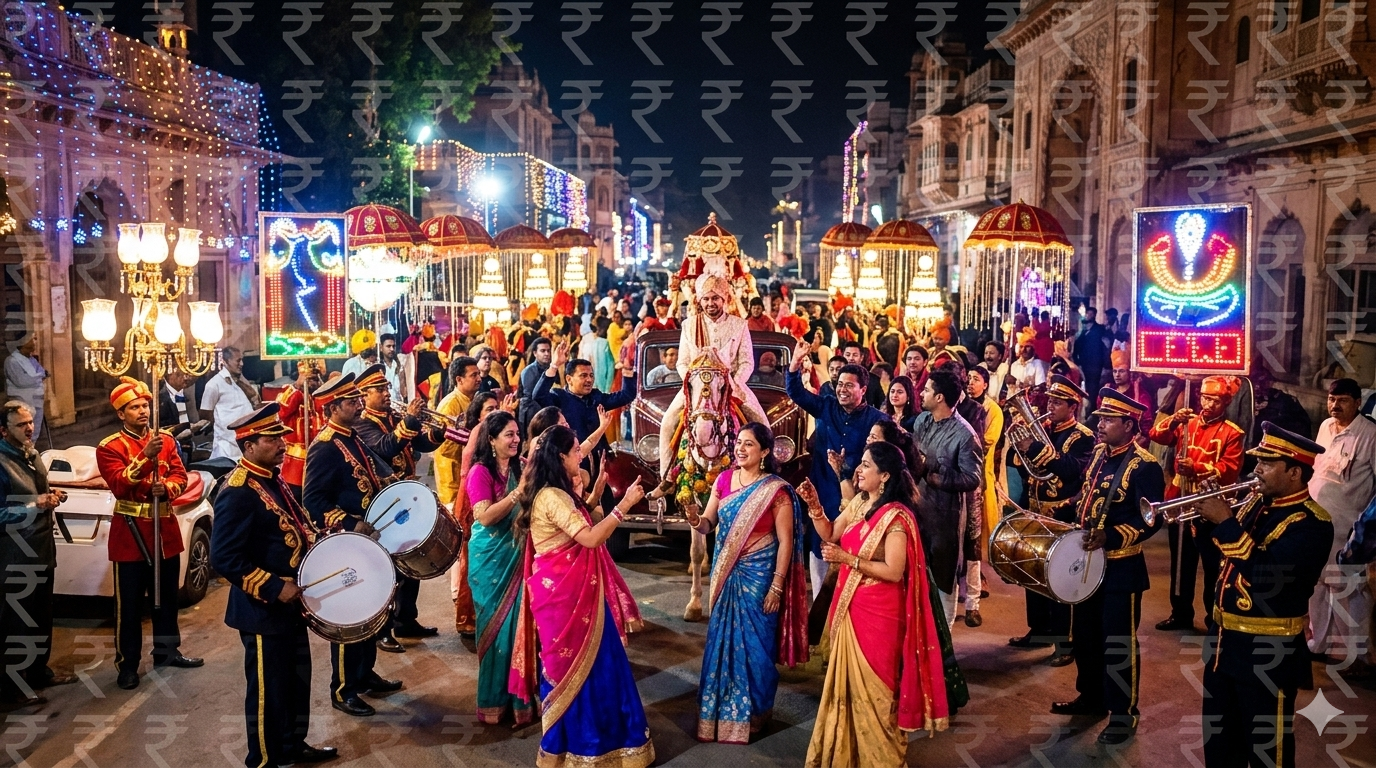
Band, Baaja, Baarat & Economy: India’s Wedding Boom
The glittering lehengas, the choreographed sangeet routines, the sparkling jewellery, the exotic destination weddings, all of it feels lavish, festive and deeply traditional. But behind the shahi exterior lies a powerful economic undercurrent: India’s weddings are not just personal celebrations, they’re a business phenomenon.
From the caterer and florist to the hotel and jewellery showroom, hundreds of millions of rupees flow with every baraat. The “industry behind the ritual” has become a staple in India’s consumption narrative.
This article explores: the size and growth of India’s wedding economy; the shifting trends and drivers; how the wedding boom impacts other sectors; what’s changing in the post-pandemic era; the risks and sustainability questions; and what it means for you as industry stakeholder, entrepreneur, vendor or consumer.
1. Setting the Scene: How Big Is India’s Wedding Economy?
Let’s start with some numbers to ground the discussion.
- One widely cited estimate: India’s wedding industry is worth around US $130 billion annually (roughly ₹10-11 lakh crore) and is the country’s fourth-largest industry after sectors such as energy, banking and insurance.
- Another projection puts the wedding services market (venues, catering, décor, event-planning) at about US $103.9 billion (~₹8.5-9 lakh crore) in 2024, with a projected CAGR of ~14.3% through 2030.
- India hosts roughly 8-10 million weddings every year, giving this sector huge scale.
Put simply: these are not just “big weddings” for the rich. They’re a major economic engine, employing millions, driving consumption across luxury, services and infrastructure, and linking tradition with commercial scale.
Why it matters
- As a consumption driver: Weddings stimulate demand for apparel, jewellery, big venues, catering, decor, travel, hospitality; spanning the formal and informal economy.
- As a labour employer: From florists to event planners to makeup artists, the wedding sector offers jobs, often in gig or seasonal form.
- As a pointer to consumer behaviour: Spending on weddings reflects broader trends in wealth, aspiration, social signalling and culture.
2. Weddings: From Tradition to Boom
To understand the wedding economy, we need to understand how the ritual meets modern aspiration.
2.1 The cultural foundations
Weddings in India are deeply ritualised. Thanks to the many customs (tilak, haldi, mehendi, sangeet, baarat, pheras, reception) across religions and regions, weddings tend to be multi-day affairs, involve large guest lists and feature significant ceremonial expense.
2.2 The shift to scale and spectacle
What used to be mostly local neighbourhood events has in many cases become destination weddings, theme-based celebrations and luxury-oriented gatherings. The Business of Fashion notes that luxury brands now tap the Indian wedding market (valued at ~$130 billion) for premium bridal wear, jewellery and destination-venue growth.
2.3 Emerging dynamics
- Rising incomes and growing middle/upper-middle class mean more discretionary budget available for weddings.
- Social media and aspirations drive “Instagrammable” weddings, leading to higher spending on décor, photography, experiences.
- Destination weddings (domestic and international) are increasingly common, adding travel and hospitality layers to the budget.
- Professional wedding planning services, apps and platforms are emerging (less informal, more organised), some research shows the wedding planning segment alone expected to grow at ~12–15% CAGR by 2030.
3. What’s Driving the Wedding Boom?
Several interlinked forces are together pushing the wedding economy higher.
3.1 Demographics and timing
With around 10 million weddings per year and millions more entering the “marriageable age” bracket, volume itself is not a constraint.
3.2 Rising disposable income
As India’s economy grows and more households move into higher income brackets, budgets for weddings expand, and features such as better venues, premium catering, designer apparel and jewellery become more accessible.
3.3 Urbanisation and exposure
Urban couples are exposed to global travel, destination weddings, and higher guest expectations. Families in Tier-2/3 cities also want to match the scale seen in metros.
3.4 Social signalling & “eventisation” of weddings
Weddings are no longer just ceremonies, they are events. The scale, the décor, the guest-experience, the after-party; all contribute to social signalling. For brands and vendors, this means growth.
3.5 Digitalisation and professionalisation
Wedding-planning platforms, vendor discovery apps, custom décor studios, online guest-management tools; all of these are professionalising the sector and enabling higher spending and finer segmentation.
3.6 Covid-aftereffects
While the pandemic disrupted weddings, it also caused postponed ceremonies, pent-up demand, and greater willingness to spend when restrictions eased. Many consumers decided to “go big” to make up for lost time.
4. How the Money Flows: Key Segments in the Wedding Economy
To appreciate the breadth of the sector, let’s walk through major spending categories and how they link into the broader economy.
4.1 Venue, catering & hospitality
Venues (banquet halls, resorts, destination venues) and catering typically account for a large chunk of wedding spend. Grand venues, destination weddings and luxury hospitality services add premium to the budget. Research shows catering & venue services comprised over 30% of the wedding services market in 2024.
4.2 Apparel & jewellery
Attire (bride, groom, families) and jewellery remain critical. The jewellery market, for example, has seen parallel growth partly driven by weddings. Average weddings with larger guest lists and more elaborate jewellery push spend higher. According to some estimates, ~50-55% of wedding spend in luxury weddings may go to jewellery.
4.3 Decor, event-planning & experience
From themed décor to custom lighting, entertainment, music, live acts, photo-booths and destination transport, these experiential elements are rising. The organiser ecosystem is becoming professional with higher margin services.
4.4 Travel and destination weddings
Destination weddings, either domestic (Goa, Udaipur, Jaipur, Kerala) or international, drag in the travel, hotel, transportation, local vendor spend. This is elevating overall costs and adding to the economic footprint.
4.5 Gifts, social obligations and downstream services
Weddings trigger spending cycles: gifts (cash/gold), pre-function parties, informal guest hospitality, post-wedding brunches. Also supporting thousands of gig workers: makeup artists, photographers, musicians, chauffeurs, temporary support staff. News coverage from MP noted 20-30% rise in demand among gig workers during wedding boom.
4.6 Media, fashion & luxury tie-ups
Luxury brands, designer fashion houses, and lifestyle services are increasingly positioning around weddings. Weddings become consumption occasions for everything from high couture to premium travel to limousine services. The luxury fashion article noted how global brands eye India’s wedding market as a growth driver.
5. The Broader Economic Impact
What does all this mean for India’s economy and consumption fabric?
5.1 Consumption multiplier effect
Weddings create demand across sectors. Venues, travel, hospitality, apparel, jewellery, decor, services. This drives employment and incomes in sectors often informal or SME-driven.
5.2 Formalisation opportunity
As weddings shift from purely informal to more professionalised markets (online booking, vendor platforms, chain venues), more spending becomes traceable, more tax revenue becomes accessible, and vendor markets scale.
5.3 Contribution to GDP & retail
When the wedding industry is estimated at ₹10-11 lakh crore (US$130 billion) or higher, it becomes a meaningful part of India’s services and retail economy, comparable to large segments like apparel or jewellery in size.
5.4 Employment and skill generation
From venue staff to event planners, from photographers to logistics teams, the wedding ecosystem offers jobs; especially in hospitality, travel and gig services. For many small-town operators, wedding season is peak income.
5.5 Regional development and tourism
Destinations benefit. Wedding tourism (destination weddings) supports hotel occupancy, ancillary services, local crafts, transport infrastructure. Regions like Rajasthan, Goa, Kerala see growth via wedding tourism.
6. Trends & Shifts to Watch
The wedding boom is evolving. Here are some key trends and shifts that are shaping the future.
6.1 Mid-/up-scale saturation and rising segmentation
While ultra-luxury weddings grab headlines, there’s growth in mid-segment weddings where more families aspire for better venues, better décor, but within a tighter budget. The opportunity is in aspirational weddings in Tier-2/3 cities.
6.2 Tech-enabled planning & vendor market
Platforms for wedding planning, vendor aggregation, guest-listing apps, virtual décor visualisation, photo-shoot drones, livestreaming; digital is entering weddings. The wedding services market forecast shows strong CAGR partly due to digital adoption.
6.3 Sustainability & value-driven choices
In recent years, some couples favour more sustainable options: fewer functions, eco-friendly décor, local sourcing, reduced guest lists, especially post-pandemic. This may moderate growth in some segments, but opens new niches.
6.4 Destination and themed weddings
With exposure and aspiration rising, more couples seek destination weddings or themed experiences (heritage locations, beach resorts, international venues). This raises spend but also shifts demand dynamics and regional competition.
6.5 Affordability pressure & debt risks
As wedding budgets rise, some households are stretching finances. Loans, credit cards, asset liquidation. Some markets report rising demand driven by tax cuts or more auspicious dates triggering bookings (MP wedding market may cross ₹40,000 crore this season).
6.6 Changing consumer psychology
There’s also a shift in what weddings mean: from social obligation to personal expression. Younger couples want experiences rather than just tradition. Music festivals, interactive guest experiences, photo-moments—all part of modern Indian weddings.
7. Risks and Headwinds
Every boom harbours risks. The wedding economy is no exception.
7.1 Economic sensitivity and discretionary spend
Weddings are still discretionary to a large extent. If incomes fall, guest counts shrink, budgets get cut. The sector can be hit by macro-slowdowns or inflation (hotel costs, food, décor).
7.2 Over-dependence on auspicious dates & seasonality
India’s wedding calendar is highly seasonal and date-sensitive (muhurat weddings). This causes peaks and troughs. News mentions “wedding season to generate ₹6.5 lakh crore from 46 lakh weddings in two months”. That kind of clustering may stress supply chains.
7.3 Vendor fragmentation and quality risks
Many wedding service providers are small SMEs. Quality, contract clarity, payment terms can be inconsistent. As spending rises, risks of vendor failure or disputes also rise.
7.4 Debt, social pressure & overspending
In some cases, families feel social pressure to spend beyond means (guest lists, designer attire, destination venues). That may lead to debt or delayed financial goals.
7.5 Regulatory, tax & GST implications
Some states/regions may regulate large weddings, tax event services, or impose caps. Changes in GST or tax policy (as referenced in MP market) can impact bookings.
7.6 Sustainability scrutiny
With rising scrutiny of material waste, carbon footprint, guest lists and extravagance, future weddings may face social or regulatory pushback. The luxury wedding culture may be challenged by calls for moderation.
8. What This Means for Stakeholders
8.1 For Vendors & Entrepreneurs
- Opportunity to scale: event planning, niche décor, destination weddings, wedding tech.
- Need to professionalise: contracts, quality standards, digital presence, vendor networks.
- Diversify: don’t just serve peak season, offer off-season services (pre-wedding shoots, corporate events).
- Think volume and value: service models for mid-segment weddings are vast.
8.2 For Investors & Industry
- The size of the wedding economy suggests opportunities in hospitality, fashion, jewellery, venue real estate and digital platforms.
- Forecasts show strong growth (CAGR 14%+ for wedding services to 2030) suggesting segments ripe for investment.
- But risk-adjust: those investing must factor in seasonality, discretionary nature, margin pressure.
8.3 For Consumers / Couples
- With rising costs, planning ahead becomes crucial. Budgeting, vendor comparison, guest management matter.
- Think value: destination weddings or luxury spend may be attractive but ensure spending aligns with long-term financial health and purpose.
- Alternative models: fewer functions, more personalised experiences, digital guest-lists, hybrid formats (virtual + physical) could become smarter.
8.4 For Policy-Makers & Regional Economies
- The wedding sector is a job creator in hospitality, travel, formal/informal services. Policies supporting vendor credit, small-business registration, training could unlock value.
- Regional tourism boards can capitalise on destination wedding appeal.
- Monitoring consumer spend, vendor regulation and debt risk in this large sector may warrant attention.
9. The Road Ahead: Predicting Wedding Economy Trends for 2030
What might weddings look like by 2030, given current growth trajectories and evolving consumer behaviour?
| Trend | 2025 Status | 2030 Projection |
|---|---|---|
| Market Size | ~$130 bn / ₹10-11 lakh crore | Possibly $200-250 bn (₹17-20 lakh crore) if 12-15% CAGR sustains |
| Destination Weddings | Growing share domestically and abroad | Higher share; new venues emerging; regional hubs stronger |
| Digital / Tech | Planning apps emerging, vendor discovery online | Digitised end-to-end wedding ecosystem; virtual + real blend |
| Sustainability / Moderation | Early signs of conscious spend | More mid-segment weddings; fewer mega-shows; eco-themes more common |
| Talent & Gig Economy | Event planner growth | Wedding services become substantial gig employer; year-round services beyond season |
| Financing & Credit | Some wedding loans or jewellery-linked spend | Financial products for weddings (loans, micro-finance, insurance) may expand |
| Vendor Professionalism | Fragmented market | Consolidation; standardisation; vendor platforms scale |
In short: The wedding economy is likely to grow, but perhaps shift from “biggest possible” to “smarter, experience-driven, digital-enabled, purpose-oriented”.
10. Challenges to Monitor & Strategic Considerations
As you think about the wedding economy, whether as vendor, investor or consumer, here are key questions and strategic pointers:
- Budget inflation vs value creation: Are we spending more just to show off, or spending intentionally to create meaningful experiences?
- Vendor reliability & ecosystem health: With so many small vendors, how to ensure contract clarity, deliverables, and payment discipline?
- Seasonality and over-crowding: Is the vendor/venue capacity sufficient if weddings cluster in select dates? Are smaller vendors able to sustain off-peak?
- Moderation and sustainability: Will social or regulatory pushback force newer formats or caps on extravagance?
- Digital transformation: Are vendors and platforms investing in tech (virtual guest-lists, livestreams, online décor visualisation, budget tools)?
- Financing and debt: With rising spend, are households at risk of over-leveraging? Is there financial advice tuned to wedding spend?
- Regional equity: Are Tier-2/3 cities participating in the boom, what does the wedding economy look like there?
- Luxury vs mid-segment balance: While luxury weddings get headlines, the mass opportunity may lie in the “aspirational but budget-conscious” segment.
11. Final Thoughts
Weddings in India have always been more than rituals. They are unions of families, communities, traditions. But increasingly, they are also economic events, consumption nodes, social signalling arenas and business opportunities. The scale is enormous, the growth dynamic powerful, and the ripple effects across sectors profound.
Yet with that scale comes responsibility and reflection. For every lehenga, every decorator and every destination venue, there’s a question of purpose, sustainability and value. Big weddings may still happen—but the smartest opportunities lie in making every wedding smarter: purposeful rather than purely showy, digital-enabled rather than purely manual, experience-rich rather than expense-heavy.
Whether you are a vendor, an investor, a consumer or a policy-maker, the wedding economy is one of the most fascinating under-the-radar stories in India’s consumption and services sectors. And as the seasons roll on, the question isn’t just how much weddings will grow, but how wisely that growth will be shaped.
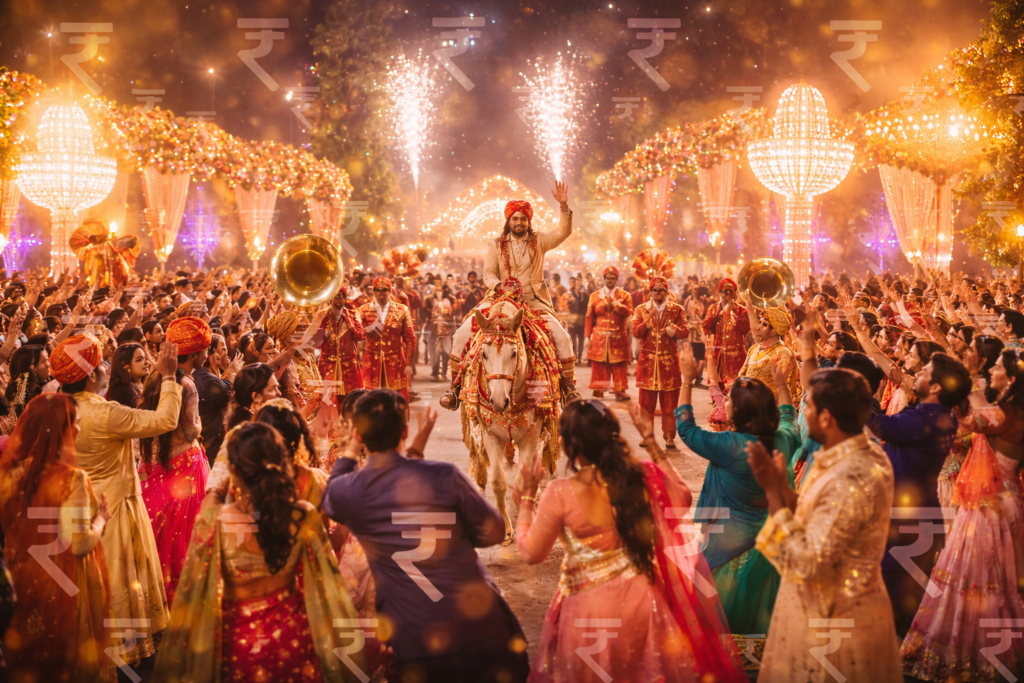
So when the next baraat arrives, and the dhol beats, and the dancers take the floor, remember: behind the sparkle lies a business engine, a cultural moment, and a pulse of India’s economy. As the country says jaa 𝘣 aarat, it’s also saying “business as usual” and a booming one at that.
