

Introduction
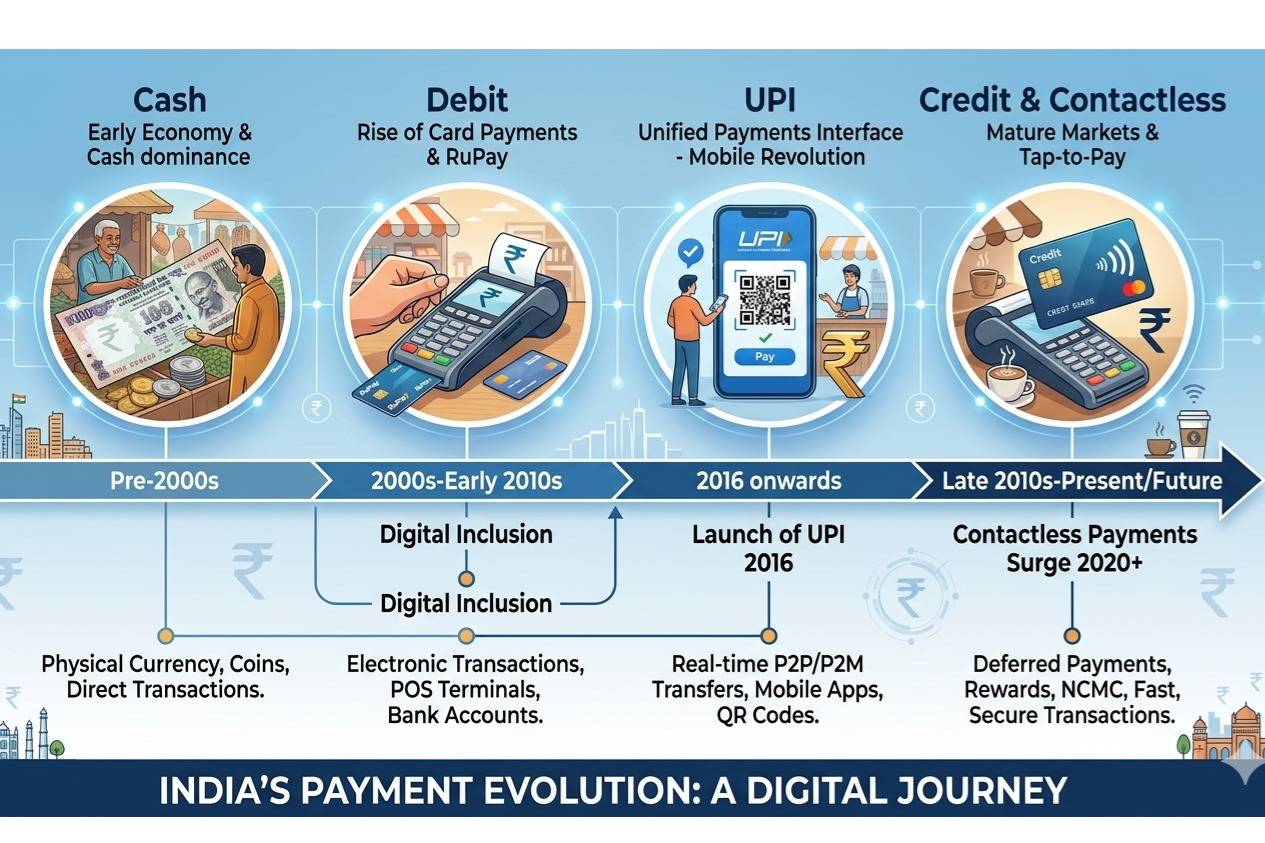
If you’ve swiped a card recently, whether at a metro kiosk, a local café or online; you’re part of India’s unfolding “swipe economy”. What started as the simple replacement of cash has, over the past decade, evolved into a full-blown transformation of how Indians pay, borrow, spend and live.
This article traces the journey from debit-card dominance to credit-card growth, explores what’s driving the boom in card usage, highlights the key enablers and bottlenecks, and offers a critical view of what could go wrong.
1. Setting the Scene: India’s Payment Shift
India’s payments landscape has changed dramatically. The Unified Payments Interface (UPI) may grab headlines, but the world of debit and credit cards is quietly accelerating.
- The Reserve Bank of India’s Digital Payments Index (DPI) stood at 465.33 in September 2024, up from the base of 100 in March 2018, clear evidence of rising digitisation.
- Card payments (debit + credit) have been growing at around a 14% CAGR.
- Despite UPI’s dominance in peer-to-peer and small payments, the credit and charge card market in India is projected to hit ₹25.4 trillion (~US $300 billion) in 2025.
So yes, cash may be fading but the real story isn’t just UPI. It’s also credit cards and the broader payment cards ecosystem making aggressive gains.
2. The Rise of the Swipe: Debit Cards First, Then Credit
2.1 Debit cards: The jump-start
When digital payments began climbing, debit cards were at the front. They were simple, low-risk for issuers, and familiar to consumers. Many banking initiatives (such as opening accounts under the Pradhan Mantri Jan Dhan Yojana) included debit cards.
Yet, growth in debit-card transactions alone cannot explain the full trajectory of India’s card economy.
2.2 Credit cards: The expansion phase
Credit cards have long been viewed as “premium”; higher risk, higher reward. And yet:
- In 2024, credit and charge cards accounted for 81% of total payment card transaction value in India – even though debit cards remain more numerous.
- In non-metro cities (“Category C+” cities), credit-card spending jumped 414% since 2019 according to a white-paper by Visa.
In short: Credit-card usage is scaling, and not just in big metros. The swipe economy is reaching deeper.
3. The Drivers Behind the Boom
What’s powering this shift from debit to credit and the broader card usage? Several key factors:
3.1 Rising income and urbanisation
As more Indians enter the middle class or upward mobility pathways, disposable incomes rise and spending patterns shift. Cards (especially credit cards) become part of that lifestyle upgrade.
3.2 Digital infrastructure & merchant readiness
With improved POS systems, acceptance of cards in smaller towns, and faster connectivity, consumers can use cards in more places than ever. Card payments have grown in non-metros: the “beyond metros” story is real.
3.3 Incentives, rewards and EMI/BNPL features
Card issuers and banks have become creative: co-branded cards, EMI options, reward programmes make credit cards more attractive to consumers.
According to one source: “Value-added features such as cashback, discounts, and EMI options are contributing to their popularity.”
3.4 Pandemic push & change in spending behaviour
COVID-19 forced swift shifts: less cash, more contactless, heightened digital comfort. While UPI grabbed headlines, card usage also benefited from the trend toward “card or phone” rather than “cash”.
3.5 Financial inclusion + bank + fintech collaboration
Schemes like Jan Dhan increased account ownership. Fintechs, banks and card networks worked together to bring cards to more people. This creates the base for upward moves (from debit to credit).
4. Data Speaks: Metrics, Trends & Growth Patterns
Numbers flesh out the picture more concretely.
- The card-payments market is expected to grow at a CAGR of ~11.5% between 2025–2029, reaching ~₹39.3 trillion by 2029. India Brand Equity Forum
- Credit and charge card transaction value in 2024: growth of ~15.3% to about ₹22.3 trillion. Business Standard
- In 2024/25, card payments in category C+ cities rose by 175% since 2019 (Visa whitepaper) in terms of spending. Visa
- Digital payments (all forms) are massive: over 130 billion transactions expected in India by end-2025. PayCom Insights
These figures show two things: scale and momentum. The swipe economy in India isn’t niche, it’s mainstream and growing.
5. From Swipe to Borrow: Credit Cards as Financial Tools
It’s important to note that credit cards are more than payment instruments, they blur into credit and borrowing. This has several implications.
5.1 Credit lines and EMIs
One of the major attractions of credit cards is access to short-term credit: multiple banks now offer instant card issuance, EMI conversion of spends, cashbacks for usage. These features make cards more attractive than plain debit cards.
5.2 Risk for issuers & consumers
With increased credit card usage comes increased risk: defaults, write-offs, financial over-stretch. For example, SBI Cards & Payment Services reported that its write-offs jumped 32% year-on-year in Q1 of 2025. Reuters
5.3 Financial inclusion vs. digital credit divide
While more people are getting cards, the question remains: who? Are the poorest left out? Do they use credit responsibly? The move from debit to credit opens opportunities, but also vulnerabilities.
6. Regional Spread: Beyond the Big Cities
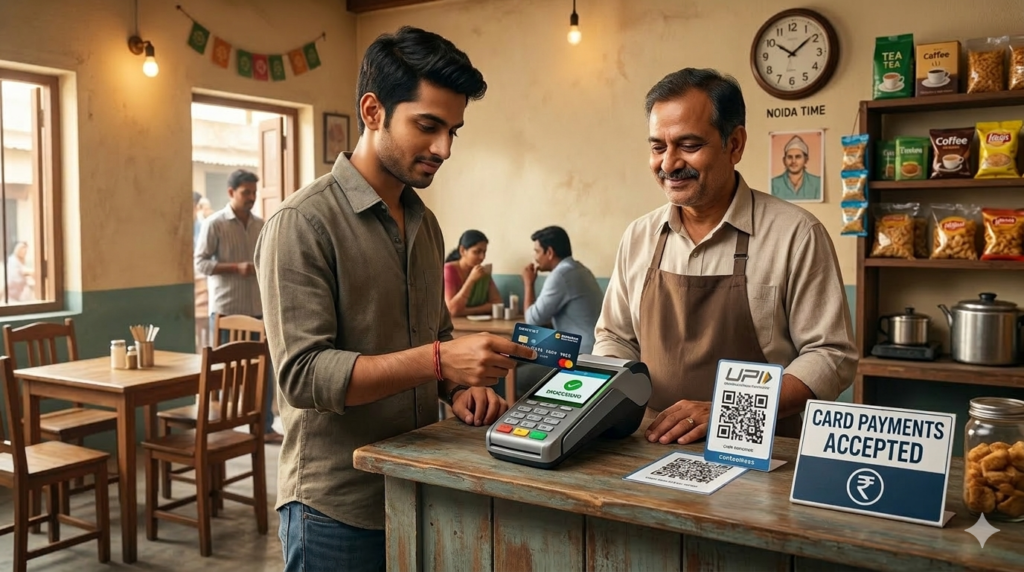
One of the biggest surprises in this story is how card usage is spreading beyond metro areas.
- In “Cat C+” cities (smaller towns), spending via card payments has grown by 414% since 2019.
- This means households in tier-2/3 towns are not just receiving cards, they are actively using them.
Why this matters: It means that the swipe economy is reaching places where cash dominated for decades and that changes the nature of commerce, credit and consumer behaviour.
7. Banks, Card Networks & Fintechs: The Players
Who’s benefiting, and who’s taking the risks?
7.1 Banks & card issuers
Traditional banks see credit cards as both profit centres and risk centres. Increased usage means higher revenues but also exposure. The recent write-off numbers show the flip side.
7.2 Card networks (RuPay, Visa, Mastercard)
The home-grown network RuPay has played a pivotal role in bringing cards to the masses. It has lower transaction costs, larger reach in smaller banks and brings cost-efficiency.
7.3 Fintechs & co-branded solutions
Fintechs partner with banks to issue co-branded cards, instant-issuance programmes, and embed cards in apps. This innovation is fueling growth.
8. Consumer Behaviour: The How and Why of the Swipe
It’s not just infrastructure; it’s about behaviour.
- The intangible nature of card spends (versus cash) tends to encourage higher spending: one study found that ~75% of respondents reported increased spending due to reliance on UPI and other digital payment means. arXiv
- Credit cards add a layer of convenience, deferment and reward which debit cards do not.
- And as cards reach tier-2/3 towns, new consumer behaviour patterns emerge: more online shopping, more EMIs, more speed, fewer constraints of cash.
9. Critical Perspective: What Could Go Wrong?
While the trajectory is upward, there are caution flags.
9.1 Over-leveraging & defaults
As noted earlier, rising write-offs in the credit-card space signal that some segment of users may be over-extended. Banks must balance growth with risk management.
9.2 Credit card penetration vs. financial literacy
If cards become commonplace but users don’t understand terms (interest, late fees, EMIs), then consumer debt issues can rise. The digital credit frontier needs guardrails.
9.3 Infrastructure mismatch
While card acceptance has grown, cash is still dominant in many segments. If cards are pushed without full merchant readiness or for micro-transactions, friction may increase.
9.4 Regulatory & cybersecurity risks
Data breaches, fraud, misuse—cards are vulnerable. For example, previously India had major debit-card data‐breach issues.
9.5 Card growth vs. cashless myth
The rise of card payments does not automatically mean cash disappears. UPI and cards both coexist with cash. Policies must reflect that reality, or risk leaving parts of the economy behind.
10. Looking Ahead: What’s Next for India’s Swipe Economy?
What should we expect in the next 3-5 years?
- Deeper penetration of credit cards in non-metros – the Cat C+ uptick is a prelude.
- More hybrid payment/credit solutions: cards linked to UPI, NFC, digital wallets.
- Growth in services like “card as subscription”, embedded credit in shopping, more tie-ups with e-commerce.
- Banks and issuers will need to invest more in analytics, credit assessments, and risk management.
- Potential tightening of regulation around card-based credit as defaults rise.
- A move from “swipe” to “tap and go” with contactless and mobile-card solutions increasing.
11. Implications for Stakeholders
For Consumers
- Cards bring convenience, rewards and access but also obligations: know your terms, pay on time, don’t treat credit as free money.
- Especially in smaller towns, the card may be new but users should be educated on interest, EMIs, fraud risks.
For Banks & Issuers
- Growth is here but risky. Need to balance credit expansion with underwriting discipline.
- Tailor offerings in non-metros: different risk profiles call for different products.
- Leverage data: user behavioural analytics will separate winners from losers.
For Fintechs & Networks
- The innovation wave continues: co-branded cards, instant cards via apps, embedded finance.
- Merchant acceptance remains key: more small merchants onboarded = more cards used.
- Collaboration between card networks and UPI/digital payments infrastructure will matter.
For Regulators & Policymakers
- Ensure consumer protection: higher card usage means more potential for misuse.
- Monitor credit-card lending and defaults; especially as cards go mainstream.
- Work on infrastructure gaps (acceptance, security) and ensure financial literacy programmes reach smaller towns as well.
12. Why This Shift Matters: Macro Impact
The rise of the swipe economy means more than convenience, it has broader economic significance:
- Consumption growth: easier access to credit and payments may boost consumption, which fuels economic growth in India’s service‐and consumption-led economy.
- Formalisation: More card payments mean more traceability, less cash: useful for tax/base expansion and formal economy.
- Financial inclusion: When cards reach beyond metro India, the financially excluded get a tool to transact.
- Data ecosystem: Card usage generates data; valuable for credit scoring, risk assessment, personalised offers.
- Global competitiveness: Card networks and acceptance infrastructure moving up help India stay competitive in fintech and payments globally.
13. Wrapping Up
India’s move from debit to credit cards is part of a broader story: transition from cash to digital, from exclusion to inclusion, from local to national payments infrastructure. The scale and momentum are undeniable.
But this isn’t just a victory parade. With growth comes challenges: credit risk, infrastructure gaps, consumer awareness deficits. The “swipe economy” is exciting, but it must be built on sustainable foundations.
For consumers: use cards wisely. For banks: grow responsibly. For regulators: stay vigilant. And for all of us: understand that a card in your wallet is more than plastic; it’s power, yes, but with responsibilities attached.
Final Thought
In a country where “cash” used to be king, the rise of the credit card is a quiet revolution. The ability to swipe, to delay payment, to spend across geographies; it changes behaviours, aspirations and opportunities.
But real freedom isn’t just the ability to swipe, it’s the discipline to repay. Because the biggest transformation will not be in plastic, it’s in how we use it, and how wisely.
