


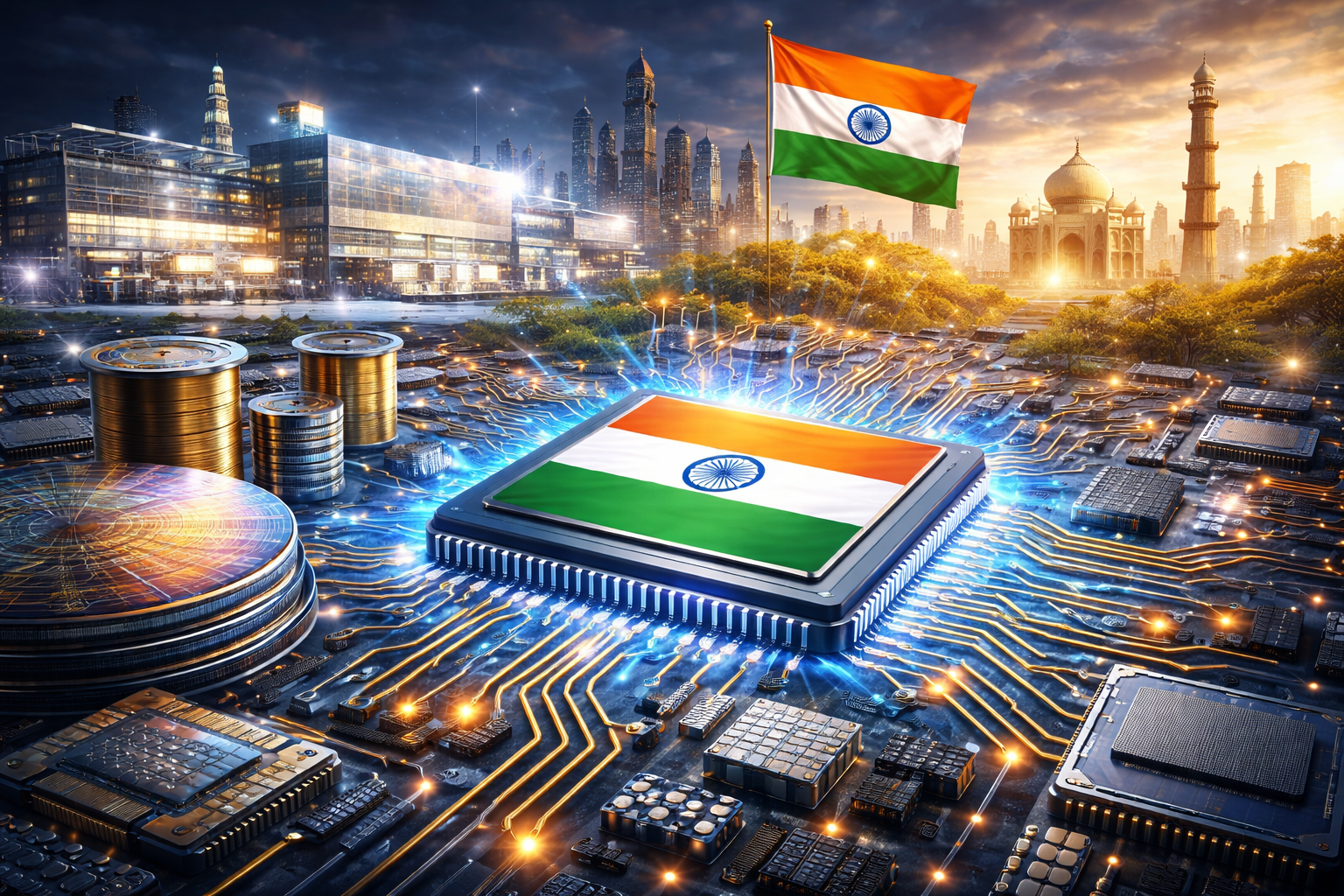
India missed the first big wave of semiconductor manufacturing. For decades, we designed chips, wrote software, shipped IT services—but imported almost all the silicon that powered our phones, cars and data centres.
That’s starting to change.
A new Deloitte report estimates that India’s semiconductor market—currently around $45–50 billion in FY2024–25—could grow nearly 6–7x to $300 billion by 2035, powered by AI, automotive electronics, data centres and an expanding electronics manufacturing base. If this materialises, India would move from being a pure consumption market to a serious node in the global chip value chain.
But how realistic is this $300 billion dream? And what does it mean for investors?
Where We Are Today: Import‑Heavy, Demand‑Rich
A fast‑growing, import‑dependent market
Deloitte’s TMT Predictions 2026 report pegs India’s semiconductor market at $45–50 billion in FY2024–25, after growing at roughly 20% CAGR over the past three years.
Today:
- India imports over 90% of its semiconductor requirements.
- Chips go into everything from smartphones, laptops and TVs to cars, industrial controls, base stations and defence systems.
The same report projects:
- $120 billion by 2030,
- $300 billion by 2035,
implying the market continues compounding at around 20% annually—in line with recent trends.
Where the demand will come from
By 2035, Deloitte expects four big segments to drive more than 70% of India’s chip demand:
- Mobile phones and consumer electronics
- Automotive and EVs (power electronics, sensors, infotainment, ADAS)
- Computing (PCs, laptops, servers)
- Data centres and AI infrastructure
Layer on top:
- Smart factories and Industry 4.0
- Telecom and 5G/6G
- Defence and aerospace
…and it’s not hard to see why semiconductor consumption could grow rapidly even if per‑capita usage remains below developed‑market levels.
The Big Shift: From 90% Imports to 60% Local Production?
The most striking part of the forecast is not just the size of the market, but the change in its structure.
Local manufacturing: from near‑zero to majority share
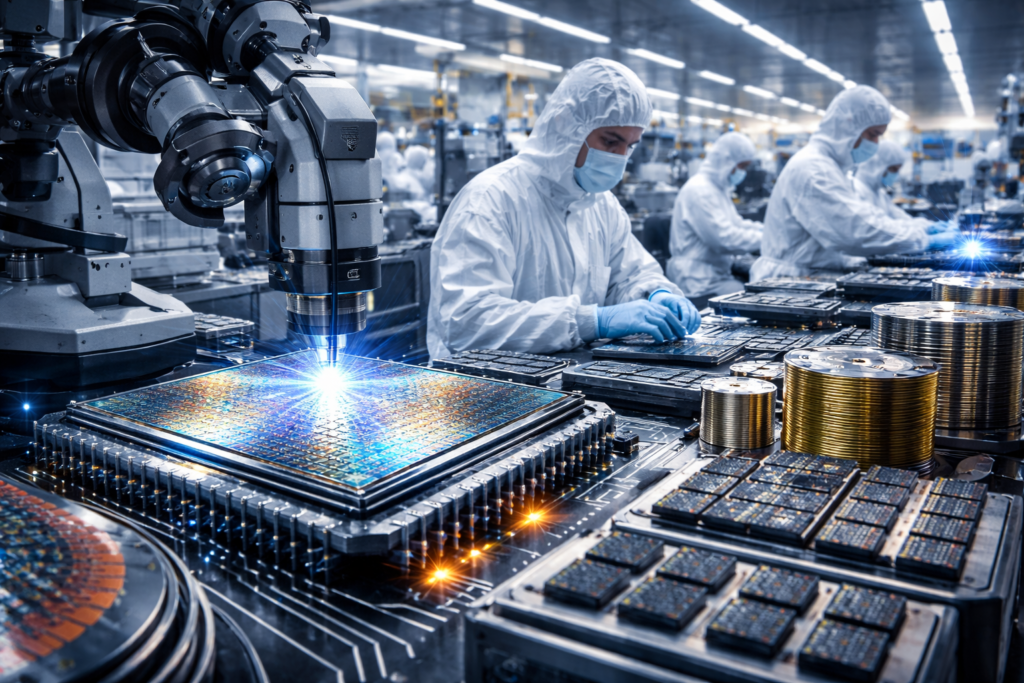
Deloitte estimates that by 2035, local production could meet more than 60% of India’s semiconductor demand, versus less than 10% today.
That would mean:
- A massive ramp‑up in domestic fabs (fabrication plants),
- A dense ecosystem of OSAT (Outsourced Semiconductor Assembly and Test) facilities,
- And a growing base of upstream suppliers—gases, chemicals, wafers, equipment and specialty materials.
This is where the India Semiconductor Mission (ISM) and state‑level policies come in.
India Semiconductor Mission: 10 Projects, Billions in Capex
What’s been approved so far
Under ISM, India has approved 10 semiconductor projects with cumulative investments exceeding ₹1.6 trillion (~$19–19.2 billion). These include:
- 8 OSAT / ATMP facilities – packaging and testing chips designed elsewhere
- 1 compound semiconductor fab – focused on wide‑bandgap materials like SiC (silicon carbide)
- 1 traditional silicon semiconductor fab
Some key highlights:
- India’s first commercial compound semiconductor wafer fab (SiCSem in Bhubaneswar, Odisha) will produce 60,000 SiC wafers and 96 million devices per year, serving EVs, defence, railways, fast chargers and solar inverters.
- An advanced packaging and glass substrate facility in the same region will introduce 3D heterogeneous integration (3DHI) and glass interposer technology for high‑end AI, RF and photonics applications.
- More projects—like advanced packaging in Uttar Pradesh and OSAT units across different states—are tied into PLI schemes and state incentives to build regional clusters.
The pipeline: 18–20 more proposals
Deloitte notes that 18–20 additional proposals, totalling $20–25 billion in investments, are in the pipeline at various stages of evaluation.
Looking ahead:
- Over the next five years, India’s semiconductor industry is expected to attract around $50 billion of new capital—
- $30–35 billion into fabs and OSAT
- $15–20 billion into the broader value chain (materials, gases, chemicals, equipment)
- Between 2030 and 2035, another $75–80 billion is likely to flow into capacity expansion and ecosystem build‑out.
By 2035, the plan is to have:
- 4–5 silicon fabs
- 8–10 compound semiconductor fabs
- 1–2 display fabs
- 20–25 OSAT facilities
If even a majority of this materialises, India’s on‑shore semiconductor footprint will look very different from today’s.
Beyond Fabs: Building the Full Semiconductor Ecosystem
So far, policy attention has focused heavily on fabs and OSAT. But a truly competitive ecosystem needs a lot more.
The upstream bottleneck: gases, chemicals, materials and equipment
A modern fab depends on a complex supply chain:
- 40–50 types of ultra‑high‑purity gases and chemicals – nitrogen, hydrogen, helium, NF₃, silane, etc.
- Specialty materials (silicon wafers, photoresists, CMP slurries)
- Advanced manufacturing equipment (lithography, deposition, etch, metrology)
Today, over 90% of these gases and chemicals are imported into India, often from a handful of global suppliers.
To reduce risk:
- Industry players are looking to co‑locate supplier facilities near fabs, creating integrated parks where gas, chemical and equipment vendors sit next to fabrication lines.
- Supplier hubs like Dholera (Gujarat) are being positioned as “semiconductor cities” with dedicated infrastructure—power, water, logistics and chemical‑handling capacity—where companies like Inox Air Products are setting up specialty‑gas hubs.
ISM 1.0 vs ISM 2.0: Shifting focus upstream
- ISM 1.0 largely targeted fabs and OSATs, offering capital support and subsidies at the central and state level.
- Many non‑fab players (gases, chemicals, wafers, equipment, logistics) felt under‑served, despite being critical to resilience.
The upcoming ISM 2.0 is expected to:
- Extend capital subsidies and tax/power rebates further up the chain
- Offer fast‑track customs, bonded warehousing and dedicated logistics corridors for critical inputs
- Encourage supplier parks and clusters where upstream and downstream players can co‑locate for efficiency and safety
If implemented well, this could:
- Lower import dependence on a handful of countries for critical materials
- Reduce lead times and inventory risk
- Make India a more attractive location for global partners who worry about single‑country concentration elsewhere
Talent and Jobs: 2 Million Careers and a Huge Skill Challenge
Big fabs and OSATs are capital‑intensive, but the broader ecosystem is people‑intensive.
Job‑creation potential
Deloitte estimates that India’s semiconductor sector could generate about 2 million (20 lakh) jobs by 2035, broken down as:
- 30% in manufacturing operations (fabs, OSAT, test, facilities, maintenance)
- 30% in design services (chip design, verification, EDA tools, IP development)
- 40% across the rest of the value chain (materials, gases, equipment, R&D, services)
This spans:
- Highly specialised roles (process engineers, equipment specialists, EDA engineers, photolithography experts)
- Technical and vocational roles (operators, technicians, maintenance engineers)
- Support functions (quality, safety, logistics, supply‑chain management)
The skills pipeline: 4–5 lakh people per year
To sustain this growth, India will need to train roughly 4–5 lakh people annually in relevant areas—semiconductor physics, VLSI design, materials science, automation, cleanroom operations, EHS (environment, health & safety), and more.
This creates parallel opportunities in:
- Universities and technical institutes forging semiconductor tracks and industry tie‑ups
- Specialised training centres and ed‑tech focused on chip design, packaging and fab operations
- Corporate academies run by large players to build custom skills
For investors, talent bottlenecks are a real risk: fabs can’t run on capital alone. But they also imply secular demand for education, skilling and R&D services related to semiconductors.
Can India Really Hit $300 Billion? The Bull and Bear Cases
A projection like $300 billion by 2035 invites a natural question: is this realistic, or just optimistic PowerPoint?
The bull case: Why it’s possible
- Strong domestic demand base
- With digitalisation, EV adoption, electronics manufacturing and AI/data‑centre build‑outs, India’s consumption of chips is set to grow structurally, even if per‑capita usage stays below China or the West.
- Global supply‑chain diversification
- Geopolitical tensions and concentration risks in East Asia have pushed policymakers and companies to look for “China+1” and “Taiwan+1” alternatives.
- India’s large market, improving infrastructure and incentives make it a viable long‑term hub for selected nodes, especially in mature processes, compound semiconductors and packaging.
- Policy alignment and incentives
- ISM, PLI schemes, state incentives and strategic support for defence/electronics all point in the same direction: chips are a national priority.
- Existing design strength
- India already hosts a large share of the world’s chip design and verification talent via captive centres of global majors and local design houses.
- Manufacturing plus design creates a stronger ecosystem loop than manufacturing alone.
The bear case: What could go wrong
- Execution and policy follow‑through
- Semiconductor projects are notorious for delays, cost overruns and shifting timelines.
- A change in political priorities, inconsistent incentives between Centre and states, or bureaucratic friction could slow the pipeline.
- Global competition
- Other countries (US, EU, Japan, Korea, Southeast Asia, Middle East) are also pouring tens to hundreds of billions into chips.
- India will need to carve out specific niches rather than assuming it can compete everywhere.
- Technology curve and obsolescence
- Fabs take years to build; by the time they’re operational, process nodes may have moved on.
- India’s early fabs are likely to focus on legacy and mid‑range nodes (28nm, 40nm, 65nm) and power/compound semiconductors, not cutting‑edge 3nm logic. The business case must be tuned accordingly.
- Talent and infrastructure constraints
- Power reliability, ultra‑pure water, logistics, IP protection and talent depth all matter more for fabs than for generic manufacturing.
- Any weakness in these areas can deter top‑tier partnerships or restrict India to lower‑value segments.
Realistically, hitting exactly $300 billion is less important than the direction of travel:
- If India gets to, say, $225–250 billion instead of $300 billion but with strong local value addition, that’s still a transformation.
- Conversely, even if consumption hits $300 billion but localisation stalls, the strategic vulnerability remains.
What This Means for Investors
From an investor’s standpoint, India’s semiconductor push is not about “buying one chip stock” and forgetting it. It’s about a multi‑decade capex and capability cycle touching many listed and unlisted spaces.
1. Fabs and OSAT: Capital‑heavy but strategic
Direct investments into fabs and OSATs:
- Are highly capital‑intensive and long‑gestation
- Often involve joint ventures, government stakes, and complex risk‑sharing structures
- May be available to public‑market investors only indirectly (via diversified conglomerates or global partners)
For long‑term, risk‑tolerant investors, exposure here is more about:
- Strategic positioning in companies aligned with national priorities
- Accepting that returns may be cyclical and policy‑linked
2. Materials, gases, chemicals and equipment: The picks‑and‑shovels
Upstream suppliers can be more interesting financially:
- Specialty gas providers
- Electronic‑grade chemicals
- Wafer, substrate and packaging‑material makers
- Equipment distributors and service providers
These businesses:
- Often have sticky relationships once qualified into a fab
- Benefit from every new fab or OSAT coming online, regardless of the end use
- May offer better return on capital and diversification than owning just one fab project
3. Design, IP and services
India’s existing strength in chip design means:
- EDA services, design houses and embedded‑software providers can benefit from both global and domestic chip cycles.
- As more fabs and OSATs appear locally, design‑to‑manufacturing integration can deepen, creating opportunities for end‑to‑end solution providers.
4. Skill development and education
Given the projected need to train 4–5 lakh people annually, investors may also see:
- Demand for specialised engineering programs and semiconductor‑focused curricula
- Growth in training institutes and ed‑tech that partner with industry on VLSI, embedded systems, cleanroom operations, etc.
While this is a more diffuse theme, it’s worth watching as part of the broader “human capital” angle.
5. The usual caveats
- Semiconductor is inherently cyclical. Even if the long‑term trend is up, there will be inventory gluts, price declines and demand corrections along the way.
- Policy risk is real: incentives can change, approvals can be delayed, and global trade rules can shift.
For most investors, the sensible approach is:
- A diversified exposure to beneficiaries across design, manufacturing, materials and services
- A long‑term horizon, aligned with 10–15 year build‑out timelines
- Careful attention to balance sheets, technology partnerships and governance
What’s Next: From Ambition to Execution
If India does manage to build a $300 billion semiconductor market by 2035, with 60%+ local production, the implications go far beyond chips:
- Electronics manufacturing becomes more competitive and less import‑dependent.
- Automotive electrification and AI/data centres get stronger domestic supply chains, reducing geopolitical and logistics risk.
- Millions of high‑skill and mid‑skill jobs emerge across manufacturing, design, materials and services.
- India gains more bargaining power in global tech and trade negotiations.
But getting there will require:
- Consistent, predictable policy implementation (ISM 2.0 and beyond)
- Tight Centre–state coordination on infra, land, water, power and safety norms
- A relentless focus on supply‑chain localisation without trying to do everything overnight
- Deep, long‑term partnerships with global technology leaders rather than only financial investors
For investors who can think in decade‑long timeframes and are comfortable with policy and technology risk, India’s semiconductor dream is not just a narrative. It’s a slow‑burn structural story that could reshape multiple sectors—from electronics and autos to chemicals, gases, education and IT services.
The key is to enter with eyes open: optimistic about the opportunity, but realistic about the execution journey.
About Finovest: At Finovest, we help investors connect big structural themes—like India’s semiconductor push—to concrete portfolio thinking, separating genuine long‑term opportunity from short‑term hype.
Disclaimer: This article is for informational purposes only and does not constitute investment, tax or legal advice. Sector and company references are illustrative, not recommendations. Please consult a SEBI‑registered investment adviser before making investment decisions.
